Austria Backs Up To €100 Million Growth Fund, Aiming To Mobilize Up To €500 Million For Scaleups

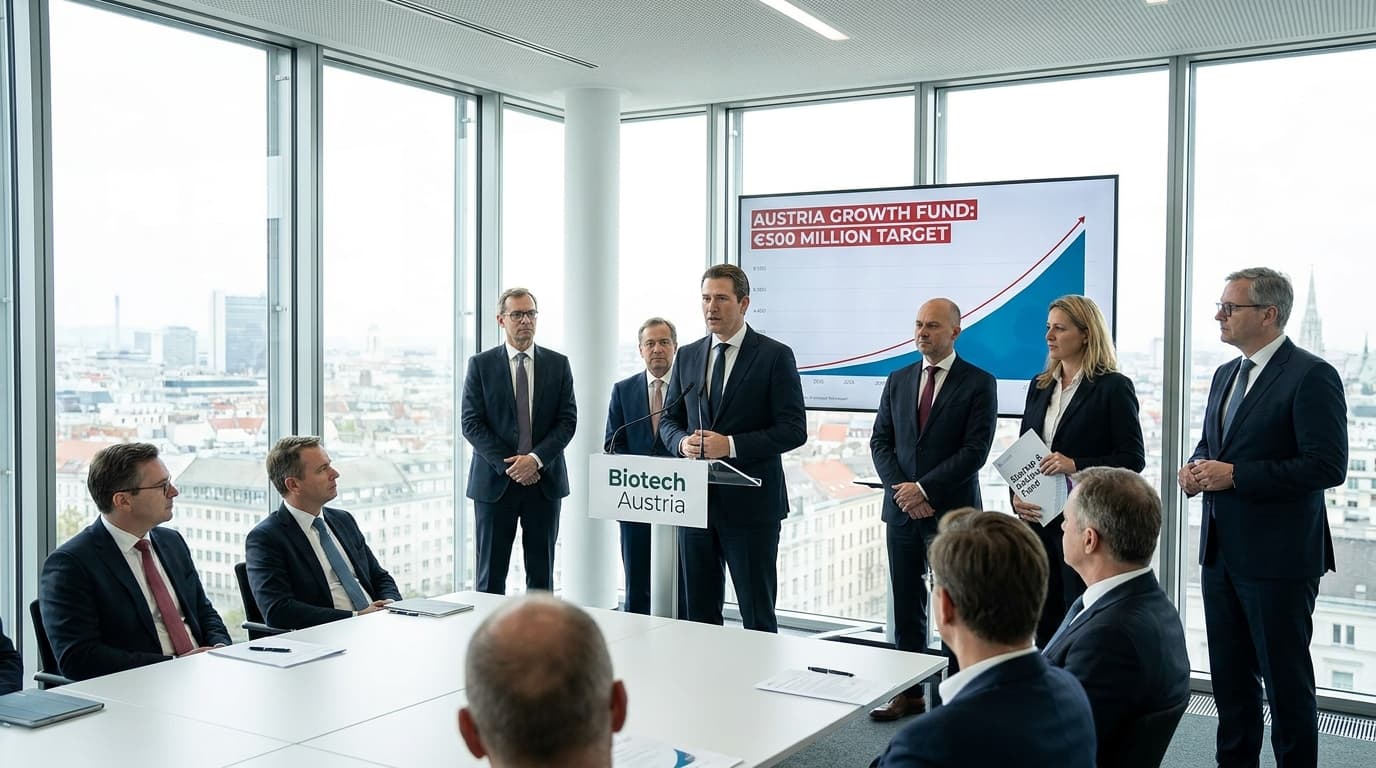
As part of the 2027/2028 federal budget, the Austrian government has pledged backing for a dedicated capital growth fund that could translate into up to half a billion euros for Austrian companies. The fund is not biotech-only, but industry advocates are pushing for life sciences to capture a large share as Austria tries to convert research strength into larger domestic companies.
Austria is moving to add a new financing layer to its life sciences ecosystem with a national Startup & Scaleup Fund that the government says will receive an anchor investment of up to €100 million. The stated structure is designed to leverage four euros of private capital for every euro of public money, translating into up to €500 million in growth capital for Austrian companies.
The fund is not purely biotech-focused, but it matters to biotech because Austria already has a strong early-stage research and nondilutive funding base. What the market has lacked is larger pools of local scale-up capital. If the new vehicle works as intended, it could start to address a familiar European problem: companies with promising science often outgrow domestic funding options and turn to foreign capital at the point where commercialization risk, not basic research risk, becomes the bottleneck.
The capital structure and why it matters
The government commitment is part of the 2027/2028 federal budget. Guido Gualdoni, a board member of Biotech Austria, told BioSpace that the industry association is heavily lobbying for most of the capital to go into life sciences. He also described the government’s role as akin to a limited partner that invests in venture capital firms, which then deploy capital into companies.
That design is a meaningful strategic choice. Rather than financing individual businesses directly, the initiative is intended to nurture the venture ecosystem itself. In practice, that could expand the number of investors able to support later rounds for Austrian companies and, as Gualdoni argued, potentially mobilize pension fund involvement in biotech financing.
That pension angle is important because BioSpace tied the Austrian initiative to a broader European scale-up gap. Without deep pension fund participation, innovative companies can struggle to raise enough local capital to stay independent through late-stage growth. The result is not only reliance on foreign investors but also fewer opportunities for local savers to participate in higher-return sectors.
Austria’s life sciences base
The financing push is landing in a country that already presents well on research metrics. A February 2026 Elsevier report described Austria as “a hidden champion in science and technology” and said the country performs significantly better than might be expected for its size. The report cited the quality of universities and research institutions, international connections, and the ability to translate scientific excellence into innovation.
Vienna remains the main biotech hub. According to Liesa Doppler of Life Science Austria, more than 50% of all life science companies are located in the capital. She said Vienna is particularly strong in therapeutics and vaccines, diagnostics, medtech, digital health, and international pharma companies. Gualdoni added that the city has become a stronger talent hub as executives exit one company and build another, a circulation effect he said has increased continuously in the last couple of years.
Other regions add specialization. In Graz, the Medical Science City Graz model places university medicine, clinical practice, applied research organizations, and companies in close proximity. Human.technology Styria connects more than 150 companies and research organizations across medical technologies, pharma and biotechnology, digital health, diagnostics, health data, bioprocessing, and health and sustainability. The cluster community has generated about €4.1 billion in revenue, and Styria invests 5.17% of GDP in R&D versus an E.U. average of 2.24%.
In Tyrol, the ecosystem combines university medicine, clinical research, pharmaceutical activity, specialized biotech firms, and medical technology and engineering. Doppler said Health Hub Tirol is helping fill a previous shortage of lab space by providing startup infrastructure, lab space, and commercialization support. Tyrol also includes Sandoz’s site in Kundl, home to Europe’s last major vertically integrated penicillin production network.
Lower Austria operates technopoles in Krems, Tulln, and Wiener Neustadt focused on healthtech, biobased technology, and medical and material technology. Upper Austria has a dedicated Medical Technology Cluster. Salzburg, the newest cluster member in the Life Science Austria network, has made life sciences a strategic priority through the Life Sciences Masterplan Salzburg and the new Life Sciences Center Salzburg.
The investment signal
Austria does not appear short on science or early public support. Gualdoni pointed to a strong nondilutive funding environment, including FFG, Austria Wirtschaftsservice, and Wirtschaftsagentur Wien, alongside domestic life science investors such as XISTA Science Ventures, Calm/Storm Ventures, and Speedinvest’s health and bio vertical.
The signal from the new fund is that Austrian policy is shifting from startup formation toward company scaling. That is the harder financing problem in European biotech. Whether this initiative changes outcomes will depend on how much of the capital reaches life sciences and whether venture managers can turn public anchoring into durable private participation at later stages.
Join the BioIntel newsletter
Get curated biotech intelligence across AI, industry, innovation, investment, medtech, and policy delivered to your inbox.