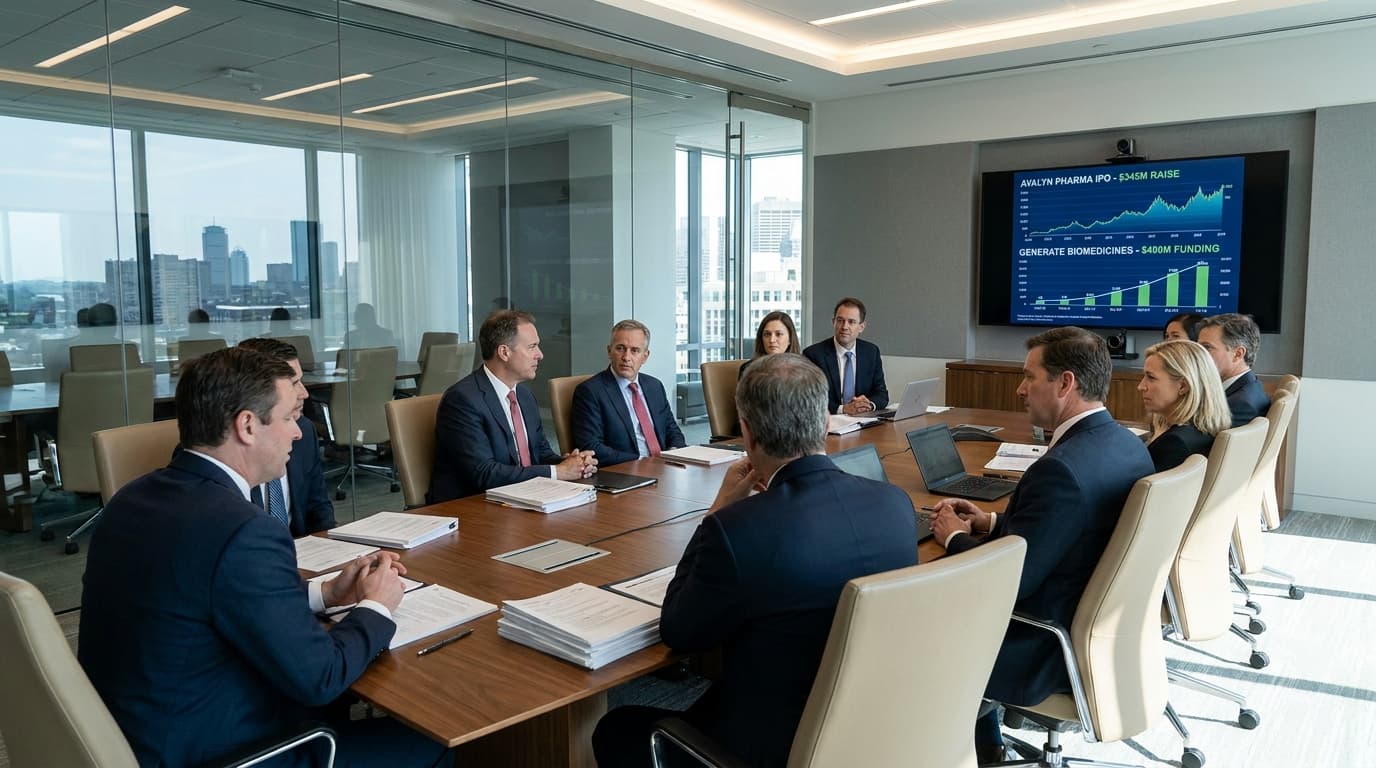
Avalyn And Generate Raised $345 Million And $400 Million, Showing How Biotechs Compressed IPO Prep

Avalyn Pharma said it raised $345 million in an upsized IPO and began trading on Nasdaq April 30, while Generate Biomedicines raised $400 million earlier this year. The reporting shows that the public offering window may be more available in 2026, but only for teams that have already done the shareholder, governance, and execution work before the filing process starts.
Avalyn Pharma and Generate Biomedicines are being presented as examples of what it actually took for biotechs to get public in 2026: not just filing documents and showing up for a bell-ringing ceremony, but years of board, investor, and management preparation compressed into a few punishing months of execution.
In BioSpace's account, Avalyn CEO Mary Stenzel Baranowski described the Nasdaq opening as a human moment rather than only a financing milestone, recalling a Morgan Stanley employee who wore his late grandfather's watch because his grandfather had died from idiopathic pulmonary fibrosis, one of the diseases Avalyn is trying to treat. That anecdote sits at the end of a process that BioSpace said took Avalyn four months in its active phase and much longer in practical terms.
The road to market
Based in Boston, Avalyn develops inhaled therapies for rare respiratory diseases and says its goal is to deliver medicines directly to lung tissue to potentially enhance efficiency and avoid side effects associated with systemic drug delivery. Its lead asset is AP01, an inhaled version of pirfenidone, a small molecule inhibitor.
Baranowski told BioSpace that when she joined Avalyn four years ago, the company was held mostly by earlier-stage investors. With an IPO in mind, she worked to diversify the shareholder base by bringing in more later-stage and public market investors. She also recruited Doug Carlson in 2024 because she wanted an executive who had already taken a company public. Carlson had previously served as chief financial officer and chief operating officer of Ikena Oncology, where he led a $144 million IPO.
That sequence is the clearest strategic signal from the story: for companies considering the public markets, IPO preparation starts well before the formal process. Capital structure and executive hiring were treated as prerequisites, not cleanup work.
The workload behind the listing
Carlson, now Avalyn's chief financial officer and chief business officer, said he was thrilled with the company's upsized IPO, which raised $345 million. He said the financing came in above expectations and gave Avalyn more room to think about pipeline expansion and other ways to continue building the business.
The pace was heavy. Baranowski and Carlson worked 12- to 16-hour days during the process. Carlson said the workload intensified after the organizational meeting that launched the IPO work group. Baranowski said weekdays became so full that the two often met on Sunday afternoons to handle issues they had not been able to address earlier and to prepare for what came next.
The hardest stretch for Baranowski came during testing the waters meetings over a two-week period. She estimated that she met around 100 investors one on one for an hour each, creating 14- to 16-hour days and requiring her to repeat Avalyn's story in a way that still felt fresh and persuasive each time. That detail matters because it shows where management capacity gets consumed in a live offering: less in abstract strategy than in sustained investor translation.
When Avalyn finally rang the opening bell, members of the leadership team and the company's patient advisory council attended, and Baranowski gave a speech. She described it as one of the most joyous days of her life and said the process created an unusual sense of camaraderie inside the company.
A second 2026 template
Generate Biomedicines, based in Somerville, Massachusetts, followed a different timetable but revealed a similar level of compression. The company describes itself as a generative biotech whose Generate Platform creates medicines on demand across multiple therapeutic modalities. Its lead asset is GB-0895, an anti-TSLP monoclonal antibody being studied for severe asthma and chronic obstructive pulmonary disease.
BioSpace reported that Generate raised $400 million earlier this year. Jason Silvers, the company's president and chief financial officer, said the team began working on the IPO shortly before Thanksgiving last year. At the first meeting about going public, they discussed a late February 2026 target date. Silvers said that just four days earlier, Generate had been considering raising money privately.
His account suggests how quickly the financing route can change when market conditions and company readiness align. Rather than hesitation, Silvers said he saw exhilaration and excitement in the room, with employees accepting the fast timeline and treating it as a solvable execution problem.
Taken together, the Avalyn and Generate stories suggest that a receptive IPO market does not reduce the burden on management teams; it shifts the advantage toward companies that can prove they are institutionally ready. In that sense, the bell-ringing moment may still be symbolic, but the more important signal for investors is what happened before it: shareholder repositioning, experienced finance leadership, and management teams able to absorb months of concentrated scrutiny.
Join the BioIntel newsletter
Get curated biotech intelligence across AI, industry, innovation, investment, medtech, and policy delivered to your inbox.