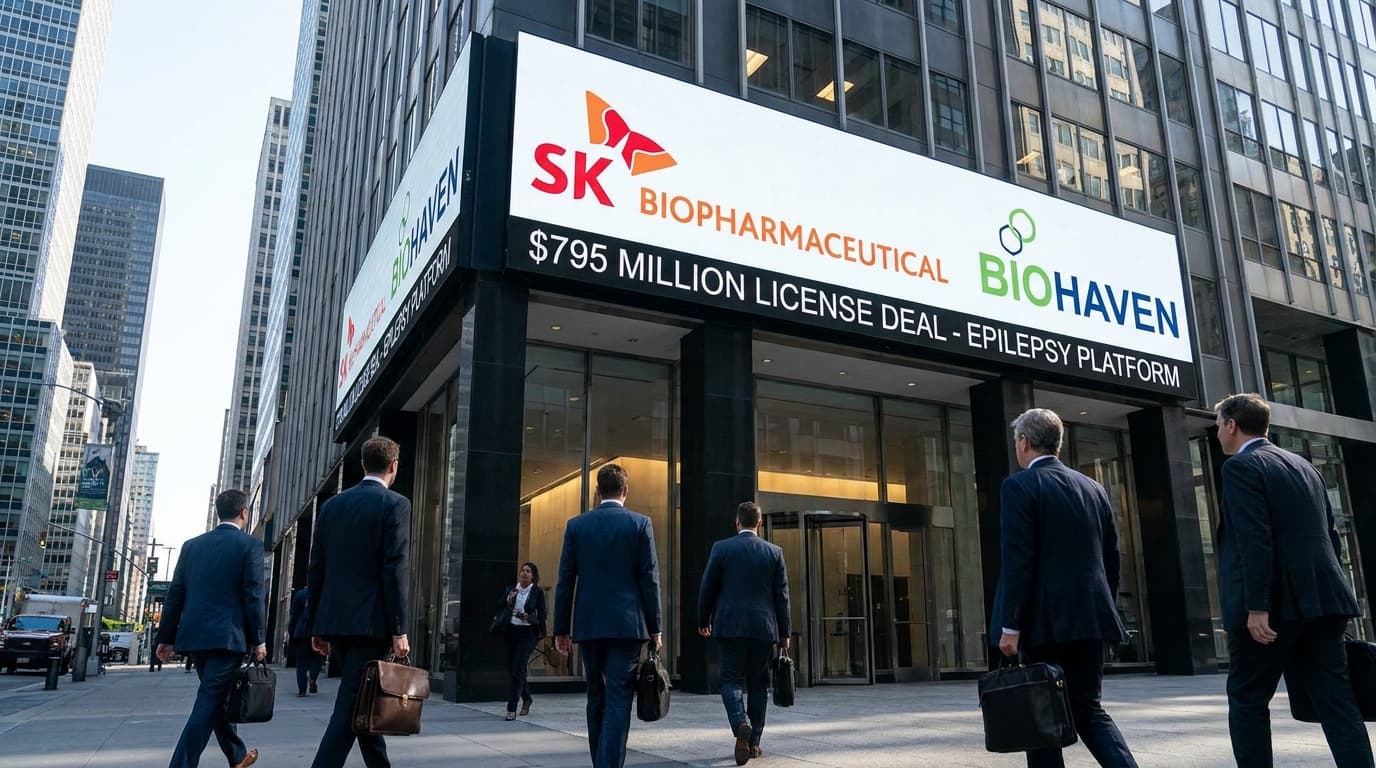
Biohaven Licenses Kv7 Epilepsy Platform To SK Biopharmaceutical For Up To $795 Million, Bolstering Cash Ahead Of Readouts

The agreement includes $400 million in near-term cash, up to $150 million in development and regulatory milestones, and the assumption of milestone obligations linked to Biohaven’s 2022 Knopp Biosciences agreement. For Biohaven, the deal strengthens the balance sheet as investors await data from the Phase 2/3 RISE3 trial in focal epilepsy.
Biohaven has struck a licensing deal with Seoul-based SK Biopharmaceutical that could reach up to $795 million, giving its partner an exclusive global license to the Kv7 ion channel platform and lead epilepsy asset opakalim. The agreement is notable less for its headline size alone than for how much of the value arrives in the near term and how much liability it removes from Biohaven’s side of the ledger.
Under the terms announced Wednesday, Biohaven is set to receive $400 million in near-term cash, including $350 million payable at closing and $50 million payable next year, according to BioSpace. Development and regulatory milestones could add up to $150 million more.
Deal Structure
The rest of the stated value comes from obligations SK Biopharmaceutical has agreed to take on. BioSpace reported that SK Bio will assume up to $185 million of Biohaven’s milestone obligations under the February 2022 agreement with Knopp Biosciences through which Biohaven gained the ion channel platform. SK Bio has also agreed to take over up to $60 million in milestone payments related to the technology.
That structure matters. A deal framed as nearly $800 million often contains back-ended milestones that may or may not materialize, but here the immediate cash component is large relative to Biohaven’s existing balance. As of June 30, BioSpace said, the company had $270.5 million in cash, equivalents, marketable securities and restricted cash. On those numbers, the transaction materially improves liquidity even before any future milestones are considered.
The Asset And Timing
SK Biopharmaceutical is licensing opakalim, described by BioSpace as an oral daily selective potassium channel activator in development for focal epilepsy, along with the broader Kv7 platform. The Phase 2/3 RISE3 trial is ongoing, with topline data expected in the back half of 2026.
The timing suggests Biohaven chose to monetize part of the platform before a major clinical catalyst rather than wait for the readout. That reduces financing pressure heading into a potentially volatile data period and transfers more of the downstream development burden to a partner willing to pay for global rights now.
Why It Matters For Biohaven
BioSpace cited William Blair analysts, who said in an Aug. 11 note that Biohaven is entering a “catalyst-rich period” that is “not without risk but is potentially transformative.” The RISE3 readout is one of the central events in that stretch.
Biohaven is also expecting mid-stage data before year-end for taldefgrobep alfa, an investigational myostatin and activin receptor blocker now being studied for obesity after a late-stage stumble in spinal muscular atrophy in November 2024, according to BioSpace. In that context, the SK Bio transaction looks like balance-sheet management as much as business development. It gives Biohaven more financial room to absorb binary clinical outcomes while narrowing its direct exposure to one platform.
For SK Biopharmaceutical, the deal buys a late-stage epilepsy opportunity and a broader ion channel platform. For Biohaven, the clearer signal is capital efficiency: it is converting a neuroscience asset package into substantial non-dilutive funding at a moment when preserving cash ahead of multiple readouts can shape strategic flexibility as much as the science itself.
Join the BioIntel newsletter
Get curated biotech intelligence across AI, industry, innovation, investment, medtech, and policy delivered to your inbox.