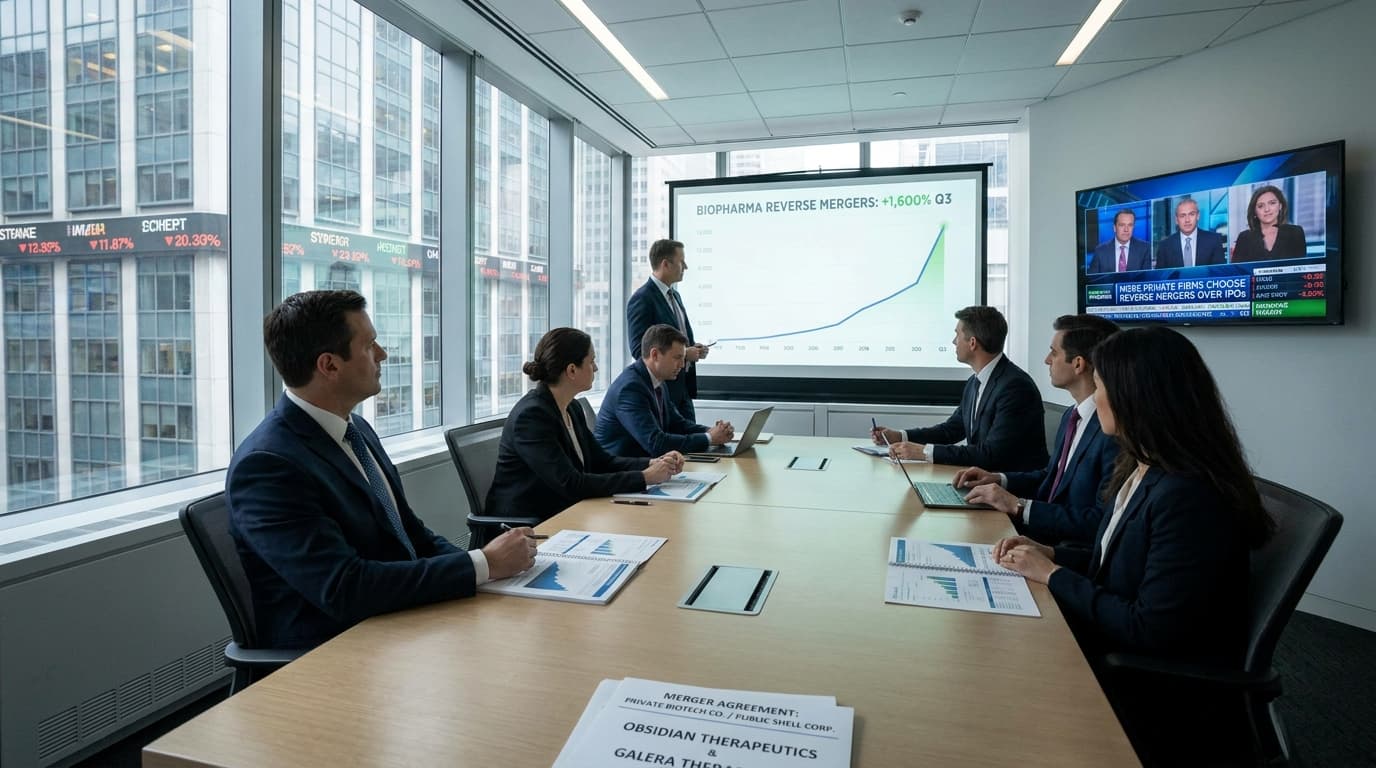
Biopharma Reverse Mergers Jump 1,600% In Q3, Giving Private Companies A Faster Route Public

By Leerink’s count, biopharma has seen 20 IPOs and 19 reverse mergers in 2026 so far, with 17 reverse mergers already completed or planned to close this quarter. The pattern suggests private companies are increasingly running multiple financing paths in parallel rather than waiting on a single IPO window.
Biopharma reverse mergers have moved from a niche financing route to a near-peer of the traditional IPO this year. By Leerink’s count, there have been 20 biotech IPOs and 19 reverse mergers in 2026 so far, and more than half of the reverse mergers have occurred in the current quarter.
The quarterly swing is especially sharp. BioSpace reported that 17 reverse mergers have already been completed or are planned to close this quarter, versus a single reverse merger last quarter, a 1,600% increase. Not since the second quarter of 2025 had biopharma seen more than one reverse merger in a quarter.
Why Companies And Investors Are Using Them
Jack Bannister, senior managing director of equity capital markets at Leerink Partners, told BioSpace that reverse mergers are often overlooked because the IPO process gets more attention even though there are other ways to get public. He said the IPO process is more of a black box for investors, who must trust that the stock will trade well based on execution by management, the board and the bank.
Maha Katabi, general partner at Sofinnova Investments, gave a related reason for investor interest. In a reverse merger, the disclosures tied to a public company combination and the accompanying private investment in public equity, or PIPE, can make the syndicate visible before the stock begins trading. That offers more clarity on who else is backing the deal.
The tradeoff is time and market exposure. According to J.B. Strategy’s tracker, reverse mergers typically take four to six months to close. Bannister cited Obsidian Therapeutics’ reverse merger with Galera Therapeutics as an example: the deal was done in March, announced in April, closed at the end of July, and the PIPE shares still were not expected to be registered for a few weeks after that. Obsidian also announced a $350 million private placement financing before the merger closed, and the combined company began trading Aug. 4 under the ticker OBX.
The Broader Financing Signal
This increase is not happening in isolation. BioSpace linked it to a wider rebound in investor activity after the lows that followed the bursting of the pandemic-era bubble. The report also cited more than 70 M&A deals signed across the industry so far this year, compared with 30 total M&A transactions recorded in the first half of 2025, based on S&P Capital IQ data.
The practical implication is that more biotechs are no longer organizing financing strategy around a single outcome. Katabi said companies are running M&A, reverse merger PIPE and traditional IPO processes in parallel. That matters because a healthier capital market is not just producing more listings; it is widening the menu of ways private biopharma companies can reach public investors.
Join the BioIntel newsletter
Get curated biotech intelligence across AI, industry, innovation, investment, medtech, and policy delivered to your inbox.