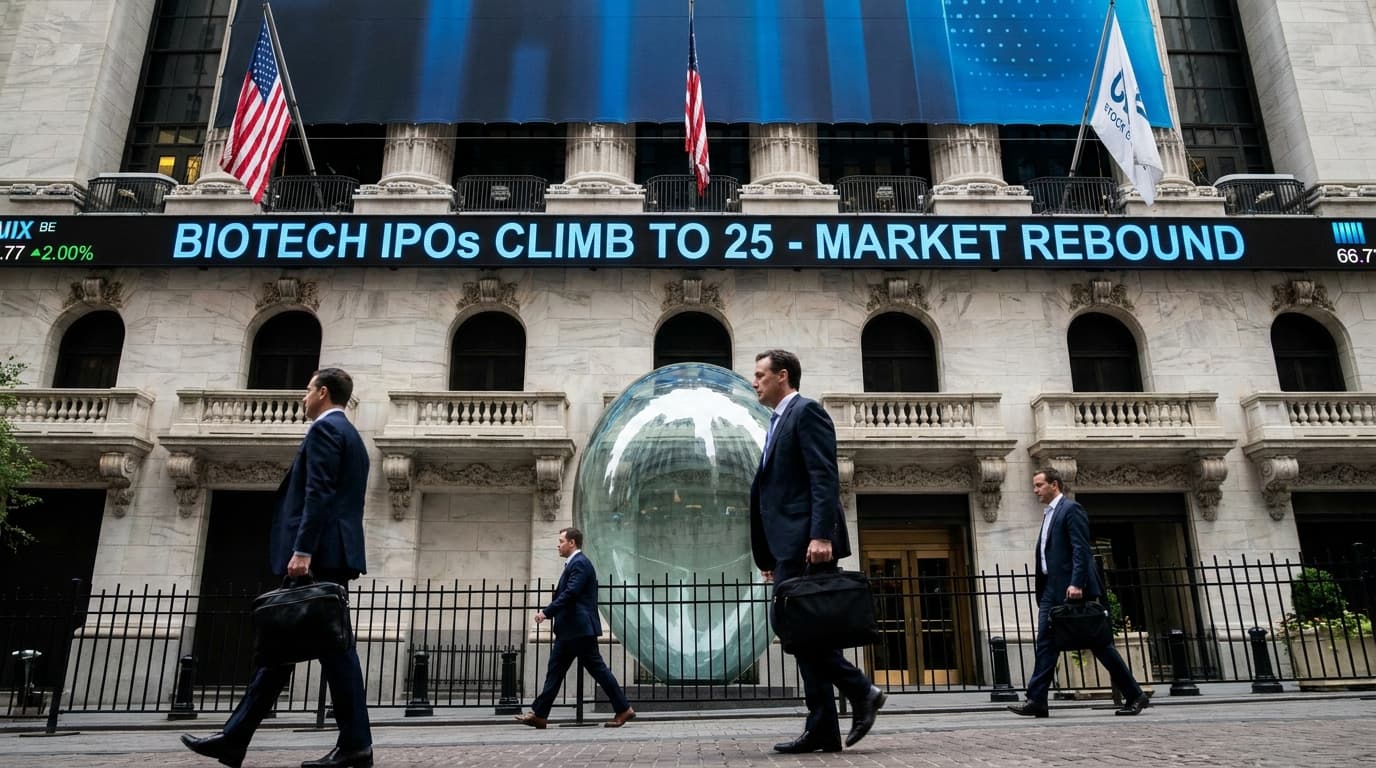
Biotech IPOs Reach 25 This Year, As Leerink Sees A More Selective Rebound

The current reopening looks different from the pandemic-era boom because investors are being more selective and still writing large checks when conviction is high. The main risks, according to Leerink’s Jack Bannister, are preclinical companies rushing out and issuers pushing valuation too far.
Biotech IPO issuance has accelerated to 25 offerings so far this year, already making 2026 the busiest market since 2021. Jack Bannister, senior managing director of equity capital markets at Leerink Partners, told BioSpace the market is approaching “escape velocity,” meaning both companies and investors are starting to act as if IPOs are working again.
That shift follows four weak years in which many biotech issuers stayed private because public listings were not seen as an advantage. Last year, only eight biotechs went public. By contrast, more than 70 biotechs listed in 2020 and 2021 each, during a period Bannister described as frothy and unsustainable.
What is driving the rebound
Bannister argued the current cycle is healthier than the earlier boom because buyers are being discerning rather than chasing every deal. Investors are still selective about which stories they support, but when they do commit, they are doing so with size, including checks around $100 million.
That conviction has supported outsized offerings such as Kailera Therapeutics’ $625 million debut and Parabilis Medicines’ $670 million IPO. Bannister said the willingness to fund large deals is not, by itself, a warning sign as long as selection remains disciplined.
On the issuer side, the companies reaching market are mostly later-stage and carry clinical inflection points in the near future. Bannister also said valuation discipline is shaping outcomes: companies that pushed too hard on price have not traded as well this year, while those that were more conservative have performed better.
The feedback loop investors are watching
According to Bannister, a constructive pattern started in late January to early February, when a small group of IPOs performed well enough for investors to make money. That encouraged more companies to test the market, and a similar wave followed at the end of July and in the first half of August.
“The latest group of August IPOs are all above deal price and trading well,” Bannister said. If that continues, he expects a larger group in September and October and said the market could end the year at about 30 IPOs, which he framed as closer to 2018 and 2019 than to the pandemic spike.
The main yellow flags, in his view, are preclinical companies trying to rush into the market and management teams pushing valuation too aggressively. Either could weaken aftermarket trading and spill over onto higher-quality issuers. The signal for investors is that the window appears open again, but only for companies that match stronger data packages with realistic pricing.
Join the BioIntel newsletter
Get curated biotech intelligence across AI, industry, innovation, investment, medtech, and policy delivered to your inbox.