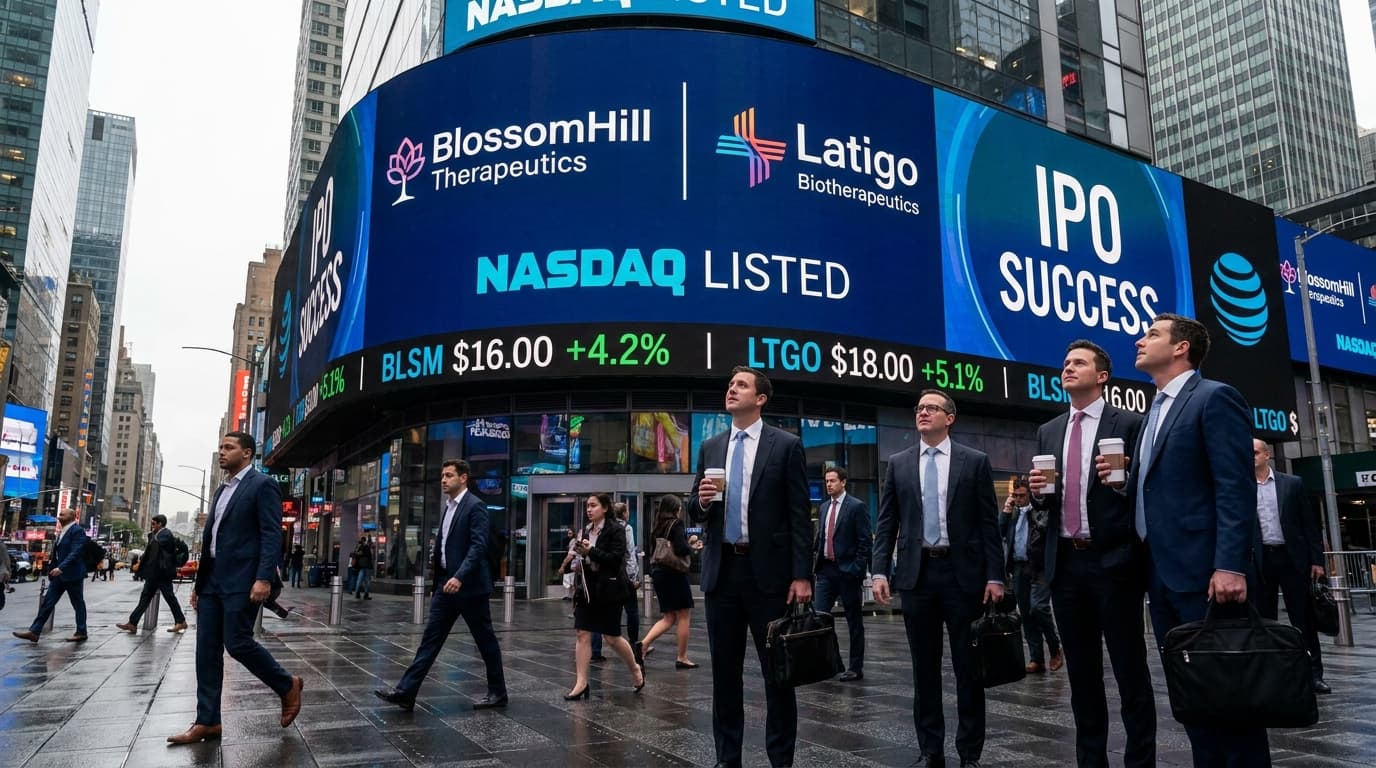
BlossomHill And Latigo Price Nasdaq IPOs Above Initial Targets, Extending 2026 Biotech Listing Rebound

BlossomHill sold nearly 9.4 million shares at $16 and expects gross proceeds of $150 million, above an original $129.1 million target. Latigo’s offering rose to 19.2 million shares at $18 for expected proceeds of about $345.6 million, versus a previously targeted up to $285.2 million. The signal for investors is less about two debuts in isolation than about reopening appetite for clinical-stage biotech stories tied to clear capital deployment plans.
BlossomHill Therapeutics and Latigo Biotherapeutics have both made it to the Nasdaq Global Select Market roughly three weeks after first laying out their IPO plans, and both companies came out with raises above the levels they had initially targeted. For a biotech financing market that had been looking for proof of breadth rather than one-off deals, the paired debuts add another data point that public investors are again willing to fund development-stage companies when the use of proceeds is tightly defined.
San Diego-based BlossomHill had expected to sell 7.8 million shares, but ultimately tendered nearly 9.4 million shares, according to a company release cited by BioSpace. At $16 per share, within the initial targeted range of $15 to $17, BlossomHill expects gross proceeds of $150 million, up from its original target of $129.1 million. Thousand Oaks-based Latigo increased its IPO to 19.2 million shares from an initial 19 million, with each share sold at $18, bringing expected proceeds to around $345.6 million after previously targeting up to $285.2 million.
The Capital Plans
The raises matter because both companies tied the money to specific late-clinical or near-late-clinical programs rather than broad platform spending. BlossomHill said the bulk of its IPO funds will go toward BH-30643, an investigational drug in Phase 1/2 development for EGFR-mutated non-small cell lung cancer. In its earlier prospectus update, the company had estimated around $70 million from the raise would support that asset through its current global study.
BlossomHill also said the IPO proceeds will help advance another clinical program in acute myeloid leukemia and high-risk myelodysplastic syndrome. BioSpace’s report identifies that second candidate as BH-30236, a CLK blocker that the biotech had been preparing for a Phase 1 study.
Latigo’s capital plan is more concentrated around commercialization-adjacent execution. In its updated prospectus, the company had said it expected net proceeds of around $247.2 million, potentially reaching $285.2 million if underwriters fully exercised their option. With the expanded deal now expected to produce around $345.6 million in proceeds, Latigo said the financing will help move LTG-001, its oral non-opioid pain pill, through Phase 3 testing while also supporting regulatory activities and commercial launch preparation.
BioSpace separately reported that Latigo had earmarked about $124.7 million of the IPO raise for LTG-001 and had also planned to direct money toward LTG-321, a next-generation NaV1.8 inhibitor that it hopes to push through a Phase 2 osteoarthritis pain study and into late-stage development.
Why These Two Deals Matter
The immediate significance is that investors did not just tolerate these offerings; they absorbed upsized versions of them. That is a stronger signal than simple pricing within range because it suggests demand extended beyond the minimum capital needed to complete a listing.
The sector context in the source is also notable. BioSpace reported that 18 biotechs had already gone public in the first half of this year, more than doubling last year’s total of eight. Once Latigo and BlossomHill are included, the 2026 IPO class becomes the largest since 2021, when more than 100 biotechs entered the public markets during the pandemic-era financing surge.
That does not mean the window is indiscriminate. Both issuers are built around programs that are easy for public investors to underwrite: Latigo is pursuing a non-opioid pain opportunity after the January 2025 approval of Vertex Pharmaceuticals’ Journavx, while BlossomHill offers two clinical-stage oncology programs with the lead candidate already in a global Phase 1/2 study. In practical terms, the market appears to be rewarding stories where new capital has an identifiable path into milestone-generating development work.
Other recently listed companies named by BioSpace include Scribe Therapeutics, Apnimed, Braveheart Bio, Attovia Therapeutics and Vogenx. Against that backdrop, the latest offerings suggest the 2026 reopening is broadening from isolated debuts into a more sustained financing channel for biotechs that can present focused pipelines and credible deployment plans.
Join the BioIntel newsletter
Get curated biotech intelligence across AI, industry, innovation, investment, medtech, and policy delivered to your inbox.