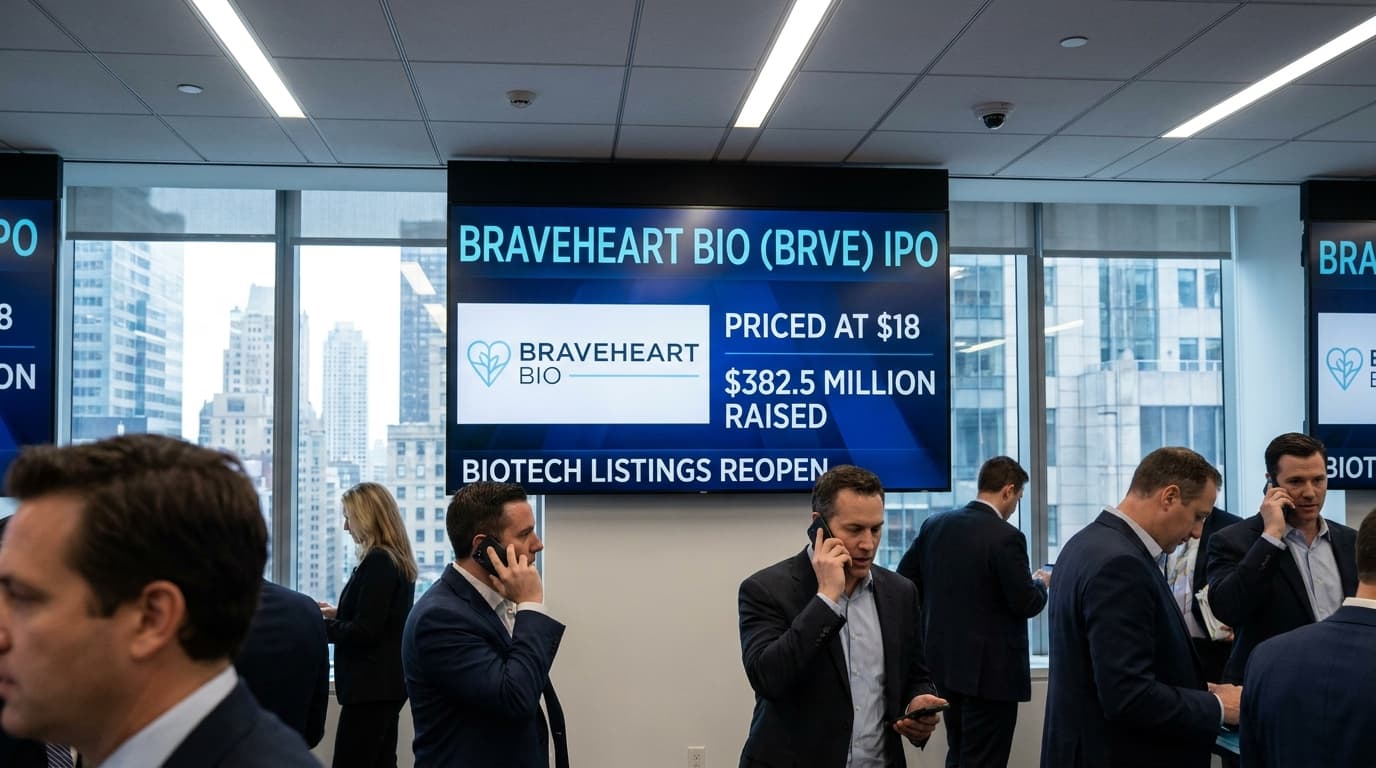
Braveheart Bio Prices 21.2 Million Share IPO At $18, As Biotech Listings Reopen

The California cardiovascular biotech increased both the size and price of its offering, moving to 21.2 million shares at $18 apiece from an earlier range of $15 to $17 for 17.5 million shares. The proceeds are aimed at advancing BHB-1893 into Phase 3 development in hypertrophic cardiomyopathy, where Braveheart wants to compete with Bristol Myers Squibb’s Camzyos and Cytokinetics’ Myqorzo.
Braveheart Bio is entering the public market with an upsized initial public offering expected to be worth $382.5 million, adding another data point to biotech’s reopening IPO window. The company said its offering includes 21.2 million shares priced at $18 each, with trading set to begin on Nasdaq under the ticker "BRVE."
That final structure came in above Braveheart’s earlier projections of 17.5 million shares at $15 to $17 apiece. For a market that was frozen for much of 2025, the increase in both volume and price suggests investors are still willing to fund later-stage stories tied to large commercial categories rather than only earlier, higher-risk platform names.
The financing case
Braveheart said it will use the new capital to support BHB-1893, an oral small molecule designed to inhibit cardiac myosin, the protein that drives heart contractions. The company is developing the drug for subtypes of hypertrophic cardiomyopathy and is preparing for late-stage testing.
The IPO proceeds are intended to push BHB-1893 through Phase 3 development in both obstructive HCM and non-obstructive HCM. That matters strategically because the company is not pitching a narrow follow-on program. It is raising against the prospect of competing across multiple parts of an established and growing HCM market.
The commercial picture
In its July prospectus, Braveheart said it aims to position BHB-1893 as "a new standard of care" in HCM. The company is targeting a market already defined by Bristol Myers Squibb’s Camzyos and Cytokinetics’ Myqorzo.
BioSpace reported that Camzyos, which is indicated for symptomatic patients with obstructive HCM, grew 77% annually to generate more than $1 billion last year. Myqorzo was approved for the same indication in December 2025. HCM, an inherited disease that causes thickening of the heart muscles, can include shortness of breath, chest pain and fainting.
Braveheart’s pitch is that BHB-1893 may address what the company describes as the "LVEF cost" of current HCM therapies: a decrease in left ventricular ejection fraction, or a decline in pump function that can accompany improvements in obstruction. The source does not provide clinical results supporting that claim, but it does show how Braveheart is trying to differentiate its asset in a market that now has validated demand and entrenched competitors.
Why this IPO matters
Braveheart licensed BHB-1893 from Jiangsu Hengrui Pharmaceuticals in a deal worth up to $1.1 billion, giving public investors exposure to an in-licensed, late-stage cardiovascular asset rather than a discovery-stage platform. That profile fits the kind of story the market has been rewarding this year.
According to BioSpace, 21 other biotechs have already gone public this year, with five debuts occurring in the last two months. In July alone, Scribe Therapeutics, Attovia Therapeutics and Apnimed all listed. The signal from Braveheart’s upsized pricing is less about one company than about what buyers will fund: programs with a defined regulatory path, a visible commercial category and a credible use of proceeds tied directly to Phase 3 execution.
Join the BioIntel newsletter
Get curated biotech intelligence across AI, industry, innovation, investment, medtech, and policy delivered to your inbox.