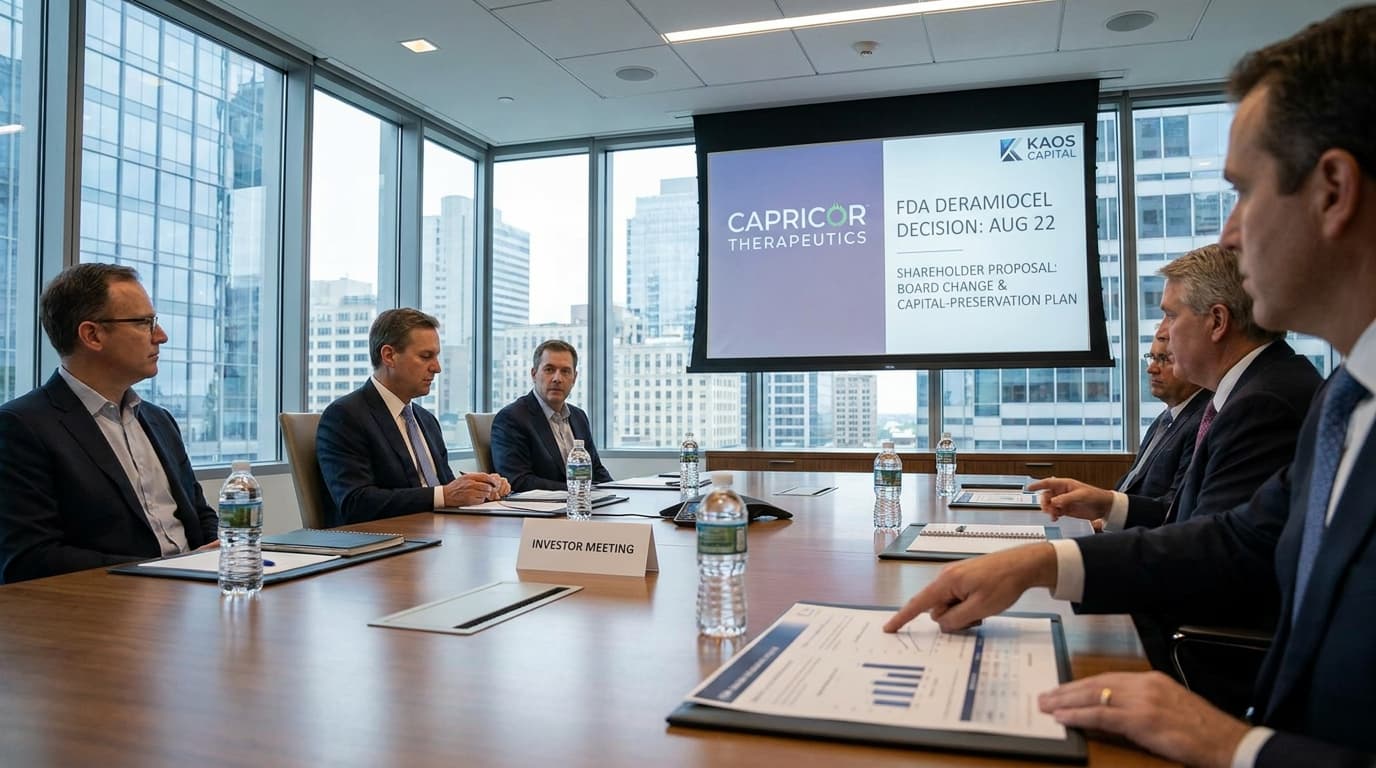
Capricor Investor Demands Board Change As Deramiocel Faces Aug. 22 FDA Decision

Capricor’s lead Duchenne muscular dystrophy cell therapy remains under FDA review after a 9-3 advisory committee vote against approval. At the same time, a significant shareholder is arguing that the company’s board has tied too much of Capricor’s capital and future to deramiocel while other programs sit paused.
Capricor Therapeutics is heading into an Aug. 22 decision date for deramiocel while also confronting a governance challenge from Kaos Capital, which described itself as a significant and growing shareholder and called for “an immediate meeting, board change, and capital-preservation plan.” In a Friday letter to other shareholders, Kaos said it plans to nominate two independent directors and seek a board-led “M&A and Strategic Alternatives Committee” chaired by a shareholder-backed director.
The timing matters because Capricor is also trying to strengthen the filing for deramiocel, its Duchenne muscular dystrophy cell therapy. CEO Linda Marbán said on the company’s second quarter earnings call that, after discussions with the FDA following the advisory committee meeting, Capricor plans to submit an amendment to its biologics license application that includes 24-month open-label extension data from the Phase 3 HOPE-3 study plus additional analyses on the existing package to support a refined indication focused on the primary endpoint. BioSpace reported that this amendment could potentially extend the Aug. 22 PDUFA date.
The regulatory setup
Capricor has been trying for more than a year to win approval for deramiocel. The therapy was first rejected last July after a canceled advisory committee meeting. When the FDA’s Cellular, Tissue, and Gene Therapies Advisory Committee finally met on July 29, the outcome was unfavorable: the panel voted 9-3 against approval.
A major source of tension in that meeting was the FDA’s decision to base its review on an outdated statistical analysis plan. Marbán argued that deramiocel’s case is better aligned with the Phase 3 trial’s primary endpoint, where HOPE-3 showed a statistically significant benefit in upper-limb function. But panelists instead voted on whether the therapy provided substantial evidence of effectiveness for treating cardiomyopathy in patients with DMD, which was a secondary endpoint.
That mismatch helps explain why Capricor is now trying to refine the proposed indication rather than simply await the original action date. The signal for investors is that late-stage regulatory risk here is not only about whether the data exist, but also about which endpoint the review is organized around.
The capital question
Kaos’ campaign goes beyond the pending FDA decision. The investor wrote that belief in deramiocel is not a sufficient reason for the board to concentrate “all of a public company’s capital, risk, and future in a single regulatory outcome.” That argument has become more pointed because Capricor has halted all other pipeline work until it gets “further regulatory clarity.”
The paused programs include StealthX, an exosome-based vaccine that was in a Phase 1 trial for COVID-19 run by the Department of Health and Human Services and wrapped in June. Capricor has said it believes the platform has potential across a variety of indications, and Kaos explicitly cited the company’s cell-therapy and exosome capabilities as part of its investment case.
Kaos also highlighted Capricor’s cash position. As of June 30, the biotech had $237.9 million in cash, cash equivalents and marketable securities, down about $80.2 million from year-end 2025, according to the letter. For a company that has paused the rest of its pipeline while waiting on one binary event, that burn trajectory sharpens the governance debate: if deramiocel is delayed again, the argument over preserving capital and reassessing strategy is likely to intensify.
Join the BioIntel newsletter
Get curated biotech intelligence across AI, industry, innovation, investment, medtech, and policy delivered to your inbox.