Scribe Therapeutics Rises 43% After $150 Million IPO, Defying Biotech’s Derisking Bias

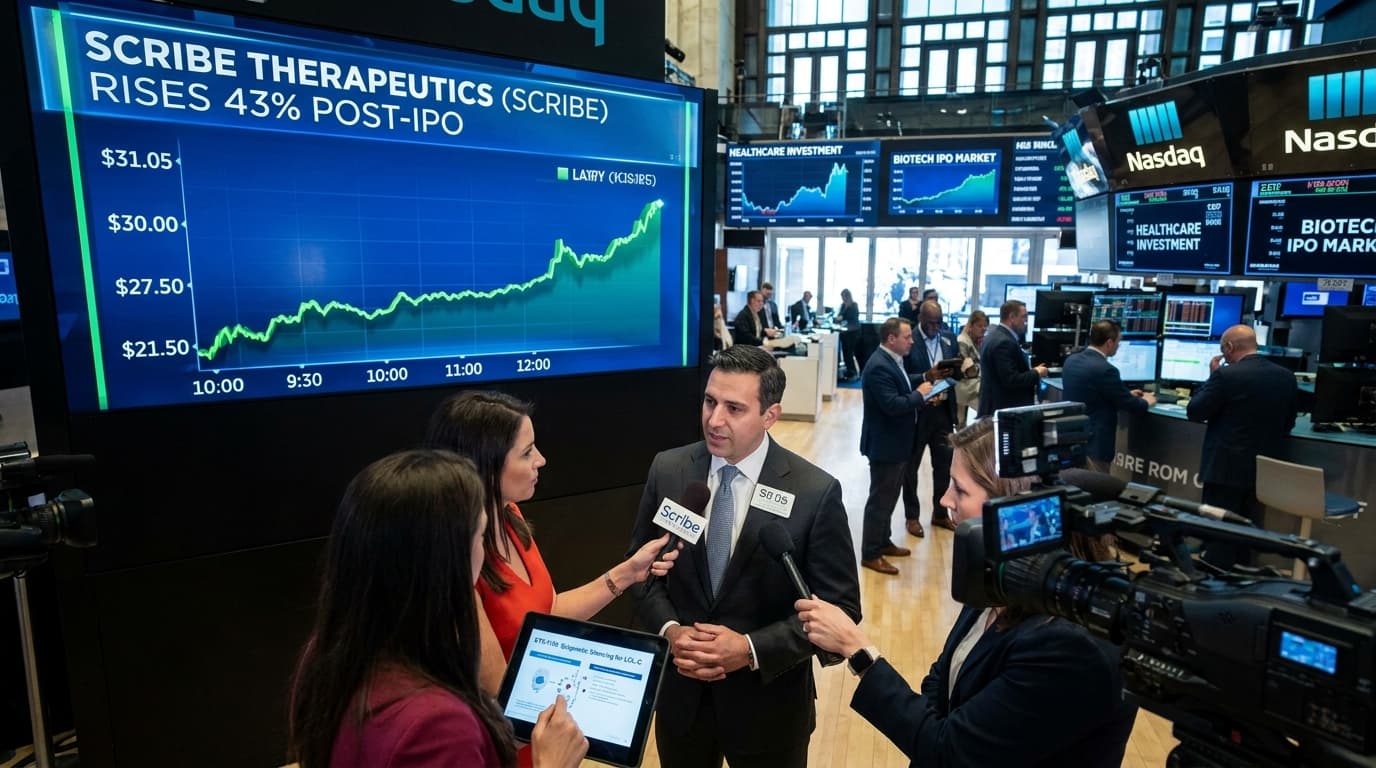
Scribe raised an upsized $150 million and has climbed 43% from its first-day price of $21.50 to $31.05 by Wednesday’s close, compared with a 12% gain in the XBI over the last month. The company is heading into Phase 1 in Australia with STX-1150, a PCSK9-targeting epigenetic silencer that investors will begin to judge on interim patient data in the first half of next year.
Scribe Therapeutics is testing a part of the biotech IPO market that has largely been out of favor: earlier-stage companies asking investors to commit before substantial clinical derisking. So far, the bet has worked better than many recent peers.
Less than a month after raising an upsized $150 million in its public debut, Scribe’s stock had risen 43% from its first-day price of $21.50 to $31.05 by the close on Wednesday, according to BioSpace. Over the same one-month period, the XBI biotech stock index rose 12%. That relative outperformance matters because 2026’s reopening IPO window has generally rewarded companies with more mature datasets and punished aggressive valuations.
The signal for investors is not just that Scribe went public earlier than usual. It is that the company offered a near-term test of value. Jack Bannister, senior managing director of equity capital markets at Leerink Partners, told BioSpace that Scribe is “a story that very quickly will be validated one way or the other,” with a data update expected early next year.
The Clinical Bet
Scribe’s lead asset, STX-1150, is designed as a single dose to lower LDL cholesterol, or LDL-C, by targeting PCSK9. The program uses epigenetic silencing rather than gene editing, with the goal of reducing atherosclerotic cardiovascular disease risk without permanently changing the DNA sequence.
The company is entering Phase 1 trials in Australia, and interim results in patients with high LDL-C are expected in the first half of next year. That setup distinguishes Scribe from many newly public biotechs that begin with healthy volunteers or generate early data focused mainly on safety. Bannister said investors should get a relatively quick sense of whether STX-1150 is working.
Leerink analysts wrote in an Aug. 18 note that, beyond a clean safety profile, they hope STX-1150 can reduce LDL-C by 50% or more. In their view, that level could translate to significantly improved adherence-adjusted efficacy versus approved drugs including Amgen’s Repatha, Novartis’ and Alnylam’s Leqvio, and Merck’s newly approved Lipfendra. Leerink also argued that a positive readout could create “a meaningful value inflection.”
That framing reflects a broader investor preference in 2026: if a company is going public early, it helps to have a program capable of producing interpretable patient data quickly rather than a long wait for proof of concept.
Why The Market Responded
BioSpace’s reporting points to a second factor behind Scribe’s reception: pricing discipline. Bannister said it was important to find a price attractive to both existing and new investors and to “price the deal to trade well.”
That approach stands out against much larger offerings such as Kailera Therapeutics’ $625 million debut and Parabilis Medicines’ $670 million IPO. While Scribe’s valuation was considerably lower, its shares have so far traded better. As of Aug. 18, BioSpace’s performance tracker showed Kailera down 31.4% from its first-day price, while Parabilis was up 24.5%.
The implication is practical for private biotech boards considering the public markets: in the current window, a lower valuation paired with a near-term catalyst may be more effective than maximizing proceeds at launch. Bannister’s conclusion was direct: companies that have been more conservative on price have traded well this year.
The Platform Story Behind STX-1150
Scribe is not only selling a single-asset thesis. The California biotech says it is the only public company with an epigenetic silencer in the clinic, and it has built a broader CRISPR-focused platform called X-Editor. That platform supports two additional potential pipeline candidates: STX-1200 for Lp(a) and STX-1400 for severe hypertriglyceridemia, both aimed at other lipid drivers of atherosclerotic cardiovascular disease.
The platform has also already produced deals with Sanofi and Eli Lilly, which Leerink described as “impressive external validation.” Both companies also invested in Scribe’s IPO. For public market investors, that does not remove execution risk, but it does provide a form of commercial validation that many earlier-stage issuers do not have at listing.
BioSpace also notes a recent comparison point that may shape expectations. Leerink referenced Eli Lilly’s $1 billion upfront acquisition of Verve Therapeutics last year, which followed Phase 1b safety and LDL-C lowering results in only 14 patients. The readthrough is not that Scribe will follow the same path, but that cardiovascular gene-based platforms can attract strategic capital before large datasets if early human evidence is persuasive.
Scribe says its cash runway extends into the first half of 2029. That gives the company time to move beyond its first clinical signal, but the immediate market case rests on something narrower: whether STX-1150 can deliver enough LDL-C reduction with a clean enough safety profile to justify why this earlier-stage IPO broke with the market’s derisking trend.
Join the BioIntel newsletter
Get curated biotech intelligence across AI, industry, innovation, investment, medtech, and policy delivered to your inbox.