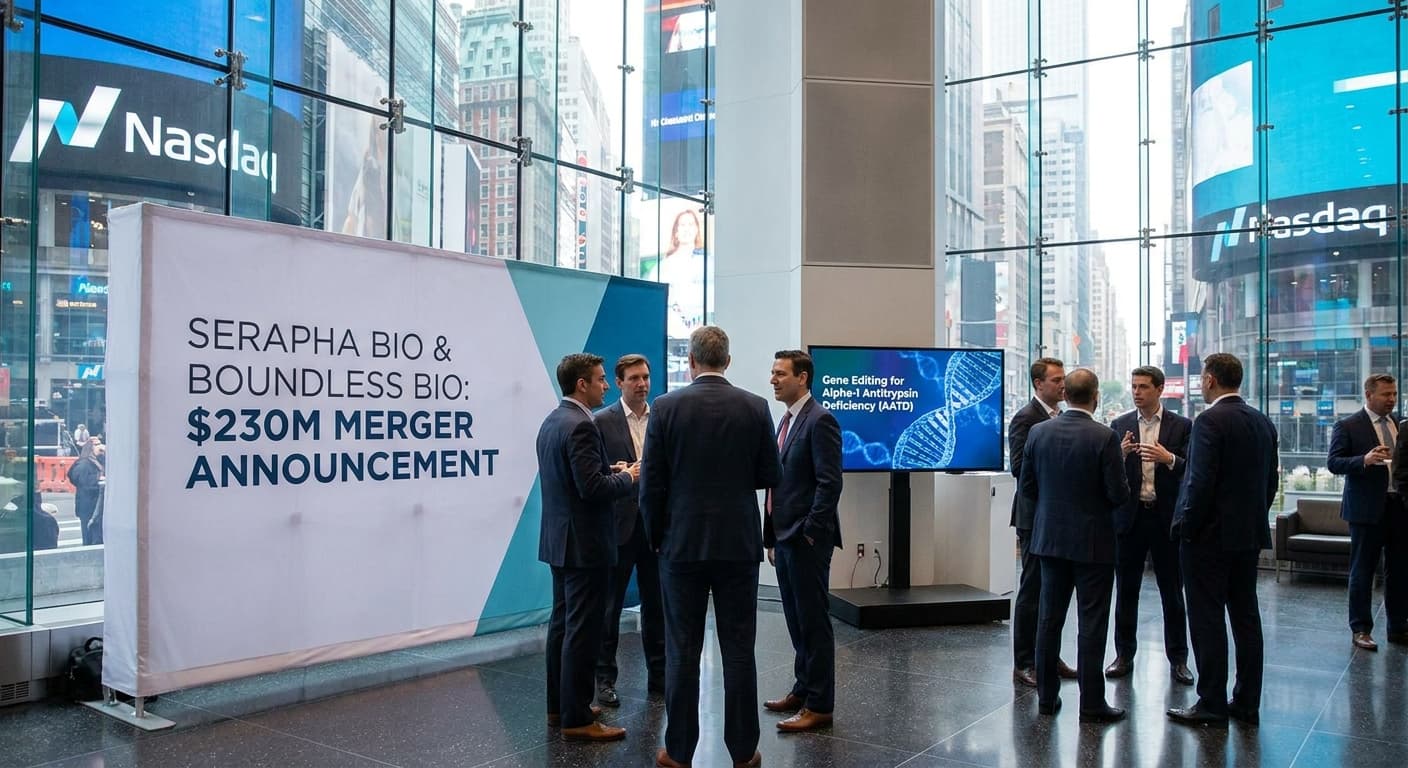
Serapha and Boundless Bio Combine Forces: $230 Million Nasdaq Reverse Merger Ushers in Next-Gen Gene Editing for Alpha-1 Antitrypsin Deficiency

Serapha Bio’s $230 million reverse merger with Boundless Bio marks a significant evolution in biotech dealmaking, enabling the new entity to pursue advanced gene editing for alpha-1 antitrypsin deficiency. The combined company, holding both a robust war chest and proprietary technology sourced from China, signals both the globalization and financial innovation now reshaping the biotech industry.
Introduction
In a move that underscores the evolving strategies and investment models powering the next wave of biotech innovation, Serapha Bio has announced a reverse merger with Boundless Bio, creating a Nasdaq-listed company with a valuation of $230 million. The newly formed entity will retain the Serapha Bio name and focus its efforts on developing an innovative gene editor, specifically targeting alpha-1 antitrypsin deficiency (AATD), a rare genetic disorder affecting thousands of patients worldwide.
This transaction is more than a simple sum of its parts—it signals changing dynamics in the capital markets, the growing importance of cross-border scientific collaboration, and the mounting interest in genetic therapies that can address previously intractable diseases. This in-depth article unpacks the mechanics of the deal, analyzes its industry context, and examines its implications for patients, investors, and the broader field of biotech.
What Is a Reverse Merger and Why Now?
A reverse merger is a financial maneuver whereby a private company merges with an already publicly traded entity, thereby gaining access to public markets without the traditional initial public offering (IPO) process. This route, while not new, has become increasingly attractive amid the volatility and selectivity of equity markets in recent years. For Serapha Bio and Boundless Bio, the reverse merger delivers not only a faster public listing—with reduced scrutiny compared to an IPO—but also injects new funding and portfolio diversification that can support long-term research initiatives.
Reverse mergers have historically been seen as a strategic shortcut or even a lifeline for cash-hungry biotechs unable to clear the hurdles of an IPO. However, with increased global investment in healthcare and a growing appetite for riskier, cutting-edge areas like gene editing, these deals have become mainstream vehicles for scaling innovation and satisfying demand from both private and public investors.
The Science: Targeting Alpha-1 Antitrypsin Deficiency
Alpha-1 antitrypsin deficiency is a hereditary condition characterized by defective or insufficient production of the alpha-1 antitrypsin (AAT) protein—essential for protecting lung and liver tissues from enzymatic damage. Individuals with AATD can suffer from early-onset emphysema, chronic obstructive pulmonary disease (COPD), and liver disease, often resulting in reduced quality of life and premature mortality.
Existing treatments are limited largely to palliative care, symptom management, or, in severe cases, lung transplantation. The holy grail remains curative therapies that address the root genetic cause. This is where next-generation gene editing comes in: By leveraging advanced CRISPR or other proprietary gene modification tools, scientists aim to repair, replace, or silence faulty genetic sequences—potentially curing the disease at its source.
Bringing together gene editing tools developed in China with the operational footprint and regulatory know-how of a Nasdaq-listed entity, Serapha Bio plans to develop and commercialize what could be a first-in-class therapy for AATD. The new company’s cross-border pedigree is an exemplar of the globalized, distributed approach now common in high-impact biomedical R&D.
Deal Structure and Financial Ramifications
The merger brings together Serapha Bio’s financing strength and Boundless Bio’s research platform and pipeline. With $230 million in capital and a public listing, the new company is better positioned to:
- Accelerate clinical development of its lead gene-editing asset.
- Broaden its research focus across other rare genetic diseases over time.
- Navigate regulatory environments in the U.S., China, and beyond.
- Attract additional institutional investors on the back of a diversified asset base and near-term pipeline catalysts.
Reverse mergers have gained popularity particularly as traditional IPOs become more elusive for pre-revenue, high-risk biotechs. By providing instant liquidity and access to capital, the mechanism allows R&D-intensive companies to keep pace with competitors and retain control over their scientific direction.
The China Factor: Globalization of Gene Editing
An especially noteworthy aspect of this deal is Serapha Bio’s plan to integrate a cutting-edge gene editor developed in China. This cross-border exchange is emblematic of the growing globalization of life sciences innovation. China’s rapid ascendancy as a biotech research hub has made its platforms attractive to U.S. and European counterparties seeking differentiated technical advantages and expanded pipelines.
Yet, the collaboration also raises questions around regulatory approval, intellectual property protection, and the management of data security—all concerns that have become more salient as U.S.-China trade and technological rivalries deepen.
Market and Industry Implications
The Serapha-Boundless transaction comes at a time when biotech capital markets are recalibrating. Investors remain keen on novel therapeutic approaches, especially where unmet need is high, but exhibit increased selectivity and risk aversion. The ability to marshal significant financial resources, while sharing development risks through mergers or collaborations, is now a hallmark of leading biotechs.
Additionally, gene editing remains one of the hottest areas in pharma and biotech. Successful clinical translation of gene editors—not only in AATD, but for a range of rare and common diseases—has the potential to transform standard of care and unlock multi-billion dollar market opportunities. This, in turn, stokes further competition and strategic dealmaking as companies race to secure intellectual property, talent, and market positioning.
Execution Risks and Unanswered Questions
While the logic of the merger is clear, execution risks abound:
- Clinical Uncertainty: It remains to be seen whether Serapha’s gene editor can safely and efficiently correct the underlying molecular error driving AATD in humans.
- Integration Complexity: Merging teams, platforms, and regulatory approaches from different companies—and different corners of the globe—adds cultural, operational, and compliance complexity.
- Regulatory Hurdles: Both the U.S. FDA and Chinese NMPA will demand rigorous evidence for any gene editing candidate, with public scrutiny likely to intensify due to the hot-button nature of human genome modification.
Broader Strategic Themes
This merger reflects broader themes in life sciences today:
- Cross-border Innovation: Scientific breakthroughs increasingly flow between countries, requiring collaboration among globally distributed teams.
- Financial Engineering: Financing structures like reverse mergers, targeted PIPE (Private Investment in Public Equity) rounds, and joint ventures are crucial for enabling sustained research in the face of mounting costs and capital market constraints.
- Focus on Rare Disease: The convergence on single-gene, rare indications offers a pathway for early commercialization of gene-editing, providing proof points and potential cash flow for expanding into more prevalent conditions.
Looking Ahead
As Serapha Bio charts its new course, the company will be closely watched by the investment community, patients, and the scientific world alike. The outcome of this merger, and the company’s success or failure in translating first-in-class science into real-world medical outcomes, will offer lessons for future generations of biotech entrepreneurs and innovators.
With $230 million on hand and a crucial gene-editing platform at its core, the new Serapha Bio represents both the ambition and complexity of today’s biopharma ecosystem—a field shaped as much by scientific discovery as by shrewd dealmaking and international cooperation.
Source: Serapha takes reverse merger route to Nasdaq with $230M and gene editor from China
Join the BioIntel newsletter
Get curated biotech intelligence across AI, industry, innovation, investment, medtech, and policy delivered to your inbox.