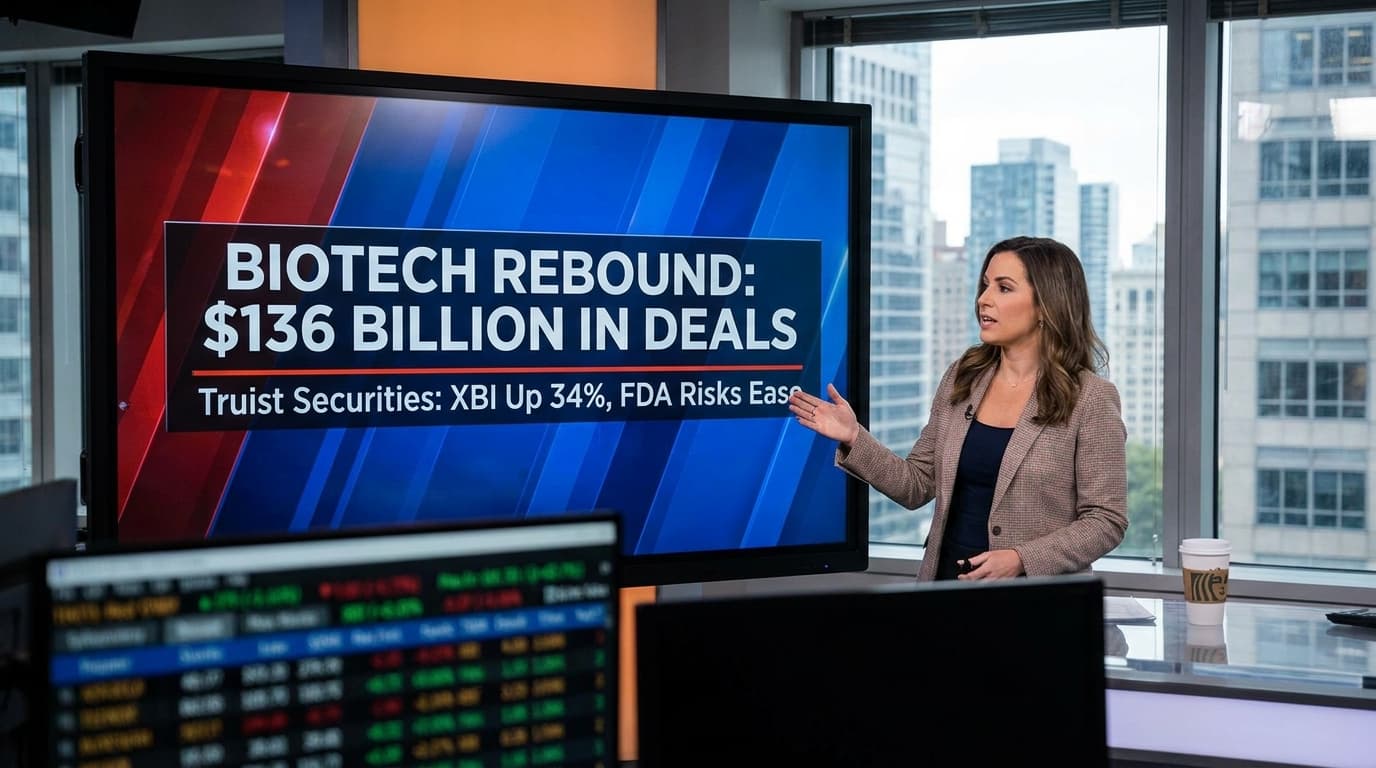
Truist Says Biotech Rebound Reached $136 Billion In Deals, As Financing And FDA Risks Ease

A Truist Securities note points to broad recovery signals across biotech, from IPOs and venture funding to large-cap acquisitions driven by patent cliffs. The firm also said regulatory and policy risks have largely played out, with innovation again driving stock performance.
Biotech’s recovery is now broad enough to show up across public markets, private financing and acquisitions, according to a Truist Securities note published Thursday. The firm said the sector’s performance over the past 18 months has “more than made up for a challenging 2+ year period,” and argued that first-half progress has set up a constructive second half.
Truist’s case rests on several measures moving at once. The S&P Biotech ETF, or XBI, ended the first half up 34% year to date and still sat there as of Friday, the firm said. M&A reached $136 billion across 57 deals, already clearing the total number of deals from 2025, while IPO issuance hit $5.9 billion across 21 debuts in the first half versus $1.54 billion for all of 2025. The number of companies trading below cash also fell to 15% from 22% in the second half of 2025.
What is driving the rebound
Truist said three forces are doing most of the work: patent cliff pressure on large drugmakers, an open financing window and a more supportive regulatory backdrop. The analysts said companies facing future revenue gaps have moved “aggressive[ly], even faster than expected” on dealmaking, citing AbbVie’s takeover of Apogee, GSK’s Nuvalent buy and Vertex Pharmaceuticals’ Crinetics acquisition as examples of deals at $10 billion or above.
On financing, the firm said venture capital has continued to come into the sector and fundraising announcements have accelerated as summer moves toward fall. That matters because a healthier capital market does more than support new listings; it also reduces pressure on companies that previously might have had to raise at distressed valuations or pursue strategic alternatives from weakness.
The policy and regulatory read
Truist also argued that regulatory and policy risks have eased. The note said the FDA has largely continued its work despite leadership departures, with 36 novel approvals from the Center for Drug Evaluation and Research through August 28. Ten of those approvals came via the Commissioner’s National Priority Review Program, which Truist described as controversial but potentially effective at speeding reviews.
The firm pointed to Revolution Medicines’ Rasonque, approved for pancreatic adenocarcinoma 6.5 months ahead of deadline, as one example. It also noted Ionis’ Alexander disease therapy zilganersen, now Zanvastro, was approved more than two weeks early.
On drug pricing, Truist said the Most Favored Nation program now reads as an accepted “cost of doing business,” even after the Trump administration added nine midsized companies earlier this week. That assessment does not mean policy risk has disappeared, but it suggests investors may be assigning less weight to headline policy pressure than they were when sector sentiment was weaker.
Where the signal is
The key implication from Truist’s note is that biotech is no longer relying on one reopening channel. Equity performance, financing access, IPO issuance and M&A are all contributing at the same time, which creates a more durable setup than a rebound driven only by takeovers or a brief risk-on trade. Truist said surveyed leaders were split on the chances of a mega-deal, though a slim majority leaned yes, and it highlighted Abivax as a potential takeout candidate. Even without a record-sized merger, the current mix suggests buyers and capital providers are again paying for pipeline value earlier and more consistently than they did during the sector’s downturn.
Join the BioIntel newsletter
Get curated biotech intelligence across AI, industry, innovation, investment, medtech, and policy delivered to your inbox.