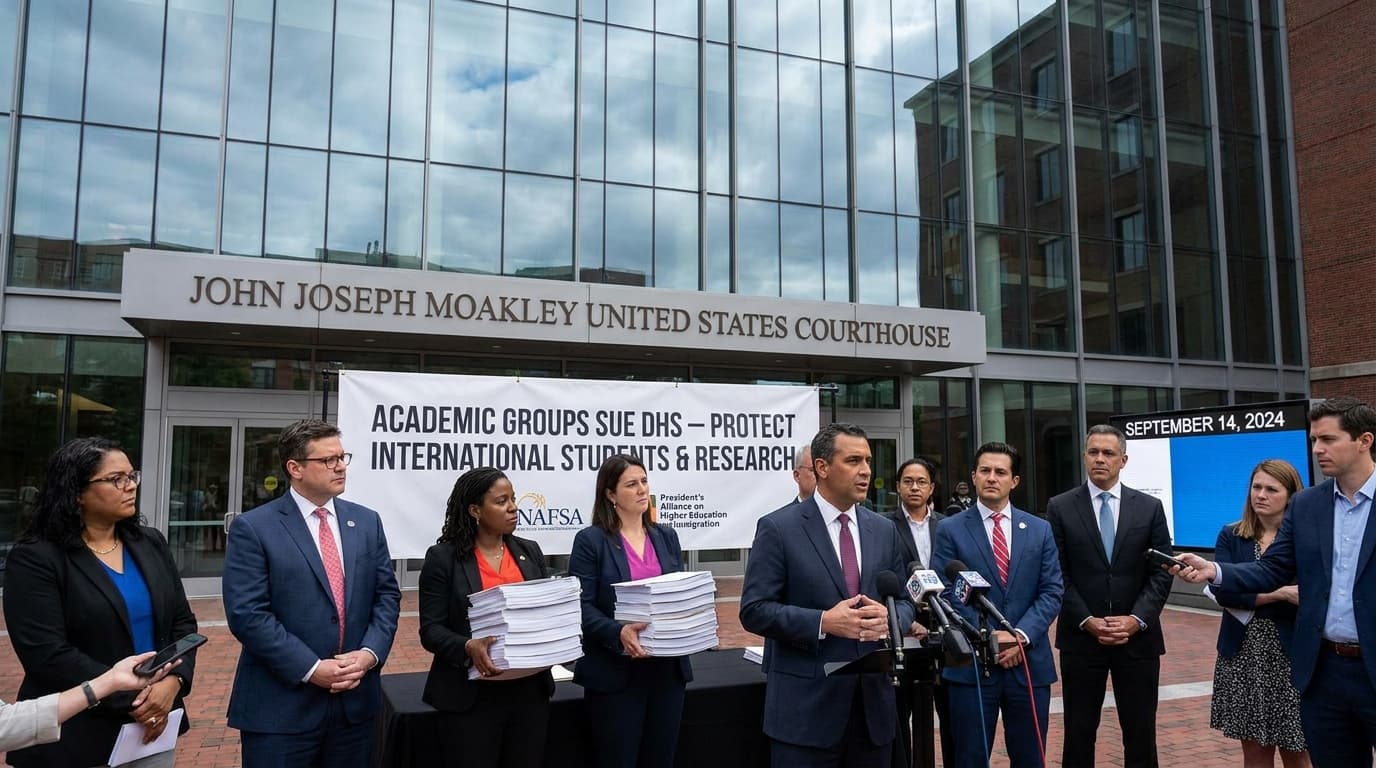
Academic Groups Sue Over Four-Year Visa Limit For Foreign Students, As DHS Targets Duration Of Status

A lawsuit filed in the U.S. District Court in Massachusetts challenges the Trump administration’s plan to replace duration of status with a fixed visa period for many international students and postdoctoral researchers. The case turns on whether DHS lawfully justified a rule change that plaintiffs say could affect more than two million nonimmigrants annually and weaken the U.S. research base.
Groups representing academic institutions and educators sued the Department of Homeland Security on Tuesday over an imminent policy change that would limit how long foreign students and scholars can remain in the United States. The lawsuit, filed in the U.S. District Court in Massachusetts, asks a judge either to rule the policy unlawful immediately or to issue a preliminary injunction blocking it while the case proceeds.
At issue is the Trump administration’s move to end “duration of status,” a policy first implemented in 1979 that has allowed foreign students and scholars to stay in the U.S. as long as they are making progress toward completing their training. In mid-July, DHS announced that, effective Sept. 15, future international students and postdoctoral researchers will be allowed to stay for no more than four years on nonimmigrant visas unless they apply for and receive an extension.
The plaintiffs include NAFSA: Association of International Educators, the President’s Alliance on Higher Education and Immigration, and the Association of Independent Colleges and Universities in Massachusetts. DHS; Markwayne Mullin, secretary of the department; U.S. Immigrations and Customs Enforcement; and David Venturella, acting director of ICE, are named as defendants.
The policy dispute
The suit argues that DHS violated the Administrative Procedure Act in how it developed and finalized the new time limit. The plaintiffs say the department did not allow enough time for public comment, failed to adequately respond to the comments it received, and did not offer a rational response to the visa fraud concerns it cited.
Under the new framework, people already in the U.S. will not need an extension if their training is set to end before September 2030, even if they have already been in the country for more than four years. The dispute therefore centers on a forward-looking redesign of student and scholar immigration status rather than a blanket immediate rollback for everyone currently in training.
DHS has argued that duration of status enables fraud by creating “forever students” who stay enrolled in courses to avoid leaving the country. In response to the lawsuit, a department spokesperson criticized both the suit and coverage of the policy, saying President Trump was “cracking down on the rampant fraud to ensure only those truly intending to study in the United States are given the privilege.”
The plaintiffs’ core rebuttal is that DHS has not identified a concrete, systemic problem large enough to justify replacing a decades-old structure. Their complaint says the department failed to show that students who remain in the country for long periods are doing anything improper, noting that a bachelor’s degree followed by a doctorate can easily take more than 10 years.
The research and economic stakes
The case matters beyond immigration administration because life science research relies heavily on international trainees. Experts cited in the source warned that the visa limits could have a sizable effect on research because internationals accounted for nearly a quarter of the field’s Ph.D. graduates and 59% of postdocs in 2023.
Plaintiffs also argue the policy would reduce international enrollment and damage the nation’s economy and scientific preeminence. Their filing says the change would affect more than two million nonimmigrants annually and likely cost the economy tens of billions of dollars each year.
A NAFSA poll of students and postdocs found last year that nearly half would not have come to the U.S. under a fixed period of admission. That does not establish what enrollment losses would actually occur, but it does point to a strategic risk for universities and research institutions: a visa rule framed as anti-fraud could function as a talent filter in laboratories that depend on multi-year training paths.
The legal argument
The lawsuit also says DHS ignored less burdensome options. According to the plaintiffs, the department could have tightened oversight through the Student and Exchange Visitor Information System, which has been used for more than two decades to monitor foreign students, or adopted a tiered approach focused on people with a history of noncompliance.
Process is a major part of the case. A draft version of the policy posted last year drew nearly 22,000 comments, and the plaintiffs say the 32-day comment period was inadequate. They also allege that when commenters asked DHS to better quantify costs and benefits, including universities’ administrative expenses, the department responded that such analysis would be difficult and was not required.
That combination makes the suit more than a dispute over one immigration rule. It is also a test of how far the Trump administration can go in reshaping research labor flows through administrative action when the stated fraud rationale is contested and the operational burden would fall on universities, labs, and the trainees they recruit.
Join the BioIntel newsletter
Get curated biotech intelligence across AI, industry, innovation, investment, medtech, and policy delivered to your inbox.