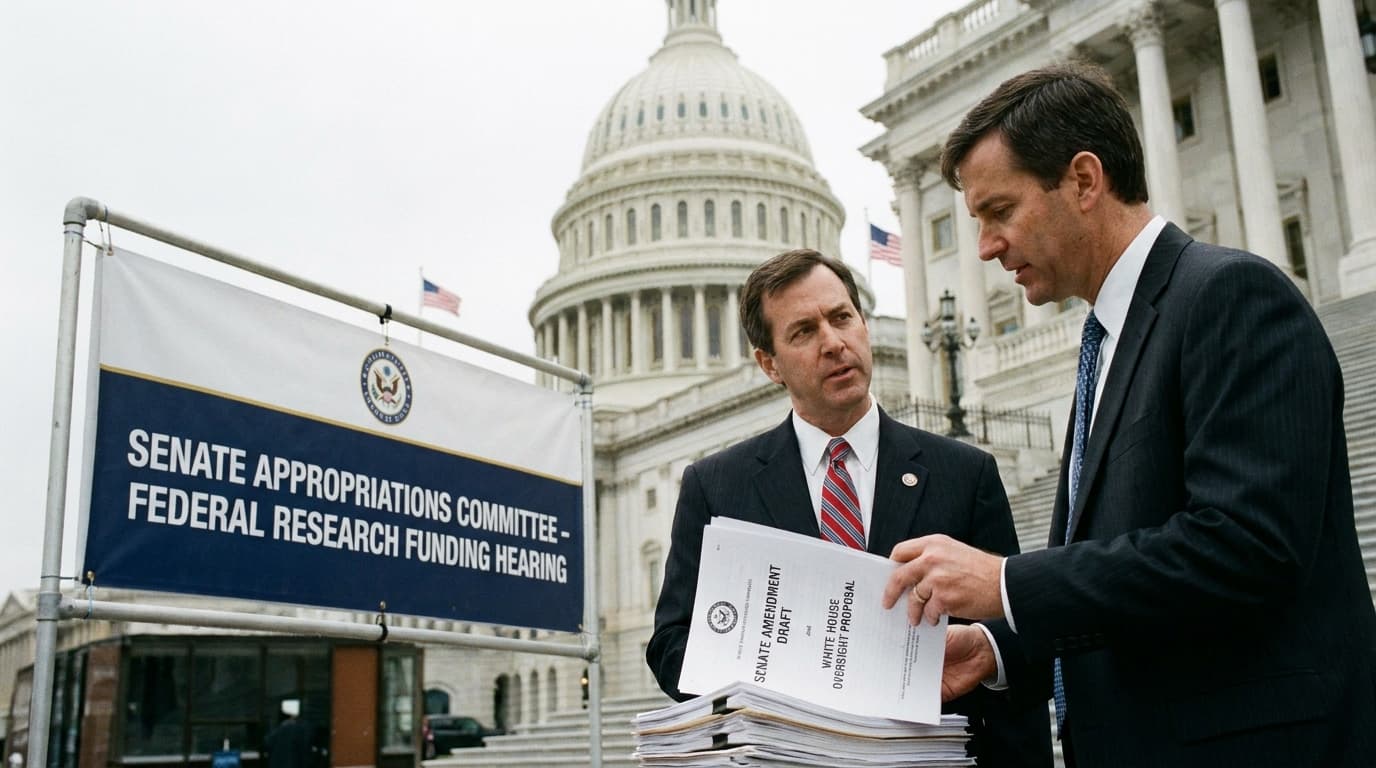
Senate Moves to Block White House Control Over Federal Research Grants

The proposed Senate action aims to serve as a safeguard against the politicization of federal research grant allocation—a move that has spurred debate across the scientific community. As federal research funding often underpins innovation in biotech, medicine, and the broader sciences, this policy battle offers a window into the ongoing tension between government oversight and scientific autonomy.
Senate Measure Temporarily Blocks White House Control Over Research Grants: Implications and Stakeholder Responses
Introduction
On August 2, 2026, news broke that the United States Senate has advanced a measure designed to block, at least for now, the White House’s proposal to subject federal research grants to increased political scrutiny. This development represents a significant turning point in the ongoing national debate concerning the independence of scientific research and the role of political oversight in the funding process. As the federal government is one of the main financiers of biomedical innovation, particularly in biotechnology, public health, and the life sciences, shifts in grant evaluation standards rarely go unnoticed.
This article explores the key aspects of the Senate’s move, the rationale behind the White House’s proposal, the implications for research organizations, and the reactions from stakeholders spanning academia, government, and industry. We also analyze the broader consequences for technology development, public trust, and international competitiveness that hinge on how such funds are awarded and managed.
The White House Proposal: Politicizing Research Grants?
The White House’s recent proposal sought to alter the longstanding process by which research grants are awarded by federal agencies like the NIH, NSF, and others. Traditionally, peer review panels comprised of scientific experts evaluate grant applications based on their scientific merit, public health impact, and feasibility. Under the new proposal, additional layers of political or executive branch review would be introduced, potentially allowing non-experts or political appointees to influence which projects receive funding.
This shift was justified by proponents as a way to ensure taxpayer dollars align more closely with national priorities, improve accountability, and root out perceived inefficiencies or ideological biases within the scientific establishment. Critics countered that such politicization risks undermining the fundamental objectivity and credibility—the very basis—of U.S. scientific leadership, making research more vulnerable to changing political winds.
The Senate’s Response: A Temporary Roadblock
In a move welcomed by much of the scientific and academic community, the Senate signaled bipartisan concern over the proposal. Lawmakers advanced an amendment that would temporarily block the implementation of the White House’s new oversight mechanism. This effectively preserves the status quo for now, ensuring that peer-reviewed science—not political expediency—remains at the heart of federal research funding decisions.
Although the amendment serves as a stopgap, its introduction underscores the tension within the federal apparatus. The legislative branch, charged with oversight of executive action, stepped in to, at least temporarily, preserve scientific meritocracy in grantmaking. The underlying debate, however, is far from resolved, as both sides continue to marshal arguments about transparency, accountability, and the proper locus of control.
Reactions from the Research Community
Universities and Academic Institutions
Universities and research institutes, heavily reliant on federal funding, responded swiftly and vocally. Many leaders issued statements warning that increased political oversight could deter talented researchers, chill academic freedom, and cast doubt on the nation’s commitment to scientific rigor. Concerns centered on the possibility that politically unpopular research topics—ranging from climate science to infectious disease—might be sidelined.
Industry and Private Sector Stakeholders
Industry leaders in biotech and pharmaceuticals, which often leverage publicly funded basic research as a pipeline for innovation, expressed alarm about unpredictability in funding streams. The fear is that layers of political review could slow grant decisions and introduce bias, disrupting partnerships and potentially undermining R&D investments that depend on foundational government-supported research.
Patient Advocacy and Public Health Organizations
Patient advocates and public health groups emphasized that the integrity of the scientific process—particularly in health and medicine—should transcend politics. They cited the COVID-19 pandemic as a stark lesson in the dangers of sidelining scientific expertise in policymaking and resource allocation.
The Stakes: Scientific Independence and Global Leadership
The United States has long been a global leader in science and technology. This position is, to a large extent, built upon a research funding model that prioritizes peer review and impartial assessment over political ideology. While there are legitimate debates about accountability and national priorities, many believe that explicit political oversight at the grant allocation stage could erode trust—not only domestically, but internationally.
Potential Impacts
-
Innovation Pipeline: A perception of politicization could hamper the ability of U.S. universities and companies to attract scientific talent from around the world.
-
International Collaboration: If federal funding becomes less predictable or more ideologically driven, the U.S. could lose key collaborators and cede ground to more scientifically focused peers like the European Union, China, and others.
-
Public Trust: At a time when misinformation and “science skepticism” are on the rise, the public’s faith in federally funded research hinges on the perception that decisions are made on the merits, not on political allegiance.
Policy Considerations Going Forward
Mechanisms for Accountability
There is broad agreement that accountability in public spending is important, but the mechanisms to achieve this are the subject of debate. Some suggest that increased transparency in the peer review process, stricter conflict-of-interest rules, and enhanced public reporting can address many concerns without crossing the line into overt political control.
Safeguarding Scientific Merit
Others call for standing committees or independent commissions, perhaps reporting to Congress, to monitor the grantmaking system and ensure it evolves with changing scientific and national priorities but remains insulated from day-to-day political pressures.
The Current Outlook
While the Senate’s measure is a temporary solution, it sends a strong message to the executive branch regarding congressional intent and the limits of political intervention in science. As the legislative and executive branches continue their negotiations, the scientific community is watching closely for signals about the future landscape of research funding in America.
Conclusion
The Senate’s move to slow or halt the White House’s plan to exert increased political scrutiny over federal research grants represents not only a key moment in U.S. science policy, but also part of a larger debate about governance, innovation, and trust in the scientific enterprise. The stakes are high, with outcomes that have the potential to shape the nation’s role as an innovation leader for years to come.
As this story evolves, BioIntel will continue to monitor developments and provide updates as new information emerges.
Source: STAT News
Join the BioIntel newsletter
Get curated biotech intelligence across AI, industry, innovation, investment, medtech, and policy delivered to your inbox.