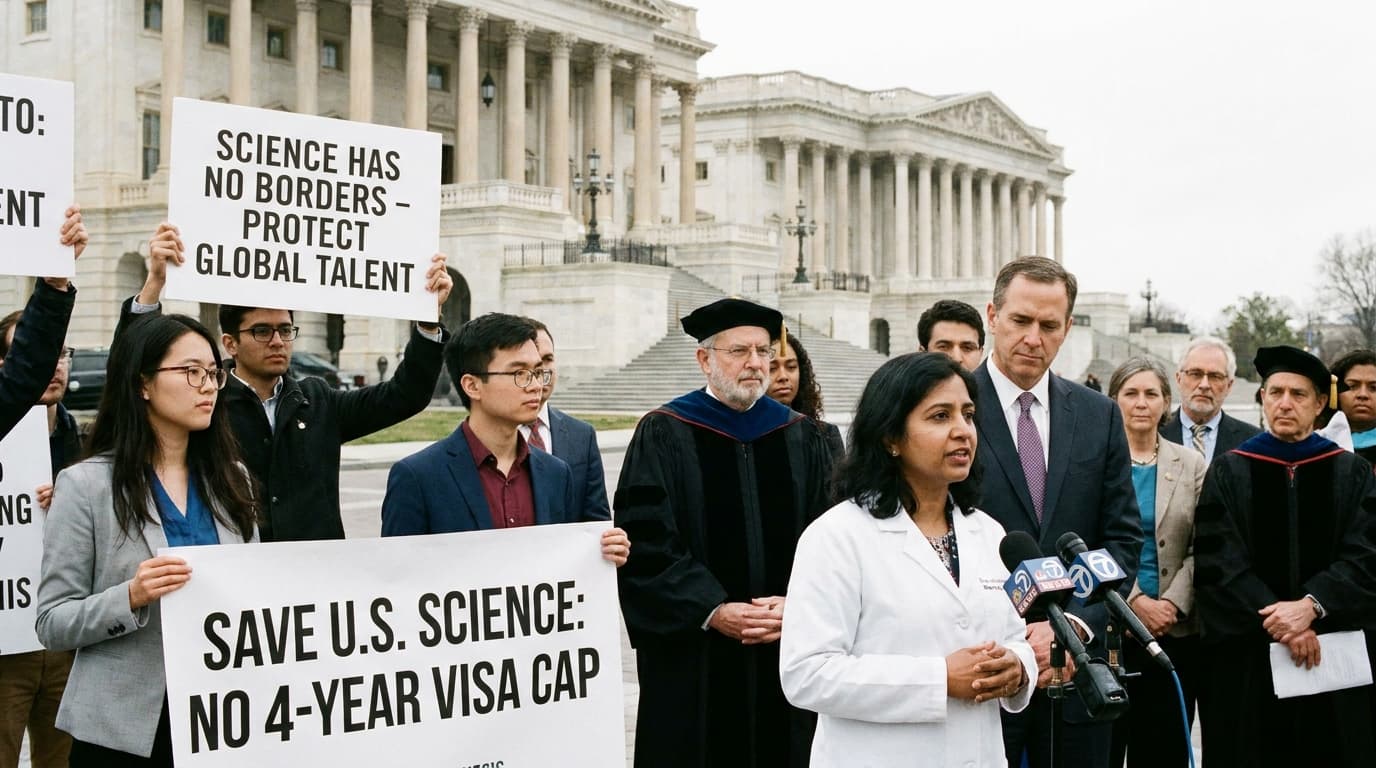
Visa Time Limits on Foreign Ph.D. Students and Postdocs: Implications for U.S. Science

Proposed new limits on the duration of visas for international graduate students and postdoctoral researchers are raising alarm bells for the future of U.S. science. Policy experts caution that these restrictions could have lasting repercussions on American competitiveness and innovation.
Introduction
In recent years, the global scientific landscape has increasingly become a complex arena influenced not only by breakthroughs and discoveries, but also by the influence of immigration regulation and national policies. The United States, long considered one of the foremost destinations for aspiring scientists and researchers worldwide, faces new policy challenges that threaten to upend its competitive advantage. At the center of the current debate is a Trump administration proposal to cap the visa duration for foreign-born Ph.D. students and postdocs at four years—a significant departure from the current system.
Visa and immigration policies have always played a pivotal role in shaping the U.S.'s scientific ecosystem. For decades, American research universities and laboratories have attracted talent from across the globe, inviting bright minds with the opportunity to contribute to, and benefit from, the vibrant U.S. research environment. Historically, these international contributions have powered innovation, fueled economic growth, and sustained the country's leadership position in science and technology.
Yet, the proposed policy change raises pressing questions: What are the potential consequences of capping the visa duration for international graduate students and postdocs? How do these changes intersect with broader goals for scientific innovation, economic competitiveness, and international collaboration? And perhaps most crucially, what do leading experts and stakeholders foresee as the real-world impact on American science?
The Proposed Policy Change: An Overview
The Trump administration's recent plan seeks to limit visas for international graduate students and postdoctoral researchers to just four years. This new restriction marks a distinct shift from the previous allowance, where qualified students and researchers could often extend their permissible stay to accommodate the lengthy timelines of scientific training and research.
The stated rationale for the time limit is to streamline immigration policy and implement more rigorous oversight of visa holders. However, as with many regulatory and policy changes, the downstream effects on science and higher education are both profound and multifaceted.
Concerns from the Scientific Community
The reaction among scientists, university administrators, and policy advocates has been swift and vocal. There is widespread concern that a four-year cap could interrupt research training and derail projects that depend on long-term data collection and continuity. Many doctoral programs, especially in STEM disciplines, often require five or more years to complete. Add to this the time spent in postdoctoral fellowships—an additional two to five years of intensive research experience—and it is clear that the majority of high-level trainees would run afoul of the proposed limit.
Impact on Research Continuity
Scientific research, especially in biomedical, life sciences, and engineering fields, is a long-term investment—one that seldom conforms to the calendar constraints typical of undergraduate education. Interrupting this continuum not only undermines the education and career progression of international scientists but also disrupts critical research projects that depend on their contribution. Leading experts in academic administration warn that truncated stays could mean the loss of skills, institutional memory, and, ultimately, completed research progress.
The Talent Pipeline: A Global Competition
The proposed policy runs directly counter to patterns seen in U.S. science achievement and leadership since World War II. Foreign-born scientists have provided a significant proportion of the workforce for major scientific advances, Nobel Prize-winning research, and startup innovation in the United States. According to National Science Foundation data, nearly half of all doctoral degrees in engineering, math, and computer science in recent years have been awarded to international students in the U.S.
This statistic underscores a reality that is increasingly apparent to global observers: scientific talent is highly mobile, and countries compete aggressively to attract and retain the brightest minds. America’s ongoing success in biotechnology, artificial intelligence, medicine, and other critical sectors has been deeply intertwined with the ability to welcome and integrate international scholars.
Introducing obstacles to this pipeline could prompt talented scientists to look elsewhere. Universities in Canada, the UK, Australia, and many European Union countries are actively courting the same applicants. With attractive scholarship programs and more favorable immigration paths, such countries stand to gain from policy uncertainty and restriction in the U.S.
Industry Implications
It is not only the academic sector that would feel the impact of these visa changes. The U.S. biotech and pharmaceutical industry, a powerhouse of economic growth and global influence, relies heavily on a workforce filled with former international students. Tightening the visa landscape threatens to reduce the pool of qualified candidates for high-skill research jobs and diminish the innovative potential of American companies.
Large-scale research initiatives, from clinical trial design to advanced manufacturing, require continuity, specialized knowledge, and the kind of creative cross-pollination that international teams provide. If U.S. research becomes less accessible or more transient for talented foreign trainees, industry development could slow, directly affecting drug pipelines, tech innovation, and economic output.
International Collaboration and U.S. Influence
Science, by its nature, is a global enterprise. Collaborative networks that cross borders enable faster progress, sharing of breakthroughs, and rapid dissemination of best practices. If U.S. policy fosters a climate seen as inhospitable to foreign scholars, the risk is not merely a reduction in student enrollment or temporary workforce shortages; it could also lead to a decrease in the country’s soft power and leadership within international scientific organizations.
Researchers who train in the United States often maintain strong ongoing collaborations with American institutions even after returning to their home countries. These professional relationships can become the foundation for future exchanges, commercial partnerships, and diplomatic engagement on issues ranging from pandemic response to climate change. Impeding the flow of people into and through U.S. institutions, therefore, could have consequences that reach far beyond individual labs or research groups.
Issues of Equity and Access
Another dimension to consider is the impact of such a policy on access and equity in science. Many of the world’s most promising students come from countries with fewer domestic research resources or from backgrounds underrepresented in U.S. science. For these trainees, an opportunity to study or work in the U.S. offers not only personal advancement but also the potential to transform global research norms by diversifying the perspectives and experiences found in American science.
Limiting their ability to fully participate in extended research programs could exacerbate the already significant challenges to diversifying STEM fields, both in the United States and globally.
Institutional Responses
American universities and research institutes are now faced with the challenge of responding to a policy environment in flux. Many are exploring advocacy efforts aimed at lawmakers and agencies, providing clearer data about graduate timelines, and clarifying the importance of postdoctoral research. Legal and compliance offices are also preparing for new visa renewal management challenges that could arise if the cap is implemented.
Additionally, institutions are considering new investments in recruitment, program redesign, and partnerships to minimize disruption. However, most agree that such changes entail significant cost, administrative effort, and uncertainty for both trainees and their mentors.
Real-world Impact: Voices from the Lab
The debate is not merely theoretical. Researchers across disciplines have come forward to share stories of international colleagues vital to their teams. Postdocs who design experiments, mentor students, or lead data analysis are lynchpins in the day-to-day operations of many labs. Graduate students often become experts in the technical specifics of a project, creating value that cannot easily be replaced in a rotating, short-term workforce.
It is reasonable to infer that if international trainees begin to perceive the U.S. as an unstable or unpredictable place to invest years of study and effort, some will likely choose to pursue their ambitions elsewhere.
The Road Ahead: Policy and Scientific Leadership
How should the U.S. balance legitimate security interests and the need to maintain a robust, high-performing scientific community? Policy experts suggest that targeted enhancements to vetting and oversight are possible without resorting to blanket time limits that disrupt productive research careers. The scientific community, meanwhile, continues to urge policymakers to consider the full spectrum of consequences and to engage transparently with stakeholders.
The coming months are likely to see continued debate, additional data gathering, and legislative or regulatory responses. As with past shifts in U.S. science policy, the world is watching closely. The central question remains: will American science remain a beacon for global talent, or will restrictive policies push the next generation of innovators to seek new horizons?
Conclusion
In sum, the proposed four-year visa cap for foreign Ph.D. students and postdoctoral researchers marks a turning point in U.S. science policy. The outcome of the policy debate will help determine whether the United States continues to welcome—and benefit from—the best global scientific talent, or cedes that position to competitors eager to claim a leadership role in tomorrow’s discoveries.
Source: STAT News
Join the BioIntel newsletter
Get curated biotech intelligence across AI, industry, innovation, investment, medtech, and policy delivered to your inbox.