ARPA-H Commits Up To $125M For GIVE RNA Manufacturing Network, Backing Distributed Personalized Production

The program is aimed at replacing a centralized manufacturing model with faster, more accessible production for personalized RNA therapies. Early work will focus on cancer, rare genetic conditions and chronic diseases, with several biotech and academic teams assigned distinct manufacturing and quality-control roles.
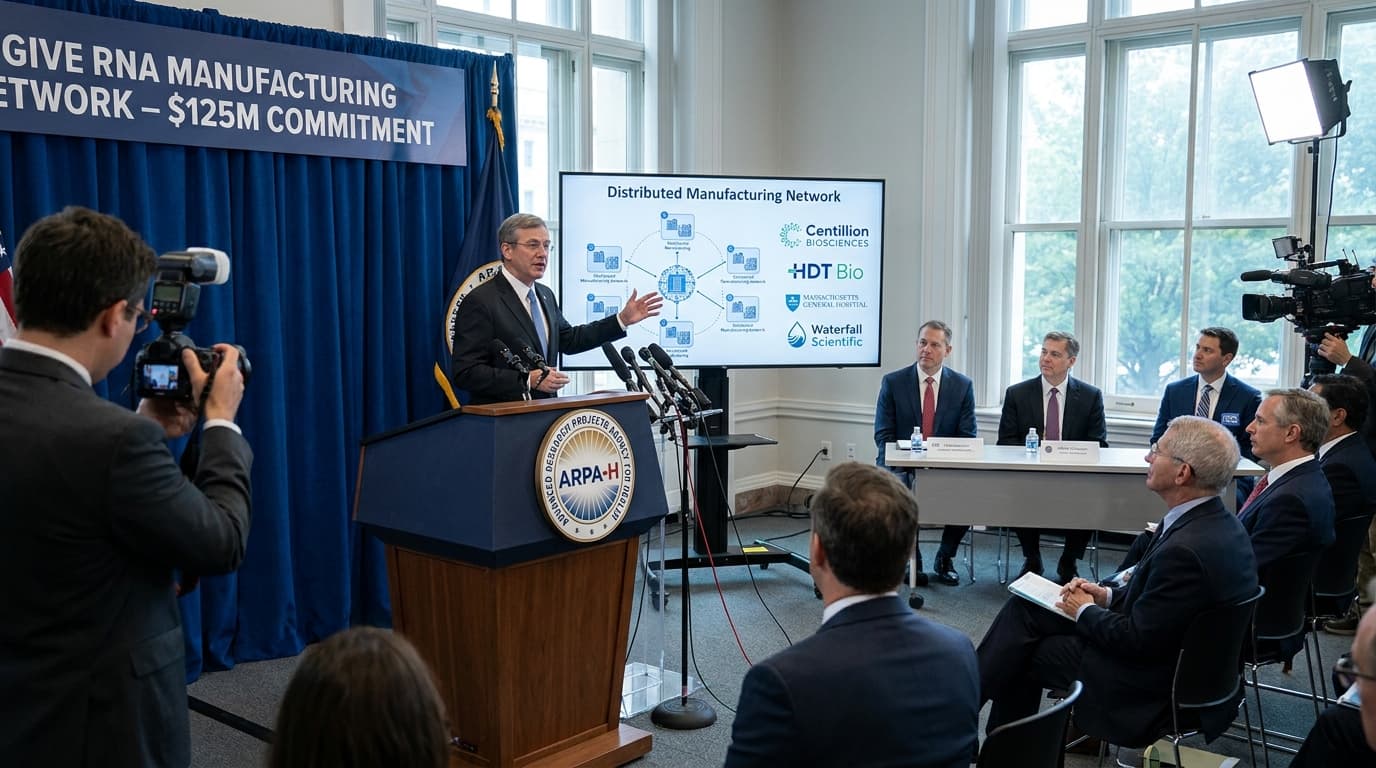
ARPA-H said it will commit up to $125 million in R&D funding to teams working on faster, more locally accessible manufacturing for RNA-based genetic medicines. In a Wednesday release, the agency described the initiative as a “new manufacturing paradigm” designed to build an automated network for individualized RNA therapies and replace what it called a slow, costly, centralized model.
The program, called Genetic Medicines and Individualized Manufacturing for Everyone, or GIVE, is intended to expand access to personalized medicines such as CRISPR gene editing therapies beyond major treatment centers while improving cost and timelines. Early efforts will focus on cancer, rare genetic conditions and chronic diseases.
How the program is structured
ARPA-H said GIVE will engage the U.S. Food and Drug Administration throughout the program to co-develop the regulatory framework needed to bring distributed, individualized genetic medicine manufacturing to scale. That makes the effort more than a grant announcement: it is also a test of whether regulators and developers can make decentralized production workable for therapies that are usually constrained by manufacturing complexity.
The agency did not specify how much funding each participating organization will receive. It did, however, assign roles across a development network. Centillion Biosciences, known for its “RNA manufacturing in a box” platform, will handle fill and finish, quality-control testing and digital process management. HDT Bio will contribute DNA synthesis and chip-based RNA production. Massachusetts General Hospital will provide continuous manufacturing and quality-control testing. Waterfall Scientific will supply automation for RNA production. A team from the University of Utah is separately developing a platform to test medications in as little as one day.
Why this matters
The strategic signal is that ARPA-H is tying manufacturing innovation directly to domestic capacity and regulatory design rather than treating production as a downstream problem. John Schiel, the GIVE program manager, said individualized domestic biomanufacturing would give the United States an advantage and help ensure access regardless of where patients live.
That push comes after federal cuts last year of approximately $500 million aimed at mRNA vaccines, which affected areas including infectious disease and cancer, according to reports cited by BioSpace. ARPA-H has also recently awarded a $4.4 million pilot to a Harvard Medical School and MIT team that includes RNAV8 Bio for programmable RNA research, suggesting the agency is still selectively building RNA infrastructure even after broader federal pullbacks.
Join the BioIntel newsletter
Get curated biotech intelligence across AI, industry, innovation, investment, medtech, and policy delivered to your inbox.