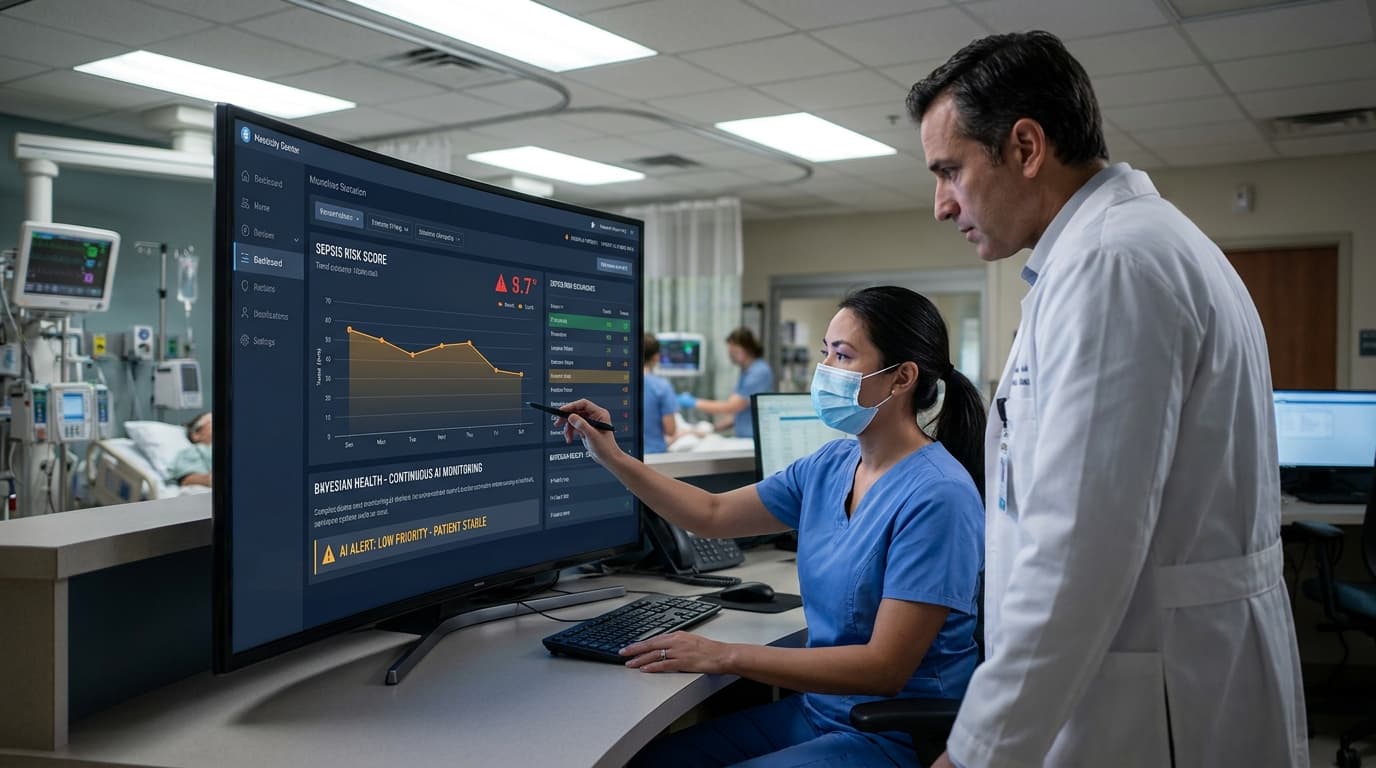
Bayesian Health’s Continuous AI-Powered Sepsis Monitoring: Reducing Alerts and Saving Lives

Bayesian Health has become a pioneer in the application of continuous AI-powered systems for sepsis monitoring. Following rigorous clinical validation and real-world deployment, the company’s system addresses the challenges of alarm overload while enhancing early detection and intervention in sepsis care.
Sepsis remains a critical condition that challenges healthcare providers worldwide, often requiring timely and accurate detection to improve patient survival rates. In a significant advancement, Bayesian Health became the first company to achieve FDA clearance for a continuous artificial intelligence (AI) powered sepsis monitoring system. This milestone signals a new era where AI can augment clinical decision-making and reduce the burden of alert fatigue, a common problem in hospital environments.
The clearance of Bayesian Health’s sepsis AI tool is the culmination of years of dedicated clinical validation studies spanning diverse health systems. The continuous monitoring framework leverages sophisticated algorithms designed to detect early physiological signs of sepsis, alerting medical staff only when necessary and thus lowering the incidence of false alarms.
Alert fatigue in clinical settings has been identified as a major contributor to delayed or missed responses, potentially worsening patient outcomes. By reducing uninformative alerts, Bayesian Health’s AI tool optimizes clinician attention towards patients at genuine risk, thus preserving critical time and resources. This approach demonstrates the practical utility of machine learning in healthcare, where balancing sensitivity and specificity is crucial.
Clinical validation studies illustrate that the deployment of Bayesian Health’s system not only decreases unnecessary alerts but also positively impacts hospital metrics related to sepsis management. Adoption across multiple health systems has provided a broad range of data supporting its scalability and robustness in real-world environments.
The successful FDA clearance represents a rigorous endorsement of safety and efficacy, meeting stringent regulatory requirements for medical devices that influence clinical care. This approval not only establishes Bayesian Health as a leader in AI-based sepsis management but also sets a precedent encouraging further innovation in AI integration within hospital workflows.
Looking forward, continuous monitoring AI tools like Bayesian Health’s system could redefine standards for sepsis detection, patient monitoring, and alarm management. Integration with electronic health records and interoperability with existing hospital infrastructure will be vital to harness full potential and facilitate broader adoption.
The underlying technology taps into vast clinical datasets, using probabilistic models to predict sepsis progression, enabling preventive interventions rather than reactive treatments. This shift represents a transformative move towards precision medicine, where AI augments human expertise to improve outcomes.
Furthermore, the success of such AI tools may encourage regulatory bodies worldwide to update frameworks for evaluating continuous monitoring systems, paving the way for innovations that were previously constrained by regulatory uncertainty.
In summary, Bayesian Health’s FDA-cleared continuous AI-powered sepsis monitoring system exemplifies crucial progress at the intersection of AI, clinical care, and regulatory science. Its real-world deployment across multiple health systems has demonstrated enhanced patient safety through better alert management and early detection, heralding a promising step towards AI-enabled healthcare delivery.
For the latest details and further developments, visit the original article: How Bayesian Health’s Sepsis AI Tool Is Decreasing Alerts & Saving Lives.
This article is based entirely on publicly available information from MedCity News and does not include speculative or unauthenticated data.
Join the BioIntel newsletter
Get curated biotech intelligence across AI, industry, innovation, investment, medtech, and policy delivered to your inbox.