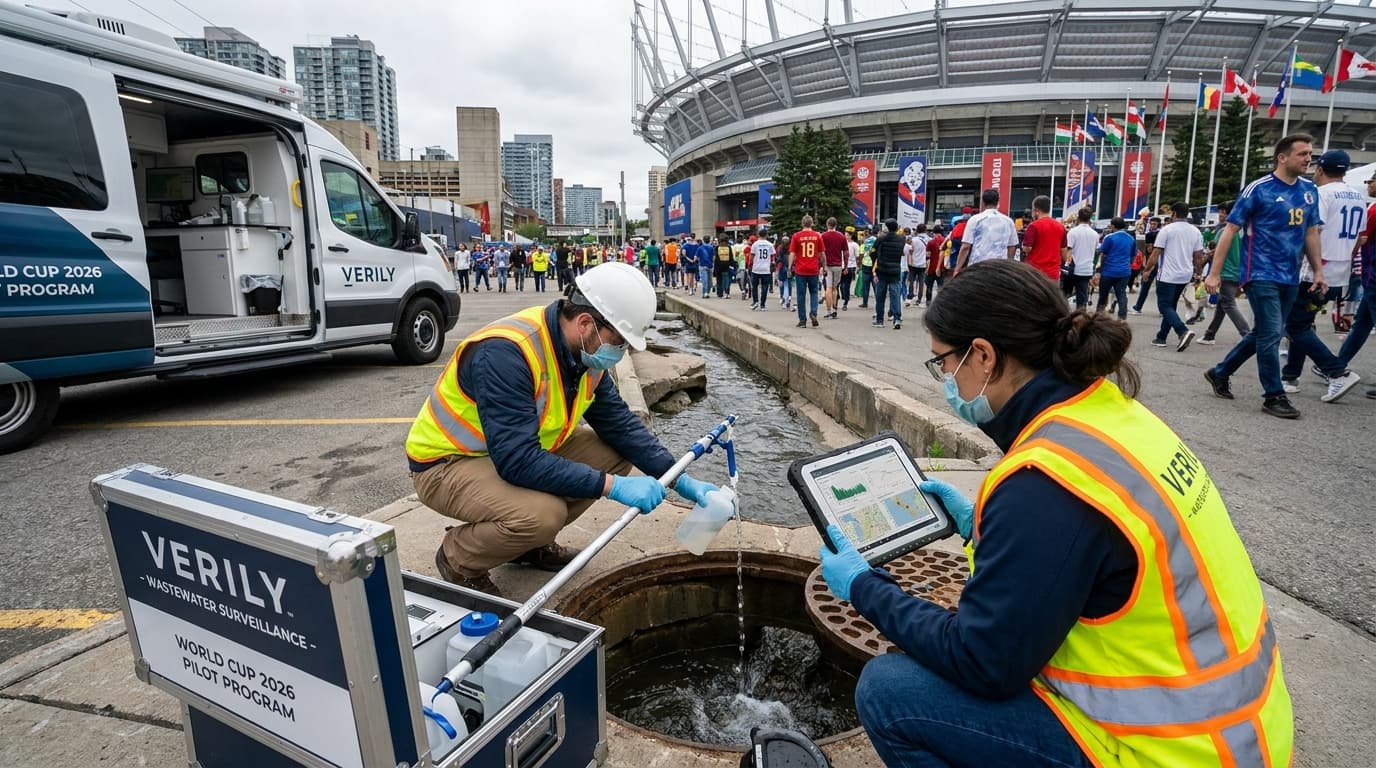
What’s Flowing Beneath the World Cup: How Verily’s Wastewater Monitoring Could Catch the Next Outbreak

As global attention focuses on the World Cup, Verily is piloting a novel approach to public health surveillance: testing wastewater in host cities for traces of key pathogens. This initiative, targeting viruses and bacteria like RSV, measles, and norovirus, could enable public health officials to identify outbreaks days before they manifest in clinics and hospitals.
Introduction
The convergence of massive international crowds, vibrant festivities, and intense competition makes the World Cup not just a sporting spectacle, but also a unique public health challenge. In 2026, as millions of spectators descend upon World Cup host cities, attention is turning beyond the stadium to the complex systems underlying urban health security. Among the most innovative approaches being deployed is wastewater monitoring — a field in which Alphabet-incubated Verily finds itself playing a pivotal role.
The Concept of Wastewater Surveillance in Public Health
Wastewater surveillance is not a new concept, but its application has grown increasingly sophisticated in recent years thanks to leaps in molecular detection and genomic sequencing. The principle is simple: as residents and visitors use toilets and sinks, pathogens they carry are flushed into municipal wastewater systems. By periodically sampling these systems, scientists can capture snapshots of community health, detecting the presence and levels of various pathogens — often before those illnesses lead to clinical outbreaks large enough to trigger alarm bells in hospitals or local clinics.
While wastewater surveillance became a household term during the COVID-19 pandemic — when it proved invaluable for tracking the virus’s ebb and flow at the community level — it is now being expanded to cover a wide array of infectious agents. Among those drawing attention at the World Cup are respiratory syncytial virus (RSV), measles, norovirus, and several other pathogens capable of spreading quickly in crowded environments.
Verily’s World Cup Initiative
According to reports, Verily is actively testing wastewater across the host cities of the 2026 World Cup for pathogens of public health concern. Their aim is to provide public health authorities with a predictive window ranging from five to seven days ahead of what would traditionally be possible through clinical case reporting. The initiative is highly strategic: in high-density urban areas experiencing sudden influxes of international visitors, early warning could prove critical for outbreak containment, resource allocation, and communication campaigns.
Verily’s approach leverages advanced genetic sequencing and quantitative PCR (polymerase chain reaction) technology to detect the molecular signatures of disease-causing agents at exceedingly low concentrations. When a spike is noticed — perhaps a sudden uptick in norovirus gene fragments, or unexpected RSV signals in the city’s effluent — epidemiologists and local authorities can take proactive steps to investigate, inform, and if necessary, intervene.
Potential Pathogens and Their Public Health Significance
RSV (Respiratory Syncytial Virus)
RSV affects all age groups but is most dangerous in young children and the elderly. Outbreaks can overwhelm pediatric and adult hospital wards with respiratory distress cases. RSV can be especially concerning in large events because attendees may travel while pre-symptomatic.
Measles
Measles is highly contagious, and even a single undetected case in a high-density setting can rapidly spread, particularly in populations with lower vaccination rates. Early detection may help identify transmission clusters before cases multiply.
Norovirus
Often associated with gastrointestinal illness and commonly dubbed the “stomach flu,” norovirus thrives in crowded conditions, leading to vomiting and diarrhea. Quick detection can prompt sweeps of sanitation improvements or food safety audits.
Wastewater Monitoring Versus Traditional Clinical Surveillance
Traditional public health surveillance relies on patients seeking care at clinics or hospitals, where diagnoses are made and reported to government authorities. However, this system has inherent delays — some due to incubation periods, others due to the lag between onset of symptoms and presentation for care. Wastewater monitoring offers a complementary approach, effectively “crowdsourcing” disease surveillance by scanning broad populations regardless of whether individuals feel sick or decide to seek medical attention.
Proponents argue that this technique leads to more agile, community-wide detection of outbreaks. By identifying telltale molecular signals in wastewater, health officials have a head start in investigating potential outbreaks and can focus interventions before disease spreads widely.
Analyzing the Implications for Global Events
Major sporting events like the World Cup are logistical marvels. They bring together diverse populations, including those from regions with different immunities and disease prevalence patterns. This makes such gatherings fertile ground for novel outbreaks. Rapid, pre-clinical detection methods thus become more than just scientific curiosities — they are vital public health assets.
Verily’s efforts are poised to not only safeguard World Cup host cities, but also to inform similar initiatives at other mass-gathering events, such as the Olympics or large religious festivals. The data generated may help refine public health protocols for event organizers and contribute to international best practices.
Technical and Logistical Challenges
While wastewater monitoring offers promise, it presents practical hurdles. Establishing baseline levels for different pathogens is an ongoing challenge, especially in cities where sewage systems may not reflect homogeneous populations. Moreover, translating genetic signals in water samples into actionable risk assessments requires substantial analytical manpower, robust laboratory infrastructure, and close coordination with municipal agencies.
International events introduce additional variables. Not all host cities will have equivalent laboratory capacities, and cross-border sharing of surveillance data may be hampered by legal or logistical issues. Countries with differing privacy laws may also have divergent interpretations of what constitutes actionable information in the context of infectious disease surveillance.
Privacy, Ethics, and Social Acceptance
Although wastewater monitoring studies aggregate results to avoid identifying individual health statuses, the expansion of such surveillance has prompted renewed discussion about public trust. Some observers express concern over data use and privacy risks, especially when surveillance extends beyond pandemics to routine public health monitoring. Transparent communication, clear governance frameworks, and robust anonymization practices are essential for continued social acceptance.
Future Directions: From Pilot Programs to Permanent Infrastructure
If Verily’s World Cup experiment delivers timely, actionable insights, it could accelerate the adoption of wastewater monitoring as a mainstream tool for public health protection. Broader networks may spring up, integrating data from airports, schools, and high-traffic commercial zones. The integration of these data streams with more traditional epidemiological tracking could yield a layered, responsive surveillance apparatus for cities worldwide.
The value extends beyond disease: environmental pollutants, antimicrobial resistance genes, and markers of substance abuse can all be tracked using similar methods. Ultimately, wastewater systems could serve as barometers for the collective health status and behavioral shifts of entire metropolitan regions.
The Global Stage for Health Security
As the World Cup captures the imagination of fans around the globe, Verily’s surveillance initiative underscores a fundamental truth: in a world where infectious diseases know no borders, proactive, real-time methods for public health intelligence are indispensable. Wastewater monitoring may one day become as routine as crowd control or food safety checks at major events — essential layers in the intricate mosaic of urban resilience.
Conclusion
The pilot program underway during the 2026 World Cup marks a significant milestone for public health technology. While the world watches the drama unfold on the soccer pitch, scientists and public health experts are watching the microbial currents running underfoot, looking for the earliest warnings of trouble on the horizon. If their efforts succeed, cities everywhere may soon find themselves following in their footsteps, making invisible threats visible — and, crucially, manageable before they become full-blown crises.
Source: MedCity News
Join the BioIntel newsletter
Get curated biotech intelligence across AI, industry, innovation, investment, medtech, and policy delivered to your inbox.