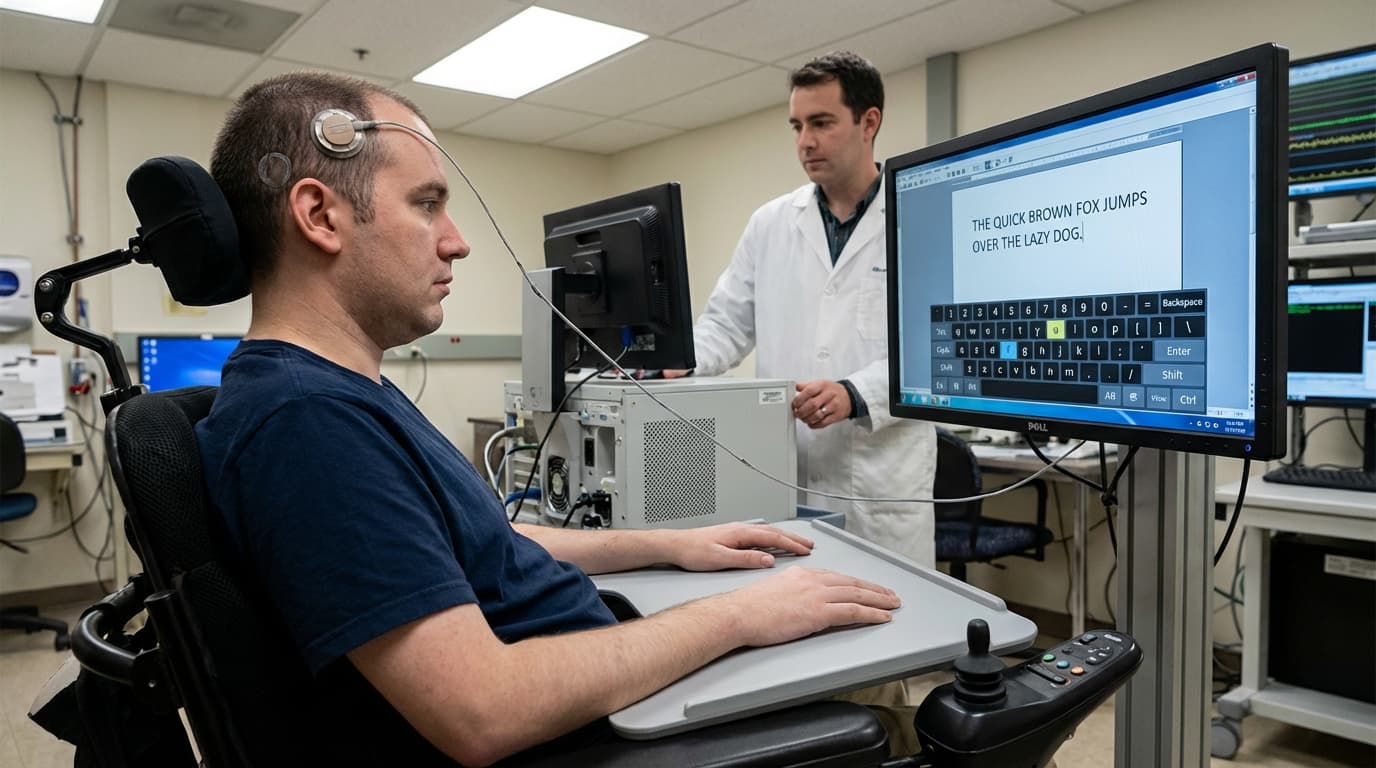
Brain-Computer Interface Breakthrough Empowers People with Paralysis to Type Using Their Minds

Recent research has enabled two people with paralysis to communicate by typing with their minds. This breakthrough utilizes advanced brain-computer interface (BCI) technology that decodes neural signals associated with attempted finger movement, marking a significant advance in assistive medical technology. The implications of this progress extend to quality of life improvements and future neural prosthetics development.
Introduction
The challenge of restoring communication capabilities for individuals living with paralysis has driven scientific innovation for decades. Traditional assistive technologies have relied on residual muscle control or eye tracking, but these methods often come with limitations in speed and ease of use. Recent progress in brain-computer interfaces offers a new way forward, utilizing neural signals directly from the brain to control external devices.
Background on Brain-Computer Interfaces
Brain-computer interfaces (BCIs) are systems that translate brain signals into commands that control computers or machines. BCIs can be invasive, involving implanted electrodes in neural tissue, or non-invasive, using external sensors. The invasive approaches generally provide higher fidelity neural data, which is critical for fine motor control applications such as typing.
The New Study: Decoding Attempted Finger Movement
The latest study, published March 16, 2026, demonstrates a novel BCI that decodes the neural activity associated with attempted finger movements rather than actual movement. This distinction is crucial for individuals with paralysis who cannot physically move their limbs but can still attempt to do so in their minds.
Two participants with paralysis used this interface to successfully type by simply attempting to move their fingers. The system interprets these neural attempts and translates them in real time into text, enabling communication without physical input.
How the Interface Works
The implanted electrodes record neural signals from the motor cortex, the brain area responsible for voluntary movement. Advanced decoding algorithms process these signals to predict intended finger presses on a virtual keyboard. The system's accuracy and responsiveness were tested thoroughly, showing promising performance metrics.
Potential Impact
This advancement has transformative potential for people with paralysis, including those with spinal cord injuries and neurodegenerative diseases such as ALS. The ability to type through thought alone can restore autonomy and facilitate social interaction, education, and employment opportunities.
Moreover, this technology contributes to the evolving field of neuroprosthetics and may soon support more complex motor functions such as controlling robotic limbs or smart home devices.
Challenges and Future Directions
Despite the promise, several challenges remain. The requirement for surgical implantation limits the immediate accessibility for many patients. Long-term stability of the implanted devices and the decoding algorithms' adaptability to neural changes over time are active research areas.
Future efforts may focus on refining non-invasive BCIs to approach similar accuracy, improving implant biocompatibility, and broadening the vocabulary and communication speed of these systems.
Conclusion
The demonstration that people with paralysis can type using a brain-computer interface decoding attempted finger movements is a major step forward in assistive technology. This work showcases how neuroscience and engineering can combine to significantly improve quality of life and pave the way for future innovations in brain-machine communication.
Join the BioIntel newsletter
Get curated biotech intelligence across AI, industry, innovation, investment, medtech, and policy delivered to your inbox.