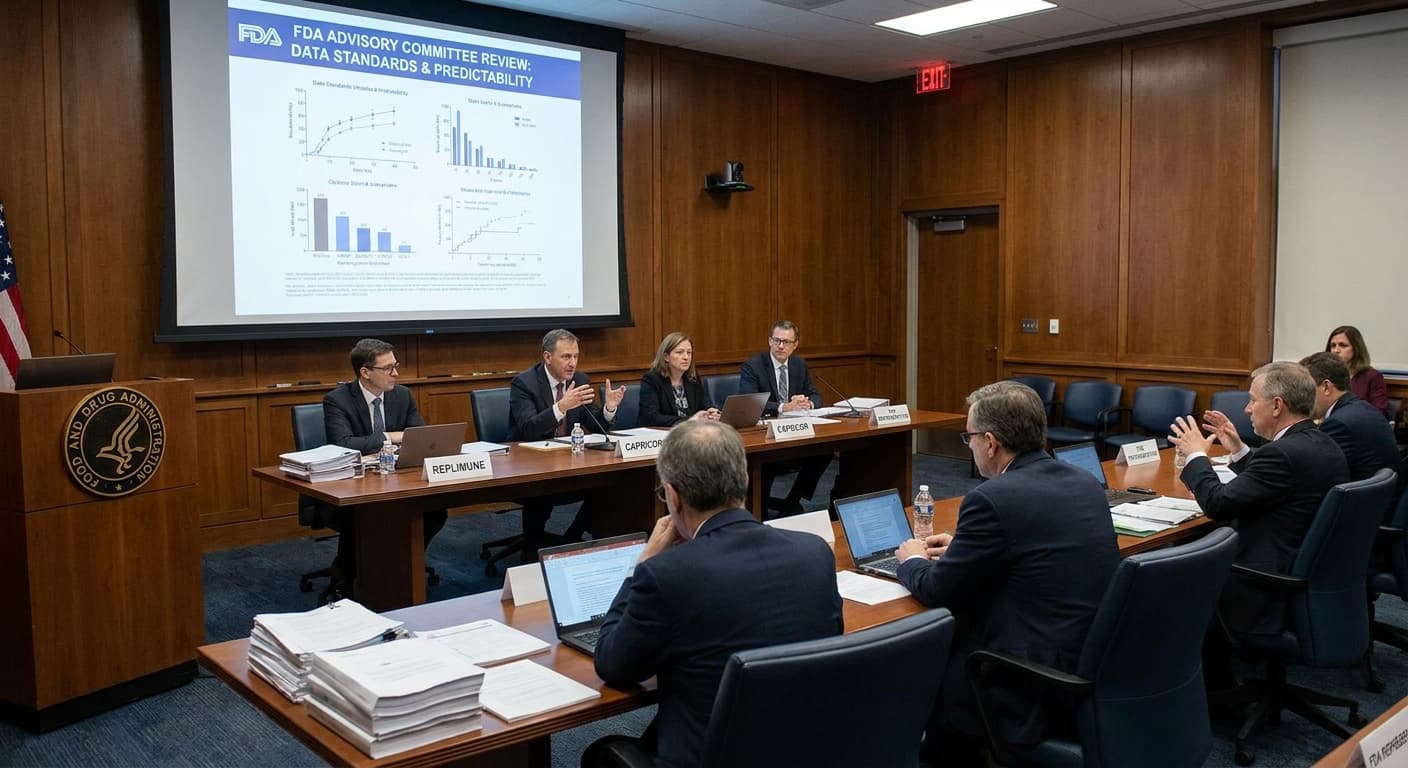
Capricor And Replimune Reviews Signal A More Predictable FDA, As Data Standards Stay Intact

BioSpace reported that experts see the FDA’s handling of Replimune’s advanced melanoma therapy and Capricor’s Duchenne muscular dystrophy filing as evidence that the agency is moving past the Makary-Prasad period. That does not amount to broad leniency: companies preparing submissions still face the same need to narrow interpretive gaps and align early with the agency.
The FDA’s recent handling of Replimune and Capricor is being read by some investors as an early test of whether the agency has become more permissive under new leadership. The clearer takeaway from the two cases is narrower: experts told BioSpace that the agency appears to be restoring reliability and transparency, while still making decisions that are tightly tied to the underlying data.
That distinction matters for companies such as uniQure, REGENXBIO and Disc Medicine, which BioSpace said had either been spurned previously or are preparing to submit or resubmit applications. If the latest reviews are a signal, it is that regulatory friction may become more predictable, not that evidentiary standards have softened.
The Recent Reviews
Mizuho Securities analyst Uy Ear told BioSpace that investors had been watching the back-to-back advisory committee meetings for Capricor and Replimune to see whether the FDA would become meaningfully more permissive. Instead, he said, the outcomes suggest that regulatory decisions remain highly data-driven.
For Replimune, that meant an accelerated approval earlier this month for its advanced melanoma therapy Tudriqev, previously known as RP1, after a difficult history. The drug had been rejected twice, most recently in April. When it returned for review, the path was still contentious. Ahead of a late-July meeting of the FDA’s Cellular, Tissue, and Gene Therapies Advisory Committee, the agency said in briefing documents that Replimune’s submission was “not interpretable.” BioSpace reported that independent experts largely agreed with that critique, with one panelist calling the data “messy,” but the committee nevertheless voted 10–3 in support of approval.
Capricor’s case pointed in the opposite near-term direction but reinforced the same principle. Late last month, the same advisory committee voted 9–3 against approval of deramiocel for Duchenne muscular dystrophy. Some experts described the company’s pivotal dataset as “very fragile.” BioSpace reported that the meeting was marked by disagreement between the FDA and Capricor over which statistical analysis plan should govern the review and even which endpoint should be central.
What The Shift Means For Companies
Donald Fink, a former FDA employee who worked at the Center for Biologics Evaluation and Research, told BioSpace that companies should adhere “to the extent reasonable” to the guidance and recommendations set by the FDA during development. Ear’s advice was similar but more tactical: minimize areas open to interpretation, align with the FDA early and proactively address potential questions well in advance of review or an advisory committee.
That reads as a direct response to the recent past. Under former FDA Commissioner Marty Makary, the agency, according to analysts at Capital Alpha cited by BioSpace, endured “the most damaging period in FDA history.” BioSpace pointed to massive staff cuts and a string of disputed decisions, including a July 2025 rejection for Capricor, the refusal to review Moderna’s mRNA flu vaccine earlier this year and other apparent reversals of guidance. Makary left in May, two weeks after Vinay Prasad, the former Center for Biologics Evaluation and Research chief tied to many of the agency’s most controversial calls.
Fink told BioSpace the FDA appears to be quickly putting that period in the rear-view mirror. In strategic terms, that matters because a more consistent regulator can lower one kind of development risk even when it does not lower the evidentiary bar.
The Next Test Cases
Capricor is still trying to salvage its filing. On August 13, during the company’s second quarter earnings call, CEO Linda Marbán said the FDA was receptive to adding open-label extension data to the current submission, a step that would require extending deramiocel’s Aug. 22 PDUFA date.
UniQure may provide another read on the new FDA posture. The company plans to submit in the third quarter for its Huntington’s disease gene therapy AMT-130, which BioSpace said had previously been criticized by both Makary and Prasad. Chief Medical Officer Walid Abi-Saab said on the company’s second quarter earnings call last month, “We welcome it,” referring to the prospect of an expert panel. CEO Matt Kapusta described recent interactions with the FDA as “constructive and productive.”
UniQure’s confidence rests on Phase 1/2 data released in September last year that BioSpace said showed AMT-130 significantly slowed disease progression after three years. But the source also described a pattern of shifting agency feedback: a couple of months later the FDA said those data were not enough for an accelerated approval filing despite earlier agreement on the development plan, and in June the agency again changed course, saying data from the Phase 1/2 study would be sufficient to support an application.
For biotech companies, the current message is more procedural than permissive. A regulator seen as more reliable can improve planning, but each application still appears set to rise or fall on how cleanly the data package matches the agency’s expectations.
Join the BioIntel newsletter
Get curated biotech intelligence across AI, industry, innovation, investment, medtech, and policy delivered to your inbox.