Capricor Signals FDA Review Extension Path For Deramiocel, After 68% Share Jump

Capricor’s latest comments suggest the regulatory process for deramiocel may be shifting from a binary Aug. 22 decision to a longer negotiation over indication and evidence. That matters because the company has effectively tied its broader pipeline, expansion studies and commercial pacing to whatever the FDA decides next.
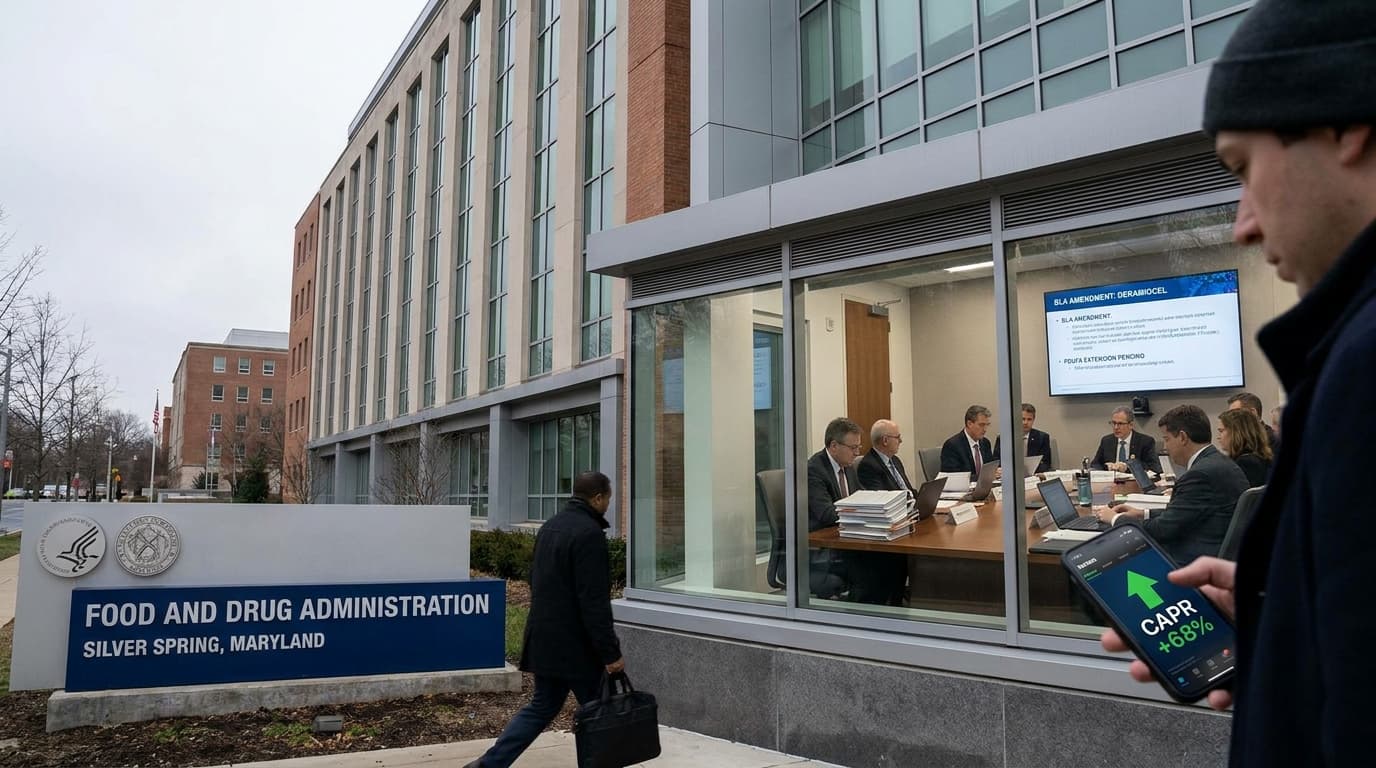
Capricor Therapeutics said it plans to submit an amendment to its biologics license application for deramiocel, adding 24-month open-label extension data from the HOPE-3 study and further analyses of the existing package to support what CEO Linda Marbán described as a refined indication focused on the primary endpoint. On Capricor’s second-quarter earnings call, Marbán said the FDA had indicated it is willing to review the amendment and, upon receipt, extend the PDUFA action date accordingly.
That comment changed the immediate tenor around a Duchenne muscular dystrophy program that looked headed toward an Aug. 22 decision after a bruising advisory committee meeting last month. Capricor’s shares rose 68% to $6.95 on Friday morning after the company framed a possible path that could keep deramiocel under active review rather than force a near-term yes-or-no outcome on the current record.
The regulatory dispute
Deramiocel is under review after a July 2025 rejection and subsequent resubmission. Marbán said there is a limit to what she can say because the review is ongoing, but she also said Capricor is continuing to work closely with the FDA on a potential path forward.
The central disagreement is not only whether the data support approval, but which patient group and endpoint should anchor any label. At the July 29 advisory committee meeting, a key point of contention was the indication tied to Duchenne muscular dystrophy patients with cardiomyopathy. In HOPE-3, which enrolled 106 boys and men with Duchenne muscular dystrophy, the primary endpoint measured upper-limb performance using an aggregate disease-specific tool covering 22 functional activities across the shoulder, elbow and wrist. Cardiac function was a secondary endpoint.
Capricor has said the trial met both endpoints with statistical significance. The FDA took the opposite position in briefing documents released before the meeting, saying deramiocel did not meet HOPE-3’s prespecified primary and secondary efficacy endpoints and showed no statistically significant difference versus placebo at 12 months. Capricor has argued that the agency relied on a draft statistical analysis plan rather than what the company intended to be the final version.
That split matters because the latest amendment appears designed to narrow the review toward the evidence Capricor believes is strongest instead of continuing to fight on the cardiomyopathy framing that dominated the advisory committee. Marbán said the FDA and the panel were too focused on cardiomyopathy given that it was a secondary endpoint, and because the left ventricular ejection fraction analysis was assessed across the full Duchenne muscular dystrophy population rather than in patients with established cardiomyopathy, which she said is the population addressed by the proposed indication.
The data and the stakes
The advisory committee ultimately voted 9-3 against approval based on deramiocel’s efficacy in Duchenne muscular dystrophy cardiomyopathy, and FDA advisers called the secondary-endpoint data “very fragile.” Capricor’s challenge has become more complicated because the full dataset under the prespecified model has now been published in The Lancet, with the measure of left ventricular ejection fraction in all patients no longer statistically significant.
Even so, Marbán said the HOPE-3 primary endpoint was unaffected and that its significance stands both statistically and clinically. The company’s amendment strategy suggests it sees a route through the review by emphasizing that distinction and supplementing the package with longer-term open-label extension results.
For investors, the signal is less that approval is back on firm footing than that the FDA may still be open to a negotiated evidentiary path. That is materially different from a clean rejection, especially for a company with no revenue stream and few near-term alternatives.
The company response
Capricor said it is putting all other pipeline work on hold until it gets further regulatory clarity. That includes StealthX, an exosome-based vaccine that was in a Phase 1 trial for COVID-19 funded and run by the U.S. Department of Health and Human Services and concluded in June. Capricor has said the platform could have broader applications, including rare diseases, and in May described StealthX as advancing therapeutic programs focused on muscle-targeted delivery of siRNA, proteins and small molecules.
The biotech also lists another Duchenne muscular dystrophy candidate based on cardiosphere-derived cell exosomes in preclinical development. Expansion trials for deramiocel in younger patients and Becker muscular dystrophy also depend on the ongoing review. In parallel, Capricor said it has started regulatory discussions in Europe and Japan and has operational manufacturing in the U.S. to support potential commercialization, although it is advancing commercial readiness at a slower pace pending regulatory clarity.
As of June 30, Capricor had $237.9 million in cash and reported a second-quarter net loss of $40.7 million, or 70 cents per share, versus a loss of $25.9 million in the same period last year. The company said its cash runway should last for at least the next twelve months. That gives Capricor time for an extended review, but the concentration risk is now explicit: the next FDA move will shape not just deramiocel’s label, but the cadence of nearly everything else at the company.
Join the BioIntel newsletter
Get curated biotech intelligence across AI, industry, innovation, investment, medtech, and policy delivered to your inbox.