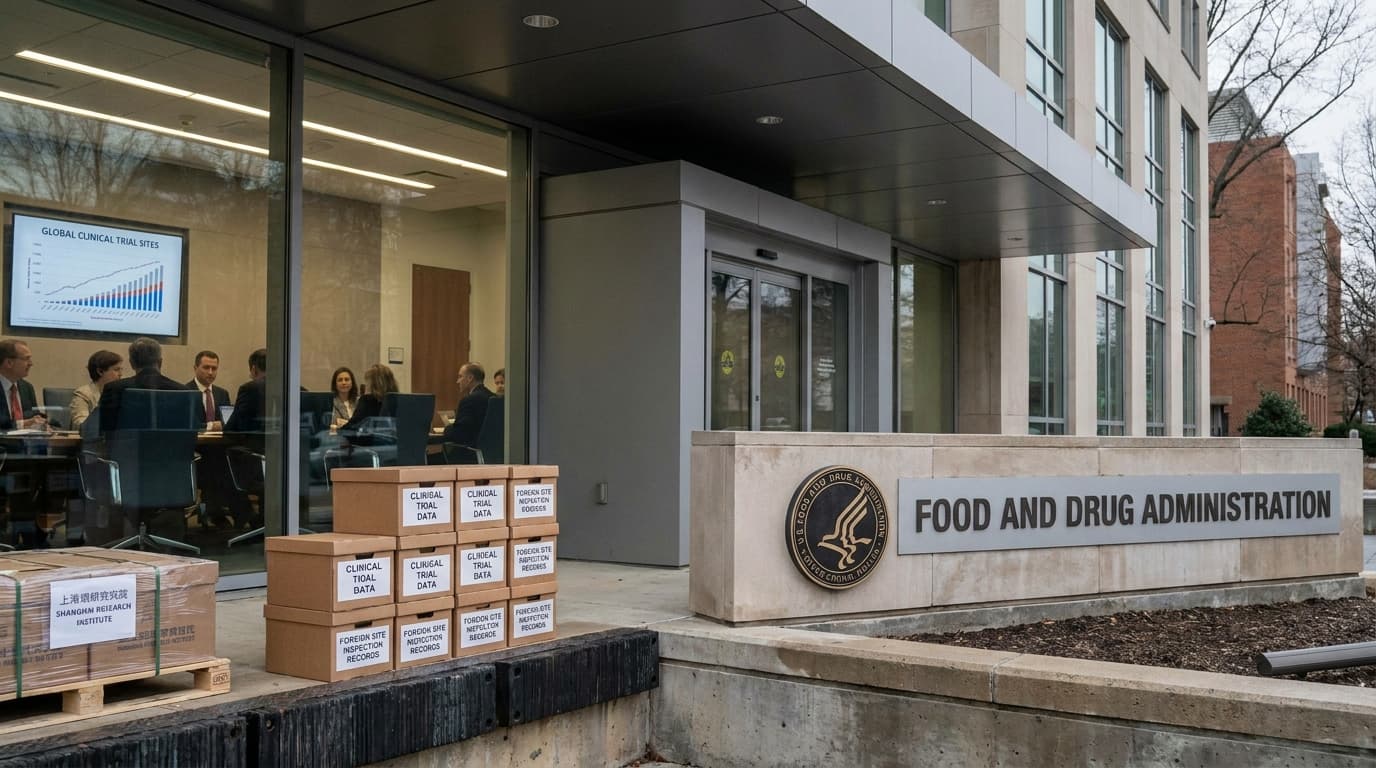
FDA Raises Foreign Trial Scrutiny, Tightening Standards As China Research Expands

Four FDA officials used an FDA Voices editorial to signal stricter oversight of foreign trial sites, including more resources for inspections, added reviewer training and earlier discussions with sponsors about foreign data provenance. The policy message is broader than any one country, but it arrives amid rising concern about data integrity and human subject protections as trial activity in China has expanded.
The FDA is preparing to apply tighter scrutiny to clinical data generated outside the U.S., laying out a more formal oversight approach as foreign trial activity grows and political pressure around China-based research intensifies.
In an FDA Voices editorial published Wednesday, four agency officials said the FDA will add resources to expand oversight at foreign clinical trial sites, improve communication with drug sponsors and strengthen internal reviewer training to help identify sites of possible concern. They also said the agency plans to make more information from inspections publicly available, as appropriate, when it identifies concerns related to human subject protection or data integrity.
The timing matters because lawmakers have already pushed the agency to reject clinical data from China unless the trial site has recently undergone an FDA audit, after three deaths were reported in separate gene therapy trials conducted in China. According to an April report from the National Bureau of Economic Research cited by BioSpace, fewer than 8% of global clinical trials were run in China in 2010, but by 2020 the country had overtaken the U.S. in annual registered trials.
The Policy Shift
The editorial was written by Michael Davis, acting director of the Center for Drug Evaluation and Research; Karim Mikhail, acting director of the Center for Biologics Evaluation and Research; Michelle Tarver, director of the Center for Devices and Radiological Health; and R. Angelo de Claro, director of the Oncology Center of Excellence.
The authors said the agency’s approach is not aimed at excluding foreign research. “This is not protectionism, and it is not a geopolitical statement about any particular country’s scientific capacity,” they wrote, adding that many foreign research institutions produce clinical data of the highest quality and that the FDA actively welcomes and relies on such data.
Still, the editorial makes clear that inspectability and data access are becoming central regulatory variables. The officials wrote that sponsors should treat the inability to inspect or access all relevant data as a material factor in their regulatory strategy, not an administrative footnote. That raises the operational bar for companies building development plans around overseas sites that may be harder for the FDA to examine directly.
Where The Agency Sees Risk
A particular concern, according to the editorial, is early feasibility and Phase 1 studies conducted at sites in countries or regions where geopolitical conditions make informed consent difficult to ensure, or where documented human rights concerns create a heightened risk that consent was not freely and voluntarily given. In a pre-publication interview, a senior FDA representative also pointed to cases in which American biospecimens are sent to China and asked whether participants are informed about that transfer.
The same representative said the FDA has definitely increased the number of BIMO inspectors both at its China office and throughout some other global offices. The agency is also considering remote assessments and information collection requests as additional oversight tools.
The FDA said it will engage sponsors earlier, including at the pre-submission stage, to discuss the provenance and investigational new drug or investigational device exemption status of foreign clinical data. That could help surface data integrity and human subject protection issues before an application reaches formal review.
Strategic Implications
The editorial arrives while the Trump administration is also trying to reshore parts of drug development and manufacturing. BioSpace reported that a senior FDA representative described the first step as modernizing and improving the U.S. system, work that the Department of Health and Human Services has begun through Operation TrialBlazer, announced in June to reduce the time from drug identification to Phase 1 trials and expedite early clinical development timelines by as much as a year.
Taken together, the message to sponsors is that foreign development may face less tolerance for weak documentation, limited access or ambiguous consent protections. For companies relying on overseas trial networks, that shifts foreign-site selection from a cost and speed decision into a more explicit regulatory risk calculation.
Join the BioIntel newsletter
Get curated biotech intelligence across AI, industry, innovation, investment, medtech, and policy delivered to your inbox.