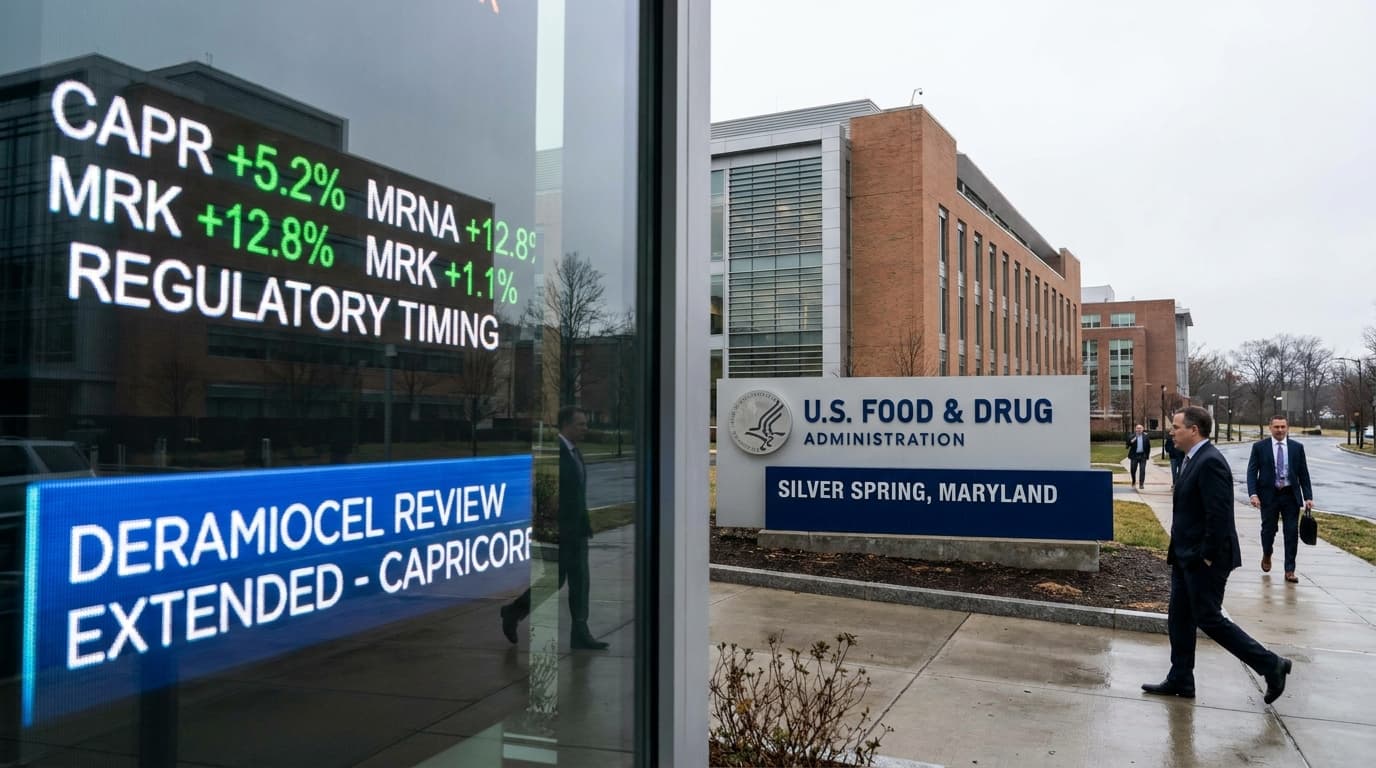
FDA Review Extension Keeps Capricor’s Deramiocel Filing Alive, As Moderna And Merck Add Phase 3 Vaccine Momentum

The article spans several companies, but the common thread is policy and review risk shaping biotech valuations and strategy. Capricor’s extension, Moderna’s stock move after cancer vaccine data, and the naming of a commissioner nominee each show how quickly sentiment can shift when the FDA timetable or leadership picture changes.
A BioSpace roundup this week tied together three developments that matter for biotech strategy even though they involve different companies: Capricor Therapeutics’ Duchenne muscular dystrophy cell therapy remains under active FDA review after a three-month extension, Moderna and Merck posted an ahead-of-schedule Phase 3 readout for a personalized mRNA melanoma vaccine, and President Donald Trump named Heidi Overton as his nominee for permanent FDA commissioner.
The items are unrelated scientifically, but they point in the same commercial direction. Regulatory timing is still moving stocks, pipeline focus is tightening around binary events, and leadership stability at the FDA remains a market variable rather than background noise.
The Regulatory Signal
Capricor has been trying to move deramiocel across the finish line since last year, when the company received its first rejection, according to the BioSpace summary. After resubmitting its application, the FDA accepted the filing and set a PDUFA date for this past weekend. That date passed before the agency issued a three-month extension.
The extra time follows what BioSpace described as a contentious advisory committee meeting that could have implications for the broader industry. The article did not add new FDA reasoning beyond the fact of the extension, but the practical result is clear: deramiocel is still alive, and Capricor is still operating inside an active review rather than facing a definitive no.
Capricor has also paused all other pipeline projects to focus on deramiocel, a concentration of resources that shows how smaller biotechs often narrow their strategy around a single regulatory outcome. BioSpace noted that at least one shareholder is unhappy with that decision, highlighting the internal pressure that builds when a company’s timetable compresses around one asset.
The Market Response Elsewhere
The same roundup pointed to a very different catalyst in Moderna’s Merck-partnered personalized mRNA-based cancer vaccine program. Moderna released what BioSpace called promising Phase 3 results in melanoma for the vaccine in combination with Keytruda, and the readout arrived ahead of schedule.
The market reaction was immediate: Moderna’s stock nearly doubled the morning of the announcement, according to BioSpace. Merck also stands to benefit if the program continues to produce favorable data as the company looks ahead to the loss of Keytruda exclusivity.
That contrast with Capricor is instructive. In one case, a company is managing review uncertainty after a missed deadline; in the other, a company captured value from an earlier-than-expected late-stage efficacy event. The operating lesson is that timing itself remains a material part of biotech value creation, not just the underlying data.
The Leadership Context
BioSpace also reported that Trump’s nominee for the FDA’s top job is Heidi Overton, currently deputy director of the White House Domestic Policy Council. The article said Overton has a medical degree from the University of New Mexico, completed a surgical residency in general surgery at Johns Hopkins, and has a PhD in clinical investigation from Hopkins’ Bloomberg School of Public Health.
Analysts cited by BioSpace said she could be good for psychedelics and new pain medicines but bad for vaccines. Those views are expectations rather than decisions, and Overton still faces the confirmation process. Even so, the nomination begins to give companies a clearer picture of the policy environment they may be selling into.
The roundup’s broader signal is that the FDA story has shifted from vacancy risk toward rule-of-the-road risk. For developers, that means attention can start moving from who is in charge to what kinds of products may find a more or less receptive path under permanent leadership. For investors, the message is simpler: a review extension, a strong trial readout, or a credible commissioner nominee can each move the market quickly, but they do so for different reasons and should not be read as the same kind of derisking.
Join the BioIntel newsletter
Get curated biotech intelligence across AI, industry, innovation, investment, medtech, and policy delivered to your inbox.