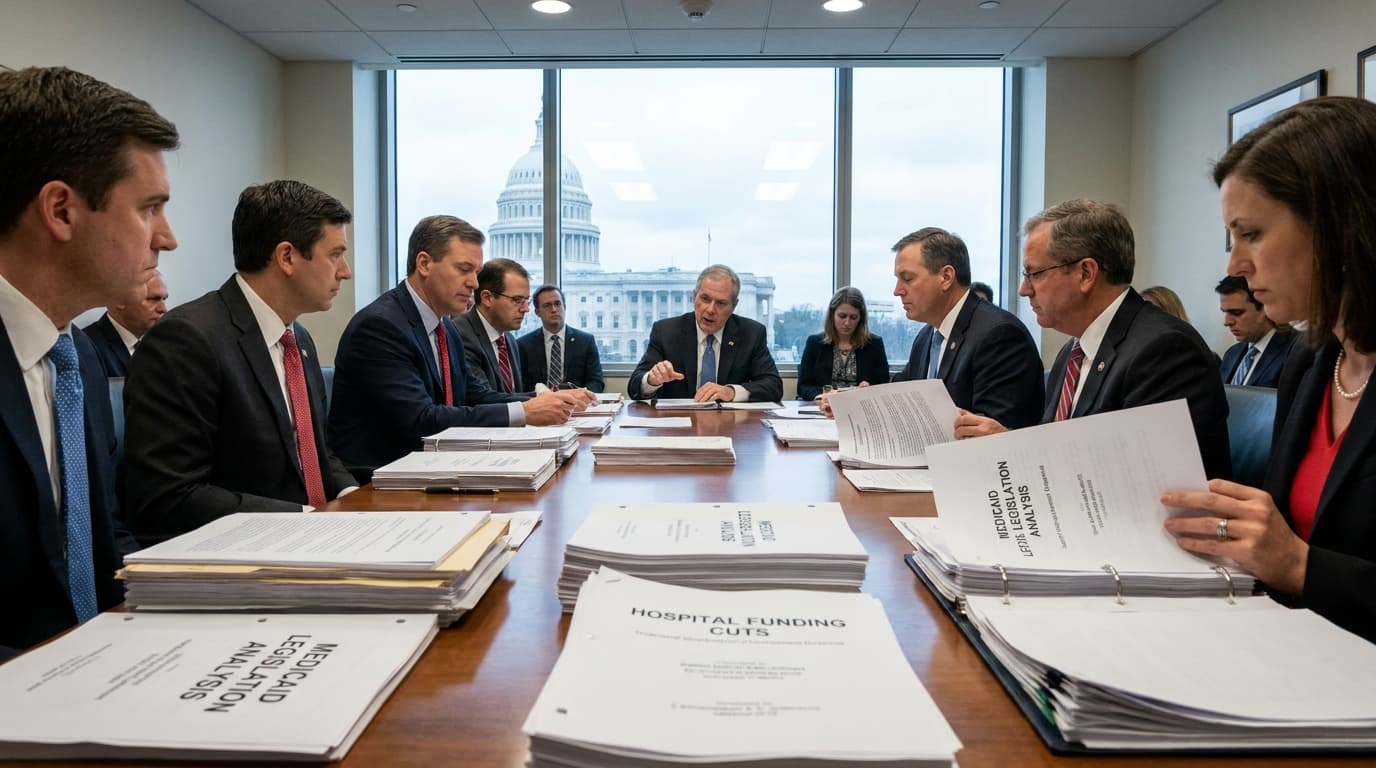
Hospitals Plot Push To Rework $1 Trillion In Medicaid Cuts, Even As Trump Law Stands

Hospital systems are remaking operations after the passage of a law that will cut nearly $1 trillion in Medicaid funding over the next decade, while lobbyists in Washington search for ways to mitigate the damage. The opening, according to people familiar with the effort, is less about a clean repeal now than about carving out narrower fixes, favorable rule changes and other federal payment support while the politics of the cuts harden.
Hospital leaders are trying to fight on two timelines after the passage of President Trump’s tax cut law: one inside their own systems, where executives are weighing mergers, new revenue sources, artificial intelligence implementation and service or facility cuts, and one in Washington, where lobbyists are testing whether any part of the law’s Medicaid reductions can still be softened.
According to four people familiar with the efforts cited by STAT, hospitals and their advocates have started laying groundwork to delay, roll back or mitigate the nearly $1 trillion in Medicaid funding cuts scheduled over the next decade. That is a difficult target because the reductions were enacted through President Trump’s signature tax cut law, and changing them would require both money to offset the cost and enough political support to reopen a landmark Republican achievement.
The immediate signal is that providers are not waiting for a single all-or-nothing repeal campaign. Instead, they appear to be building a menu of narrower asks: carveouts from the cuts, delays to implementation, rule changes and boosted payments from other parts of the federal health care enterprise. That approach reflects both the scale of the fiscal hole and the reality that some providers need relief before any broader political realignment arrives.
The political opening
Hospital executives and lobbyists think the cuts may become more politically potent as the midterms approach. Democrats see the issue as a voter liability for Republicans, and some hospital leaders believe that pressure could create room for partial fixes even if the larger law remains intact.
Sen. Tim Kaine told STAT that Democrats have begun discussing how they would roll back cuts if they retake the Senate in November. He said those conversations had started but that there were no decisions yet on what to reverse or by how much. Kaine also said he knows of some Republicans who are interested.
Among the Republicans named in the report, Sen. Josh Hawley is the most explicit. Despite voting for the bill that created the cuts, he told STAT he hopes to persuade colleagues closer to implementation that they should not proceed and that rural hospitals should be funded directly. Hawley introduced legislation last year that would repeal some reductions to state Medicaid funding and would double the funding and timeline for the Rural Health Transformation Fund.
Other senators identified as having a history of voicing concerns about the law’s Medicaid cuts were Lisa Murkowski, Susan Collins and Jerry Moran. Hawley also argued that lawmakers focused on rural hospitals have already had some success, including delaying implementation deadlines and securing rural health funding in the law.
The provider strategy
For now, the hospital campaign remains vague by design, according to the people involved. The first task is to convince policymakers how deeply the cuts will hit health systems. If that case gains traction, the hoped-for result is not necessarily a full reversal but a patchwork of more workable policy adjustments.
That matters strategically because many systems are already making structural decisions. If Washington offers only limited relief, hospitals may lock in operating changes that outlast the politics of the current fight. A policy campaign that starts as an effort to protect Medicaid revenue could therefore end up accelerating consolidation and altering care delivery even if parts of the law are later revised.
Some providers still appear to be betting on a fix. James Jarvis, president of the Maine Medical Association, told STAT he has heard bipartisan talk that something has to be done, though he added that it may take a catastrophe.
The longer bet
The long-range version of the hospital strategy runs through 2028. Health system leaders see value in building Democratic support now for larger funding increases if the party wins the White House and Congress then. Senate Minority Leader Chuck Schumer pledged to give hospitals “a seat at the table” should Democrats return to power.
The broader battle over Medicaid and insurance subsidies will shape more than provider finances. It could also test the political durability of the cuts and the usefulness of health providers’ traditional Washington playbook. A Democratic Congressional Campaign Committee memo in May 2025 called the issue “the defining contrast of the 2026 election cycle,” and Democrats have already tested messaging around higher insurance costs and coverage losses tied to Medicaid rollbacks.
The core market signal is that hospitals are treating the law less as a settled reimbursement reset than as a policy risk that can still be traded around. Whether that produces carveouts, delays or only operational retrenchment, providers are now planning as if federal health policy will remain a moving target rather than a fixed budget line.
Join the BioIntel newsletter
Get curated biotech intelligence across AI, industry, innovation, investment, medtech, and policy delivered to your inbox.