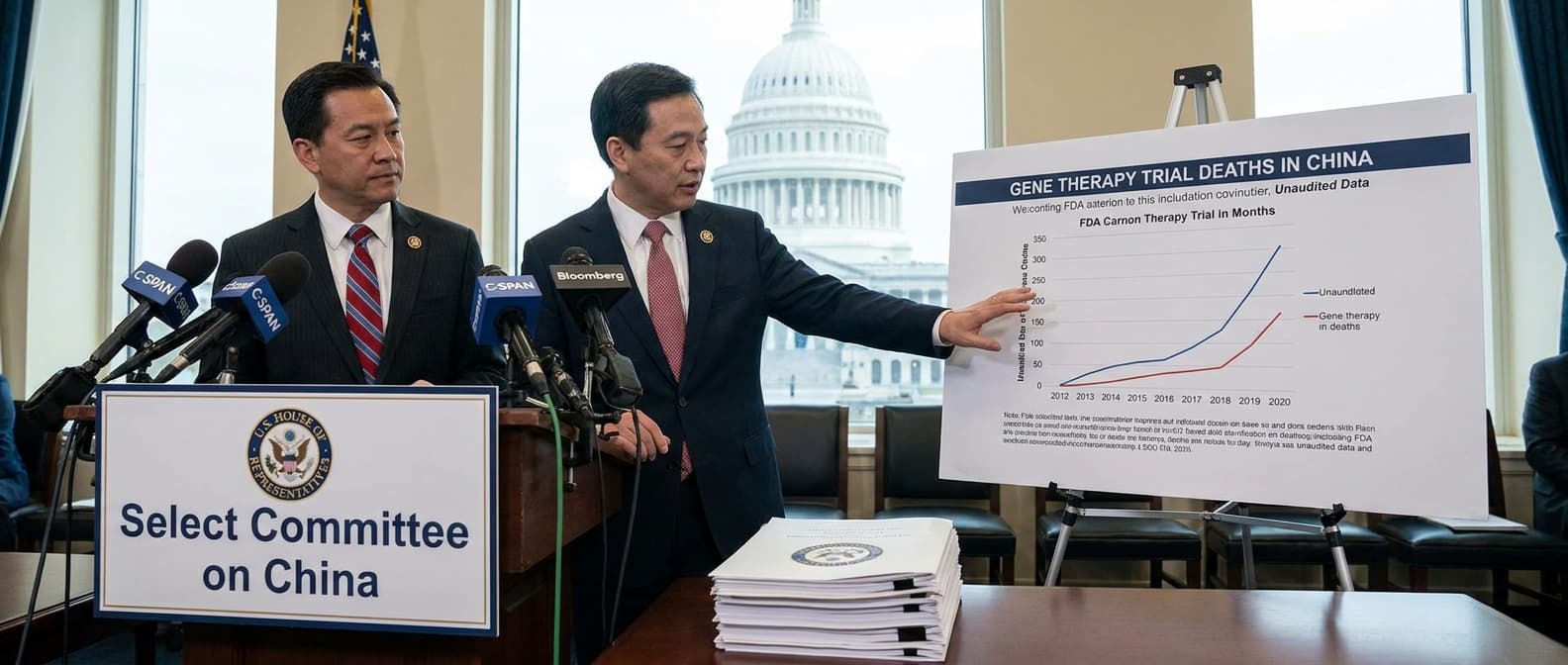
House Lawmakers Urge FDA To Reject Unaudited China Trial Data After 3 Gene Therapy Deaths

Reps. John Moolenaar and Ben Cline reportedly asked Acting FDA Commissioner Kyle Diamantas to reject clinical data from China unless a trial site has recently undergone an FDA audit, and to review products already approved using clinical results from China. The pressure comes after at least three patient deaths were reported over the last few months in trials in China, including a Duchenne muscular dystrophy study run by HuidaGene.
Two House members are asking the FDA to redraw its guardrails around clinical data generated in China after three patient deaths were reported in separate gene therapy trials there. According to a letter obtained by Endpoints News and described by BioSpace, Reps. John Moolenaar (R-MI) and Ben Cline (R-VA) told Acting FDA Commissioner Kyle Diamantas that “accepting Chinese clinical data poses real risks for patients.”
The lawmakers are reportedly seeking two specific actions: rejection of clinical data from China unless the trial site has recently undergone an FDA audit, and a broad review of products that have received U.S. approval based on clinical results from China. Their argument goes beyond the individual deaths and targets a development model in which early-stage studies are offshored to lower-cost settings, then used to support U.S. regulatory decisions.
The policy push
The sharpest line in the lawmakers’ case is their contention that offshoring early-stage clinical trials to China can reward speed and cost savings without sufficient protection for participants. As cited by Endpoints, they wrote that the system risks treating “children’s deaths as an acceptable cost of faster, cheaper research.”
That framing matters because it attempts to turn a safety debate into a regulatory standard. Rather than asking for closer case-by-case scrutiny, Moolenaar and Cline are pressing for a presumption against accepting China-generated data unless the FDA has recently audited the site. If adopted, that would raise the bar for companies relying on China studies not only in gene therapy but potentially across other modalities where foreign trial data is part of a U.S. package.
BioSpace reported that the House Select Committee on China, which Moolenaar chairs, and the BIOtech Caucus, of which Cline is a member, did not respond to requests for comment by publication. The FDA also did not respond.
The deaths behind the letter
BioSpace said at least three patient deaths occurring in China trials have been reported over the last few months. One involved a young boy with Duchenne muscular dystrophy enrolled in a HuidaGene gene therapy study. In an Aug. 5 statement that followed a STAT investigation, HuidaGene said the child died a year earlier, in August 2025, after receiving its investigational CRISPR-based therapy HG302.
According to HuidaGene, the boy “developed acute respiratory distress syndrome in the setting of severe complement and cytokine activation following high-dose systemic administration of an adeno-associated virus vector.” The company said full findings on the death were submitted for peer review in January and will be shared upon publication.
BioSpace also reported that, on Aug. 9, China-based RiboX Therapeutics reported a death in a patient with systemic sclerosis. The source excerpt provided here does not include further detail on that case or the third reported death, so the public record in this event is fuller on the HuidaGene case than on the others.
Why this could matter beyond one controversy
The immediate issue is patient risk in gene therapy, particularly where adeno-associated virus vectors and high-dose systemic administration are involved. The larger signal is regulatory portability: whether data generated in one oversight environment should continue to move into another with limited fresh inspection.
For biopharma companies, the proposal would matter most where China trials are used to accelerate timelines, reduce development costs or build an early efficacy and safety package before U.S. expansion. A requirement for a recent FDA audit would add operational friction and could narrow the advantage of running those studies offshore. A retrospective review of already approved products could create a second layer of uncertainty for programs whose U.S. path depended in part on China results.
The letter also arrives at a sensitive moment for gene therapy. Even without any new formal FDA policy, reports of fatal toxicities can reset agency tolerance for ambiguity around vector dose, monitoring and site quality. The lawmakers are trying to use that pressure to influence how the FDA evaluates not just the therapy platform, but the provenance of the underlying data.
Whether the agency adopts any of the requested measures is still unknown. But the episode signals that foreign clinical data, long treated primarily as a technical regulatory question, is becoming a live political and market-access issue as safety failures accumulate.
Join the BioIntel newsletter
Get curated biotech intelligence across AI, industry, innovation, investment, medtech, and policy delivered to your inbox.