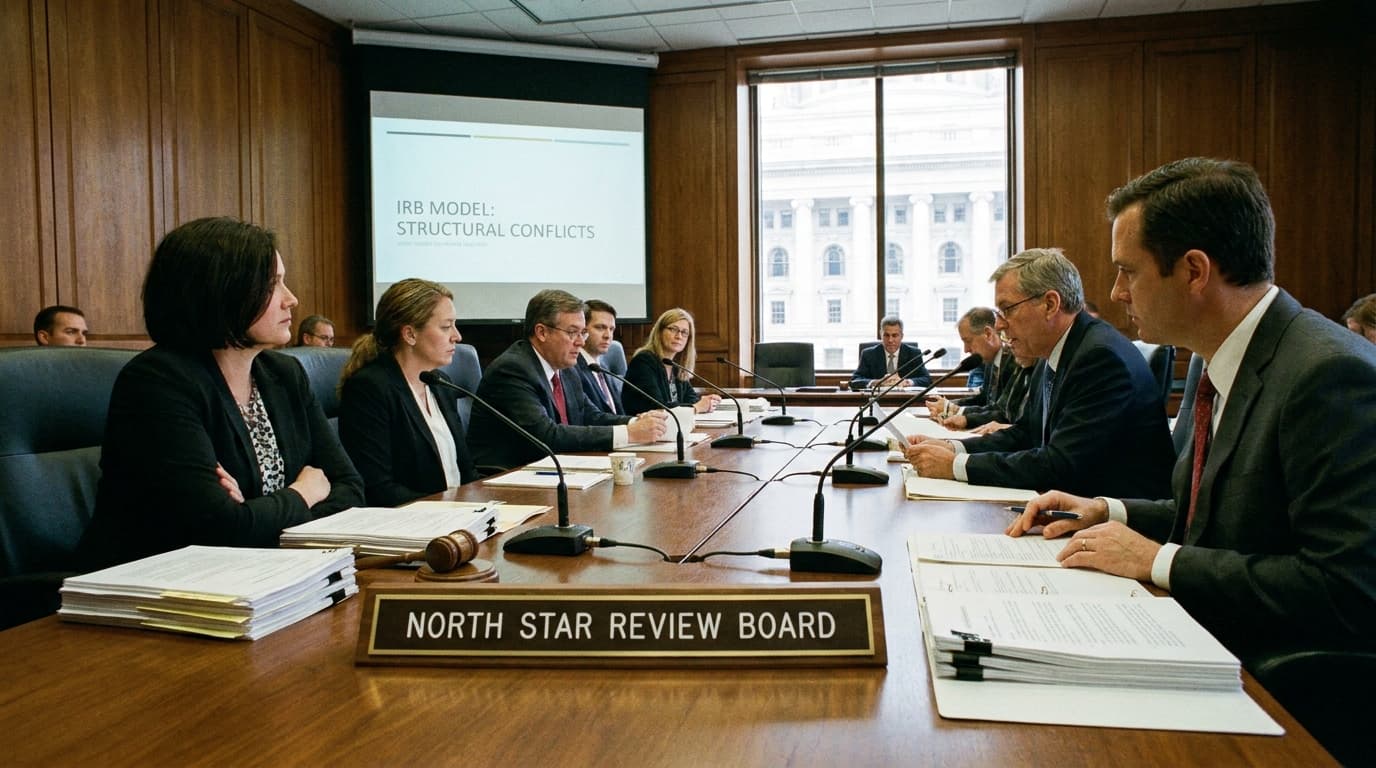
North Star Review Board Pushes Nonprofit IRB Model, As Ethics Experts Warn Of Structural Conflicts

The debate is less about whether IRBs exist than about who they are designed to serve when research institutions and commercial boards face financial pressure. The policy signal is that trust in research may increasingly depend on whether oversight can move beyond compliance and address privacy, data use, and other risks current regulation does not fully capture.
North Star Review Board, a not-for-profit institutional review board founded by research ethicists Stephen Rosenfeld and Patricia Seymour, is positioning itself as an alternative to a U.S. oversight system they say has drifted away from its core mission. Their critique, as reported by STAT, is that IRBs are supposed to prioritize the rights and welfare of human research participants, but the structure of the current system often pulls them toward investor returns, turnaround time, and minimally acceptable legal compliance instead.
That argument lands at a moment when research institutions are dealing with financial instability and strained trust between researchers and the federal government. The practical question is whether a nonprofit model can do more than signal a different philosophy and actually counter the incentives that many ethicists say have long shaped ethical review.
The Structural Problem
Before research can begin, it must pass ethical review, and IRBs are meant to protect participants from exploitation or intentional harm. Experts quoted by STAT said those boards generally still catch major harms, particularly physical ones. But they also described a system that has increasingly evolved to facilitate speed and satisfy regulatory requirements rather than consistently ask what is best for participants.
Rosenfeld told STAT that the challenge is structural. In his view, it is difficult to conduct review, pay for it, and avoid conflicts of interest at the same time when the system is organized around institutions and companies that have their own stakes in getting research moving. He framed the issue not primarily as bad actors doing bad things, but as incentives embedded in how oversight is set up.
Holly Fernandez Lynch, an associate professor of medical ethics at the University of Pennsylvania, gave STAT a sharp description of how those incentives can show up in practice. She said some IRBs now operate with a customer-service model in which the investigator is treated as the customer, with emphasis on turnaround time and speed. In that setting, she said, it becomes easier to force review toward approval of research that is only minimally legally acceptable.
The gap between legality and ethics is especially important as research creates new concerns around privacy and data exploitation that current regulation does not adequately address, Rosenfeld said. His argument is that public trust in science depends not only on meeting the letter of the rules, but on giving participants confidence that the information they provide will not be exploited.
The Road Here
STAT points to earlier scandals as evidence that these concerns are not theoretical. In 2009, the Government Accountability Office tested whether for-profit IRBs could identify and reject a bogus unethical research protocol. One of the three companies tested, Coast IRB in Colorado, approved the fake application even though the fictitious device matched several examples of “significant risk” in FDA guidance. The GAO said the episode revealed a vulnerability to “unethical manipulation” in the IRB system.
Coast was shut down, but experts told STAT that broad reform did not follow. In their telling, the scandal exposed a weakness without changing the basic incentive structure.
The deeper history also matters. Laura Stark, a science historian at Vanderbilt University and author of “Behind Closed Doors: IRBs and the Making of Ethical Research,” told STAT that the mid-20th-century foundations of the current model were shaped in part by efforts to push liability away from the federal government. Under NIH director James Shannon, who served from 1955 to 1968, the NIH budget expanded from $65 million to over $1 billion, increasing the agency’s exposure if unethical behavior occurred in its extramural program.
Stark said research organizations and leaders also resisted external regulation and instead developed industry guidelines that scientists could choose to follow. She compared that effort to sectors trying to substitute voluntary codes for formal oversight.
A tipping point came after the Tuskegee syphilis study, in which members of the U.S. Public Health Service deliberately withheld syphilis treatment from Black men in order to study the disease. In the version of the history presented here, the present IRB structure emerged from compromise, institutional self-protection, and resistance to outside control as much as from a pure participant-protection mission.
Why The Nonprofit Model Matters
North Star’s bet is that governance matters because incentives matter. A nonprofit IRB does not automatically resolve every conflict in research oversight, but Rosenfeld and Seymour are arguing that it can reduce one of the most persistent ones: pressure to reconcile ethical review with commercial or institutional interests.
The signal for the industry is broader than one organization. If ethical review is increasingly judged on speed and legal sufficiency, oversight may lag the risks created by newer forms of research, particularly where privacy and data use are central. In that setting, nonprofit IRBs are being presented not as a nostalgic return to older norms, but as one attempt to rebuild credibility in a system whose formal rules may no longer cover the full ethical exposure of modern research.
Join the BioIntel newsletter
Get curated biotech intelligence across AI, industry, innovation, investment, medtech, and policy delivered to your inbox.