Psychedelics Near Commercial Inflection, As Phase 3 Data And Trump Administration Policy Support Build

BioSpace’s review of the sector points to a market moving from theory toward execution. Recent late-stage data in treatment-resistant depression and major depressive disorder, alongside actions by the Trump administration and the FDA, have improved the setup for developers even as safety, abuse risk and care-delivery constraints remain unresolved.
Psychedelics are moving closer to a real market test as clinical evidence and policy support accumulate, but the sector still has to prove that promising results can translate into scalable psychiatric care. Graig Suvannavejh, managing director and senior biotech and biopharma analyst at Mizuho Securities, told BioSpace the field is “at the cusp” of hitting it big, with the industry waiting with “rational exuberance” for psychedelics to reach primetime.
The setup reflects two forces moving at the same time. On one side, physicians and patients are looking for psychiatric treatments that act faster and help people who do not achieve remission on existing drugs. On the other, sponsors and investors are trying to determine whether medicines that may require careful administration can fit real clinical practice at meaningful scale.
The data
The current standard treatments for psychiatric conditions still matter, but they leave room for new entrants. Patrick Trucchio, managing director and biotech analyst at H.C. Wainwright & Co., said selective serotonin reuptake inhibitors, serotonin-norepinephrine reuptake inhibitors and antipsychotics are “highly useful,” particularly earlier in the treatment pathway. He also said millions of patients remain inadequately treated, including some 4 million people in the U.S. with treatment-resistant depression, many of whom do not reach remission after cycling through therapies.
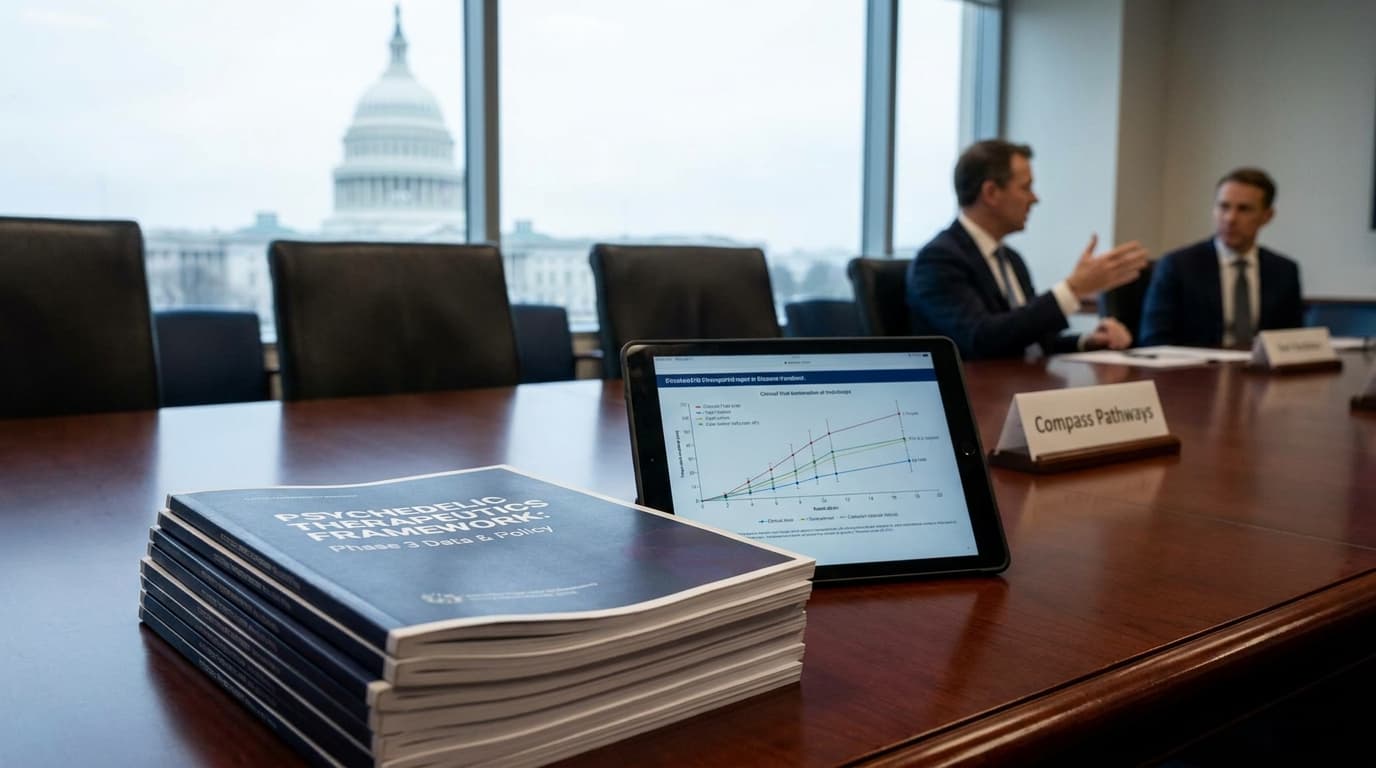
Recent trial results are the clearest reason the field has gained momentum. Last month, two fixed doses of Compass Pathways’ psilocybin candidate COMP360 significantly eased disease severity in a Phase 3 treatment-resistant depression study. In February, the same regimen showed durability in a pair of Phase 3 trials in the same indication. In June, a single dose of Definium Therapeutics’ LSD-based treatment eased symptom burden in a late-stage trial of major depressive disorder.
Trucchio said those results mean the field has “crossed an important clinical threshold.” The strategic significance is that psychedelics are no longer being argued mainly on theory or early signals; companies now have late-stage evidence in indications where existing options are often slow to work, require long-term dosing and still leave a substantial group of patients behind.
The commercial picture
Commercially, the likely ceiling is not broad first-line use. Trucchio said psychedelics can be “particularly compelling” for patients with treatment-resistant depression who no longer respond to typical therapies, but are unlikely to replace simpler first-line therapies across the broader depression market.
That limitation does not eliminate the revenue opportunity. Paul Matteis, head of Therapeutics Research at Stifel, said psychedelics are likely to be used later in treatment, but argued that even later-line therapies in major depressive disorder and treatment-resistant depression can generate blockbuster revenues at branded pricing.
The market reference point remains Johnson & Johnson’s Spravato, an esketamine-based nasal spray approved in 2019 for treatment-resistant depression alongside oral antidepressants. Johnson & Johnson has previously told BioSpace it does not consider Spravato a classic psychedelic, but analysts still use it as a commercial barometer. Spravato became the first monotherapy for the condition in January 2025, rose 57% last year to $1.7 billion, and posted a 40% year-on-year increase to $584 million worldwide in the second quarter of this year.
Large-company interest has also become harder to dismiss. A few weeks ago, Eli Lilly moved to acquire AtaiBeckley for up to $3.8 billion to pursue a synthetic psychedelic for treatment-resistant depression. Matteis said it is “very hard to say what, if any, the implications of the LLY deal are,” but he added that the transaction at least shows societal acceptance has advanced materially.
Policy support and remaining constraints
The policy backdrop has also improved. In April, President Donald Trump issued an executive order directing the FDA to use its new priority review program to accelerate psychedelic development. Weeks later, the agency awarded Commissioner’s National Priority Vouchers to Compass, Transcend Therapeutics and Usona Institute. Last month, the regulator finalized psychedelic guidelines that give sponsors more flexibility and mechanisms for blinding trials, addressing a longstanding difficulty in studying these drugs.
For Jama Pitman, strategic advisor at Rose Hill Life Sciences, that shift matters because legal barriers and stigma had long prevented the field from advancing despite the science and medical need. Her point, echoed across the sector, is that the bottleneck was not only biological proof but also the policy environment around research and acceptance.
The remaining hurdle is operational. Matteis said Stifel sees “a lot of enthusiasm” but also “some trepidation” about whether these medicines can be scaled and deployed in clinical practice. That is now the core investment question. The science has moved far enough to justify serious commercial planning, and policy has become more accommodating, but the winners may be the companies that solve administration, trial execution and adoption rather than those that simply show psychedelic activity.
Join the BioIntel newsletter
Get curated biotech intelligence across AI, industry, innovation, investment, medtech, and policy delivered to your inbox.