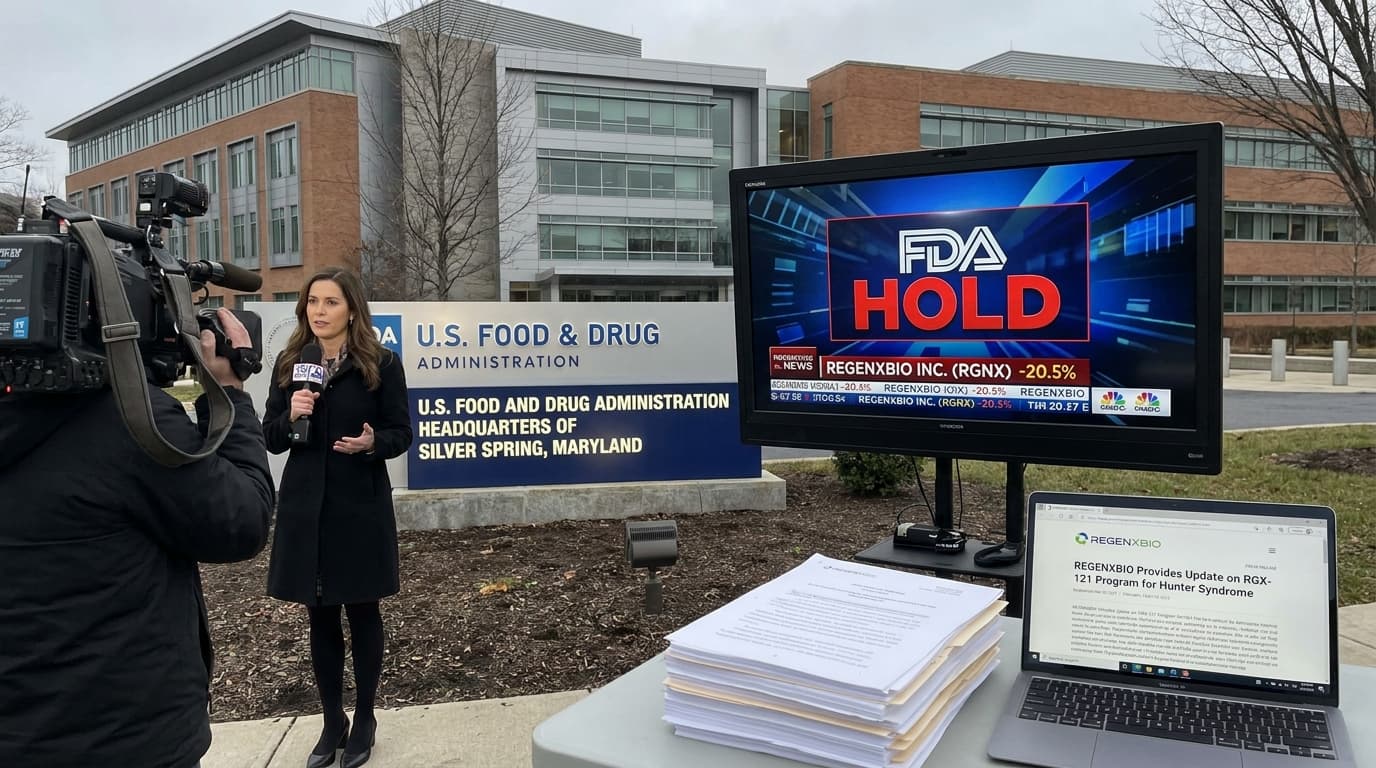
REGENXBIO Hits RGX-121 Setback After FDA Hold, Delaying Hunter Syndrome Refiling

RGX-121 had regained a possible path under accelerated approval in June after the FDA earlier rejected the filing and asked for a new study, more patients and a placebo arm. The new hold shifts the focus from filing strategy back to safety interpretation and longer-term follow-up in an ultra-rare disease setting with limited imaging history.
REGENXBIO’s attempt to revive RGX-121 for Hunter syndrome has run into another FDA setback. The company said the agency placed the gene therapy on clinical hold after expanded monitoring found asymptomatic small nodules or small cystic masses in the spines of five participants in the Phase 1/2/3 CAMPSIITE study.
The findings derail REGENXBIO’s plan to resubmit its biologics license application in the third quarter. The company now says it does not expect to resubmit the RGX-121 application in the near term, and investors responded sharply, with shares falling more than 20% in premarket trading Monday according to both reports.
The Data
RGX-121 is being developed for mucopolysaccharidosis type II, also called Hunter syndrome. The spine MRI findings were identified in five of 48 CAMPSIITE participants who had received intracisternal or intraventricular RGX-121 about three to six years ago.
REGENXBIO said investigators deemed the findings nonserious and radiologists believe they are likely benign. The company also said all five participants continue to do well clinically and have shown overall stability to improvement on neurocognitive and neurobehavioral assessments. No clinical or pathological evidence confirms the nature or causation of the MRI findings, and no brain nodules or masses were identified.
The company said the signal emerged through an expanded MRI monitoring plan put in place after events in another program. It added that spine MRI is not typically performed for Hunter syndrome in either clinical practice or trials, leaving the underlying prevalence and clinical significance of asymptomatic findings in this patient population unknown. Roberto Giugliani of the Federal University of Rio Grande do Sul said limited imaging natural history in neuronopathic MPS II leaves open the possibility that such likely benign findings may be inherent to the disease’s effects throughout the body.
The Road Here
RGX-121’s regulatory path has shifted repeatedly this year. The FDA rejected the BLA in February and told REGENXBIO to run a new study, treat more patients and include a placebo arm for a resubmission. In June, the agency reversed course and determined that the existing data could support a resubmission under the accelerated approval pathway.
The new hold follows broader gene therapy safety scrutiny around REGENXBIO’s lysosomal storage disease programs. In January, the FDA put both RGX-121 and RGX-111 on clinical hold after a central nervous system tumor was discovered in an RGX-111 patient with Hurler syndrome, or mucopolysaccharidosis type 1. BioSpace reported that genetic analysis of that tumor sample showed the AAV vector used to deliver RGX-111 had integrated into the genome, causing a mutation in a known cancer-causing gene.
REGENXBIO now argues the latest spine findings appear limited to RGX-121. Fierce Biotech reported that the company’s other gene therapies, including RGX-202 and surabgene lomparvovec, use different capsids and routes of administration, which informs that view.
What To Watch
The immediate question is not approvability but interpretation. REGENXBIO and partner NS Pharma said they are evaluating additional patient imaging, longer-term follow-up data, the clinical hold letter and other FDA feedback to determine next steps, while investigators plan periodic imaging of the five affected patients.
For the broader field, the signal is that accelerated approval flexibility does not remove the FDA’s ability to reopen safety questions when monitoring changes reveal new findings years after dosing. In rare gene therapy programs built on small datasets and long follow-up windows, post hoc imaging can quickly become the gating item for both development timelines and filing strategy.
Join the BioIntel newsletter
Get curated biotech intelligence across AI, industry, innovation, investment, medtech, and policy delivered to your inbox.