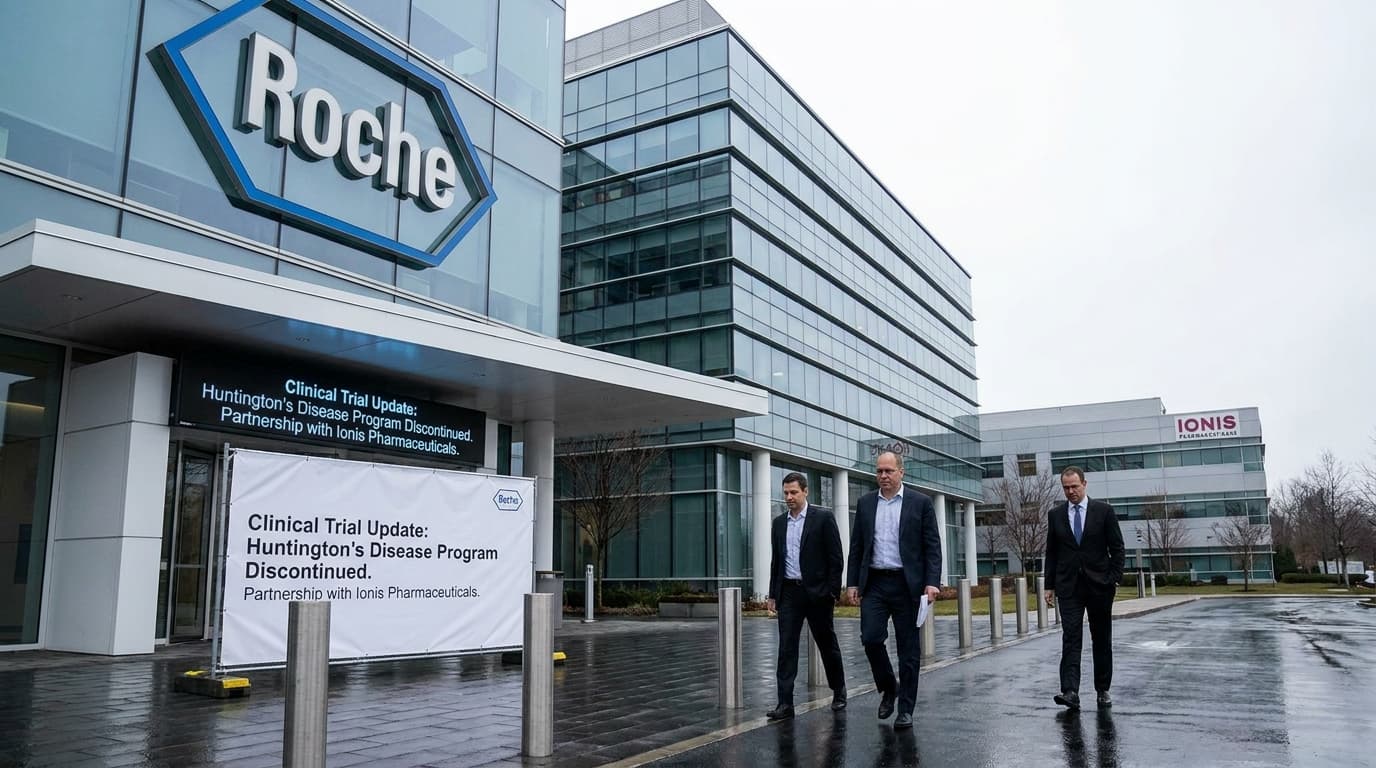
Roche Discontinues Huntington’s Disease Studies, Delivering More Setbacks for Ionis

Roche's decision to discontinue its Huntington's disease clinical trials—partnered with Ionis Pharmaceuticals—adds to a string of setbacks for the RNA-focused biotech. The move follows closely after the company's late-stage failure in the ATTR-CM space, challenging Ionis' trajectory in genetic and rare disease innovation.
Executive Summary
Roche, a major international pharmaceutical player, has officially discontinued two prominent clinical studies targeting Huntington’s disease, which were conducted in partnership with Ionis Pharmaceuticals. This move comes on the heels of Ionis' late-stage failure with a different therapy in ATTR-cardiomyopathy (ATTR-CM), casting a shadow over the biotech’s near-term clinical ambitions. As Huntington’s disease remains one of the most challenging neurodegenerative disorders with limited therapeutic options, this development could alter the course of drug development in the field and reshape investor sentiment around RNA-based innovation.
The Background: Roche and Ionis’ Partnership in Huntington’s Disease
Roche has been at the forefront of neurodegenerative research, especially in areas such as Alzheimer’s, Parkinson’s, and Huntington’s diseases. The latter, a devastating, inherited neurodegenerative disease marked by progressive motor dysfunction, psychiatric disturbance, and cognitive decline, continues to elude effective treatment. In pursuit of this high unmet need, Roche partnered with Ionis Pharmaceuticals, a recognized leader in RNA-targeting drugs, with the goal of advancing anti-sense oligonucleotide (ASO) therapeutics for Huntington’s disease. ASO technology represents a promising class of therapies designed to modulate the expression of specific genes, offering a targeted approach for monogenic disorders like Huntington’s.
Initiated several years ago, these trials represented hope for families and clinicians navigating Huntington’s disease. The studies sought not just to slow—or possibly reverse—disease progression, but to establish a new paradigm for addressing genetically driven neurodegeneration.
The Clinical Rationale and Study Design
Roche and Ionis' studies were built on years of preclinical research and earlier clinical signals. The therapeutic rationale centered around the notion that reducing the production or aggregation of mutant huntingtin protein—the root cause of disease pathology—could protect neurons and slow disease progression. The compounds deployed used Ionis’ ASO technology, aiming to selectively silence the toxic gene transcript.
Large, multicenter, placebo-controlled studies recruited patients across a spectrum of disease severities. Recruitment was challenging but generated critical datasets for future drug development, including biomarker, imaging, and functional data from people living with Huntington’s across diverse geographies.
The Decision to Terminate: What Went Wrong?
The discontinuation signals a complex interplay of scientific, clinical, and possibly regulatory challenges. While the companies have not released exhaustive datasets from the discontinued trials, clinical trial discontinuation at this stage usually follows pre-specified futility analyses, safety flags, or lack of efficacy signals sufficient to warrant reassessment of risk-benefit profiles.
For Huntington’s disease, targets are high, and even modest signals are scrutinized with rigor. Given the high hopes and substantial investments—both intellectual and financial—behind the Roche-Ionis partnership, the termination is especially notable. It underscores the ongoing gap in effective Huntington’s disease treatment and the cautionary lessons of moving from early promising data to late-stage, robust clinical outcomes.
Implications for Ionis: A Cascade of Clinical Setbacks
This latest development compounds challenges for Ionis, which had already faced a major clinical disappointment with a late-stage failure related to ATTR-CM, a rare cardiac disorder. For any biotech company—especially one so reliant on a particular technology platform or set of late-stage candidates—such back-to-back setbacks can reverberate across R&D, investor relations, and partner strategy.
For Ionis, the discontinued Huntington’s studies may prompt reassessment of its pipeline composition, resource allocation, and future investments in neurology. The clock is also ticking on Ionis’ other late-stage programs and on its ability to generate clinical win stories that can attract further partnerships, investment, or commercialization prospects.
What’s Next for Huntington’s Disease Research?
The discontinuation of these high-profile trials sends ripples through the larger Huntington’s community. For patients, families, and advocacy groups, every new trial offers a glimmer of hope for an effective therapy. Every discontinuation, then, is a setback not just for sponsors but for the field as a whole.
From the industry’s vantage point, the need for robust biomarkers, smarter patient stratification, and more adaptive trial designs has never been more apparent. The field must continue to innovate in translational science, improve animal models, and build on natural history cohorts to de-risk future therapies before entering costly late-phase studies.
Broad Biopharma Implications and Investor Sentiment
The Roche-Ionis Huntington’s trial termination is another reminder of the high-risk environment faced by biopharma pioneers tackling rare and neurological diseases. First-in-class and best-in-class ambitions are often met with disproportionate failure risks. For investors and biopharma strategists, the news may temper short-term enthusiasm toward RNA-based approaches for neurodegeneration, but the relentless medical need continues to attract significant research dollars and scientific attention.
The coming months will reveal more details, as the companies parse trial data for subgroups, biomarker signals, and lessons learned. However, industry watchers will be attuned to how Roche, Ionis, and the broader community recalibrate their strategies for Huntington’s and similar neurological challenges.
Conclusion
The decision by Roche to discontinue its Huntington’s disease clinical trials in partnership with Ionis marks a pivotal moment for both companies and the neurology drug development landscape. While highlighting the enormous complexities inherent in tackling neurodegeneration, it also reinforces the biopharmaceutical industry’s need for perseverance, smarter design, and clinical humility. As we move forward, the search for effective therapies against Huntington’s disease grows ever more urgent, with each setback setting the stage for future innovation—grounded in science, informed by real-world data, and responsive to the needs of patients and families.
For further reading and updates on the trial discontinuation and implications for Ionis, the original report is available at BioSpace.
Join the BioIntel newsletter
Get curated biotech intelligence across AI, industry, innovation, investment, medtech, and policy delivered to your inbox.