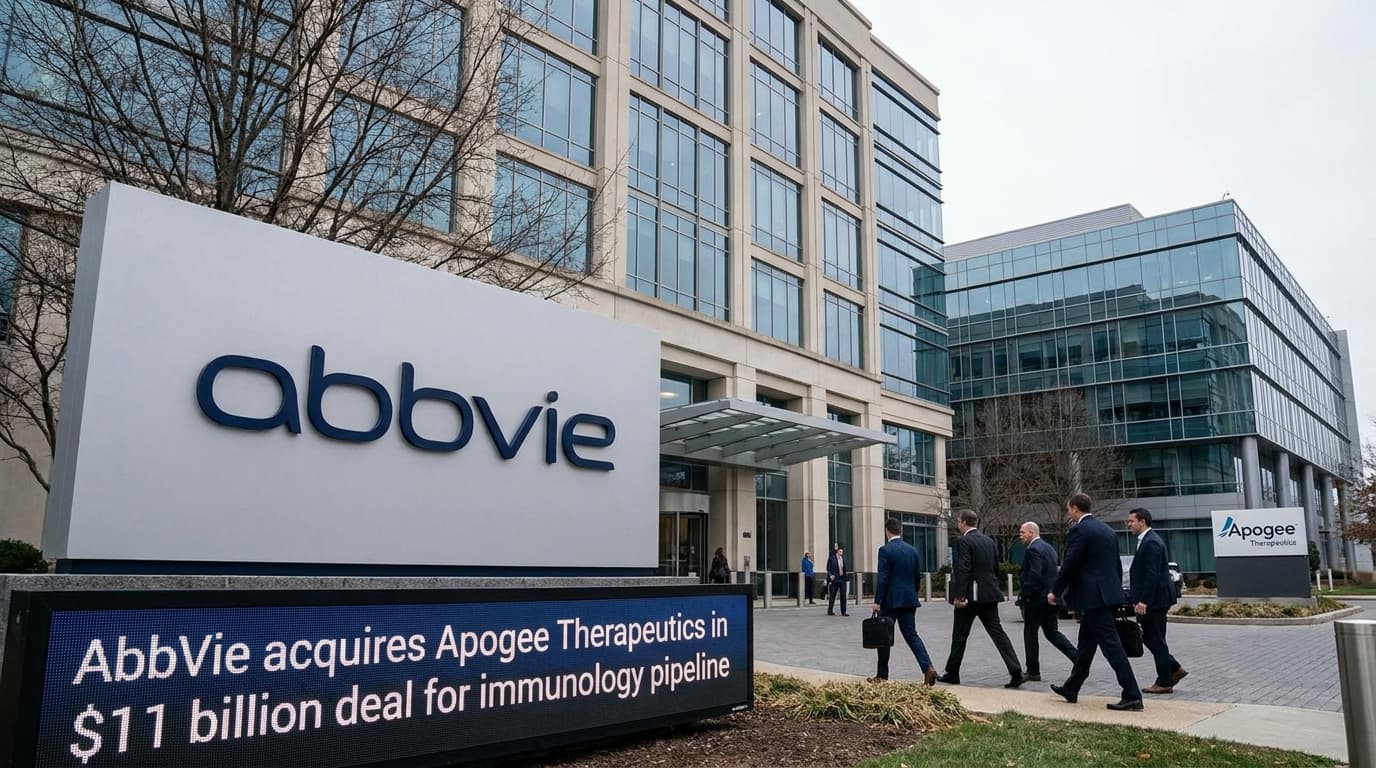
AbbVie’s $11B Apogee Therapeutics Acquisition Signals Aggressive Immunology Expansion

The biopharma landscape is witnessing accelerated consolidation as major players, including AbbVie, advance a run of strategic acquisitions. By acquiring Apogee Therapeutics for nearly $11 billion, AbbVie underscores its intent to remain competitive in the burgeoning immunology market. This move highlights the intensifying competition and the critical importance of pipeline innovation in the post-Humira era for AbbVie and its major rivals.
On June 22, 2026, AbbVie announced its plan to buy Apogee Therapeutics in a deal valued at nearly $11 billion. The acquisition, which centers around Apogee’s developmental atopic dermatitis drug, reflects both the growing emphasis on immunology within big pharma and the broader trend of continuing consolidation across the biopharmaceutical industry. This substantial move is another episode in what many industry analysts have already dubbed a pharma acquisition spree.
Context: Pharmaceutical M&A Momentum
The pharmaceutical sector has always been dynamic, but recent years have seen a pronounced uptick in merger and acquisition (M&A) activity. In a fiercely competitive market, mature companies like AbbVie find themselves at a crossroads: with blockbuster drugs such as Humira facing steep patent cliffs and subsequent erosion from biosimilar competition, the urgency to replenish product pipelines and revenue streams has continued to intensify.
AbbVie has already established itself as a major player in the immunology space, largely through the success of drugs like Skyrizi and Rinvoq. However, these alone are not sufficient to replace the heights reached by Humira in its prime. Executives and shareholders have become increasingly focused on finding new avenues for growth, particularly in areas of high unmet medical need, where therapies can occupy dominant, durable market positions. Thus, the acquisition of Apogee—developer of a promising atopic dermatitis treatment, zumilokibart—aligns perfectly with this pipeline-centric strategy.
Why Apogee? The Asset and Its Market Potential
Apogee’s most valuable asset is an experimental drug for atopic dermatitis—a chronic, immune-mediated skin condition with significant prevalence worldwide. Atopic dermatitis, especially in its moderate-to-severe forms, can have a profound effect on quality of life, often requiring long-term management. Recent advances in immunology have unlocked new therapeutic options beyond traditional steroids and general immunosuppressants, with Dupixent (from Sanofi and Regeneron) emerging as the sector’s juggernaut.
AbbVie’s decision to acquire Apogee is both defensive and offensive. On one hand, it ensures the company is not left behind as competitors rapidly expand into high-value immunology indications. On the other, it leverages AbbVie’s ability to commercialize and maximize the value of new therapeutic candidates, thanks to deep expertise built up with Skyrizi and Rinvoq in psoriasis, Crohn’s disease, ulcerative colitis, and other inflammatory conditions.
Competitive Positioning in Immunology: Challenging Dupixent’s Dominance
Dupixent, the flagship atopic dermatitis therapy from Sanofi and Regeneron, has set a high bar for competitors, boasting strong, consistent sales growth and an expanding range of indications. AbbVie’s acquisition of Apogee, and particularly of its lead IL-13/IL-4 pathway-blocking asset, is a direct response to this competitive pressure.
Industry analysts have closely tracked the battle for market share in immunology. With more patients seeking innovative therapies that offer improved efficacy and safety over older treatments, the stakes have never been higher. Apogee’s drug—poised as a potentially best-in-class option—could significantly alter the therapeutic landscape, assuming it secures regulatory approval and delivers on its clinical promise.
"AbbVie will add Apogee’s IL-23 blocker to its current immunology stalwarts Skyrizi and Rinvoq, which have helped the pharma ride out the steep patent cliff left behind from mega-blockbuster drug Humira," according to a related report from BioSpace. This highlights a broader strategic vision: building a comprehensive immunology franchise robust enough to withstand market shocks and competitive encroachment.
Financials & Deal Structure
The nearly $11 billion price tag signals both the high expectations for Apogee’s lead asset and the overall escalation in valuation for promising mid-stage biotechs. Unlike some of the industry’s recent bolt-on acquisitions—where companies cherry-pick later-stage, de-risked assets—this deal carries an element of clinical risk but also the potential for outsized future payoff if Apogee’s candidate becomes a new standard of care.
Industry observers note that such moves may place increased pressure on other players to follow suit, particularly as large pharma firms flush with cash seek to mitigate revenue erosion from upcoming and past patent expiries.
Industry Reaction: Mixed Views on M&A Spree
The news has prompted a mixture of optimism and skepticism within the industry. Supporters argue that robust M&A—especially when focused on innovative science—accelerates the development of much-needed therapies and translates scientific advances to tangible outcomes for patients. Detractors, however, worry that a frenzy of consolidations can stifle competition, drive up costs, and reduce overall innovation if smaller players are routinely absorbed before they reach commercial maturity.
Nevertheless, with the global pharmaceutical market exceeding $1 trillion in annual revenues and R&D productivity a perennial concern, most analysts believe that deal-making of this scale is likely to continue. In fact, some foresee an increasing pace as the sector adapts to changing competitive dynamics, pricing pressure, and a more demanding regulatory environment for drug approvals.
Broader Implications for the Biotech Sector
For emerging biotech companies, this acquisition highlights the existential paradox of the field: independent advancement can yield outsized rewards, but often the ultimate payoff—whether for investors, founders, or patients—comes through commercial partnerships or M&A. The 2026 boom in pharma-biotech deals underscores a heightened appetite for both risk and reward across the life sciences ecosystem.
The Apogee deal may serve as a bellwether. If its atopic dermatitis program successfully navigates clinical and regulatory hurdles, it could affirm the syndicate investment and exit strategy that underlies much of biotech’s venture capital engine. Conversely, if the asset falls short, it may prompt more caution and recalibration in what biotechs are worth to large pharma acquirers.
Conclusion: What’s Next for AbbVie and Immunology?
AbbVie’s billion-dollar wager on Apogee Therapeutics represents a decisive swing for leadership in the next-generation immunology market. As immunology becomes an ever more crowded but lucrative battleground, strategic acquisitions like this one are poised to define the contours of the sector for years to come. Patients, investors, and competitors alike will be watching closely as AbbVie integrates Apogee and advances its experimental pipeline through mid- and late-stage clinical development.
With the stakes so high, the coming months and years will test not just the science, but AbbVie’s ability to execute in one of the most competitive and innovative spaces in modern pharmaceutical medicine.
Join the BioIntel newsletter
Get curated biotech intelligence across AI, industry, innovation, investment, medtech, and policy delivered to your inbox.