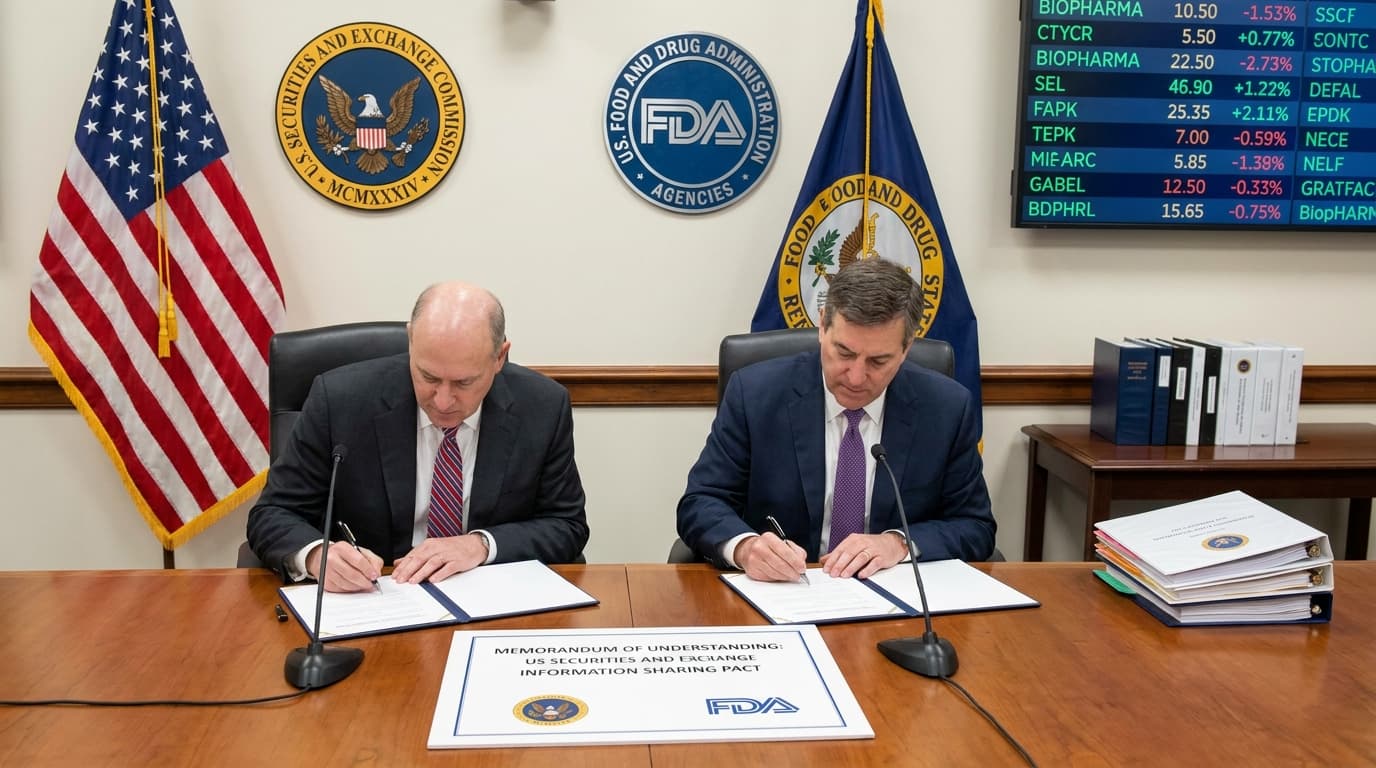
SEC And FDA Sign Three-Year Information-Sharing Pact, Tightening Biopharma Insider Trading Scrutiny

The pact does not create entirely new SEC powers, but it gives both agencies a more formal mechanism to exchange non-public information and route requests through designated points of contact. For biopharma companies, the practical implication is a tighter link between what is said to investors and what the FDA may know about clinical trials, approvals, and other regulated events.
The SEC and the FDA have signed a three-year memorandum of understanding aimed at improving cooperation and information sharing between the two agencies. According to the MOU, the agreement is intended to enhance each side’s ability to carry out its mission of protecting public health and ensuring the integrity of the financial markets.
For biopharma companies, the immediate significance is not that a new enforcement regime has appeared overnight. The more important shift is operational. The MOU creates a formal mechanism for sending information requests, sharing non-public information and assigning points of contact, which could make it easier for the SEC to compare FDA-related facts with what public companies tell investors.
What the agreement does
The SEC already reviews disclosures and financial statements of public companies, including organizations engaged in FDA-regulated activities such as clinical trials and drug approvals. Under the new arrangement, if a company makes false or misleading statements connected to the FDA, or if an insider uses information to improperly benefit in the public markets, the agencies are positioned to move information between them more efficiently.
SEC Chairman Paul S. Atkins said in the release that “FDA-related disclosures by public companies have a significant impact on our markets.” Acting FDA Commissioner Kyle Diamantas said streamlining information sharing helps protect both patients who rely on FDA-regulated products and the public trust that supports healthcare innovation.
The practical value of the pact may be greatest in the parts of biopharma enforcement that are data-heavy and technically specialized. Clinical trial disclosures often involve scientific detail that can be difficult for securities investigators to parse quickly. A more direct exchange with the FDA could shorten that gap.
Why biopharma is the target
Pillsbury Partner David Oliwenstein, a former senior counsel in the market abuse unit of the SEC’s Division of Enforcement, told Fierce that the MOU is a potential tool for obtaining real-time information from the FDA about drug trials and related matters so SEC staff can compare that information with what companies are telling investors.
He said the agreement likely serves three goals. First, it signals to the industry that the SEC intends to keep a close eye on insider trading in biopharma. Oliwenstein said the sector has long been an area of focus for SEC enforcement staff in relation to trading ahead of clinical trial outcomes.
Second, he said the arrangement should make investigations more efficient because the volume and technical nature of clinical trial data create unusual hurdles for the SEC. Third, he said the MOU likely reflects a judgment by enforcement staff that biopharma remains an area where there is substantial misconduct risk.
That framing makes this more than an administrative update. The agreement tells public biopharma companies that FDA interactions, trial conduct and disclosure practice are becoming more interconnected from an enforcement perspective.
The signal to the market
Oliwenstein said the SEC already had the ability to access FDA information and interview executives and others involved in trials during investigations. The difference now is that the process should be more streamlined and could provide both new leads and an added check on public statements.
He also pointed to the rise of biopharma in prediction markets as a factor complicating the federal government’s ability to regulate the improper use of inside information. In that setting, a faster link between health regulation and securities enforcement matters because market-moving information in biotech often emerges first through trial progress, regulatory feedback or approval timing rather than conventional financial events.
The broader signal is that biopharma disclosure risk is no longer confined to how carefully a company drafts its press releases. The SEC is indicating that when trial or regulatory information moves markets, it wants a tighter line of sight into whether those statements match the underlying FDA-facing reality.
Join the BioIntel newsletter
Get curated biotech intelligence across AI, industry, innovation, investment, medtech, and policy delivered to your inbox.