STAT Reports Public Employers Raise Taxes And Weigh Benefit Cuts As Health Costs Strain Budgets

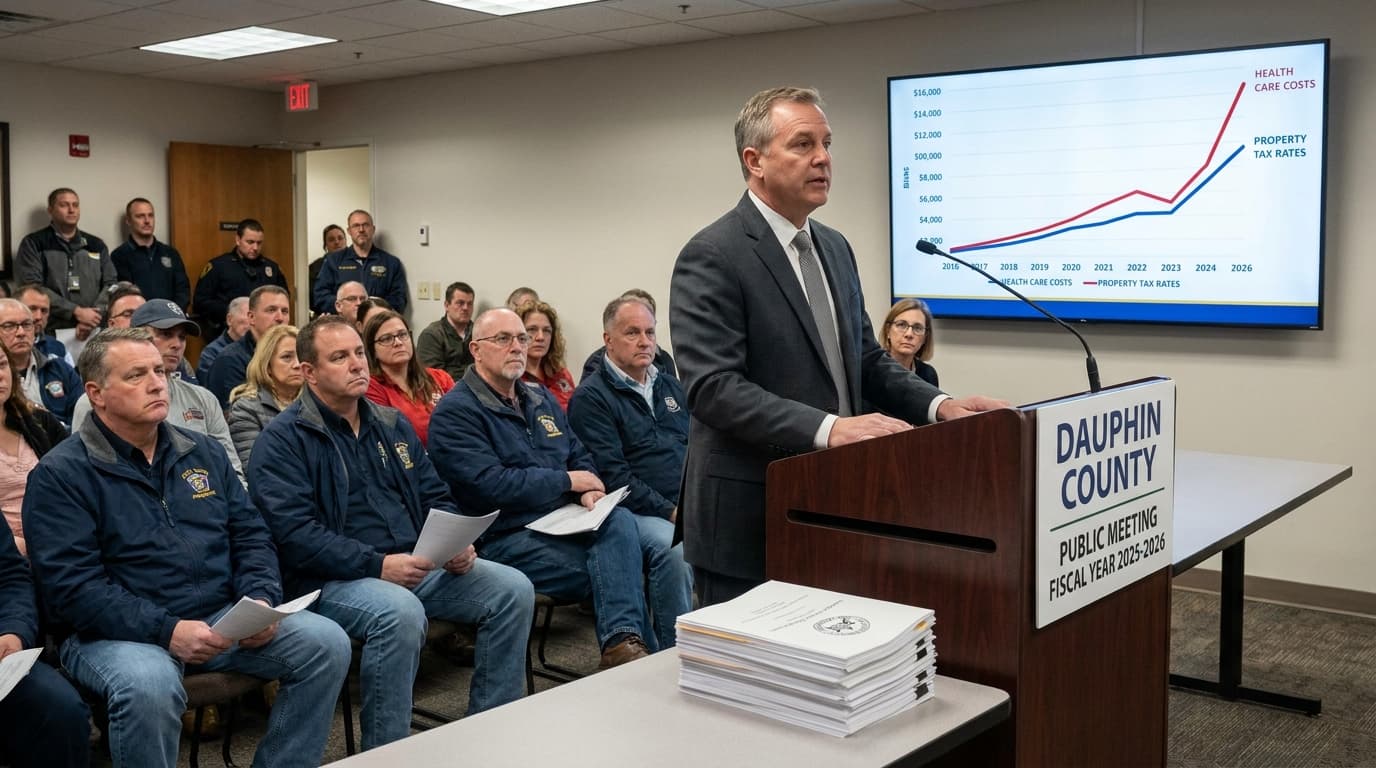
Dauphin County’s recent property tax increases offer one local example of a broader fiscal squeeze hitting state and local governments. With public employers often constrained by union expectations, fixed budgets, and political resistance to tax hikes, the story suggests health benefit inflation is becoming a structural policy issue rather than a negotiable line item.
Rising health care costs are putting public-sector employers into a bind that private employers do not face in quite the same way: when health benefits become too expensive, the burden can flow directly to taxpayers, not just employees. STAT’s reporting uses Dauphin County, Pennsylvania, as a concrete case, showing how health spending pressure helped push county leaders to raise property taxes by 22% in December 2024 and then by almost 10% again for 2026.
County officials did not attribute those tax increases solely to the health plan. Inflation has affected the broader budget, and the Trump administration has cut federal funding for many state and local programs. But Justin Douglas, chairman of the Dauphin County Board of Commissioners, told STAT that pressure from health care costs had become “untenable” and was a critical factor.
Over the past 20 years, Dauphin County cut its workforce by 19%, yet its health care spending more than doubled and per-employee costs tripled. For residents with a $100,000 home, roughly the median assessed value in the county, the 2024 tax increase meant about $150 more per year.
The fiscal squeeze
The broader signal in the report is that public employers are being hit by the same medical-cost inflation affecting corporate plans, but with less room to maneuver. State and local governments often cannot easily absorb double-digit premium growth, and they also face intense resistance if they try to shift costs to workers who entered public service expecting stronger benefits in exchange for lower pay.
STAT reports that premiums are rising by double digits across public worker plans in Arkansas, California, Colorado, Missouri, Nevada, and even the federal government. In New Jersey, teachers and other school workers face premium hikes of 34% next year. In Alabama, leaders of state health plans are saying they have little control over their costs. Idaho’s teachers’ health benefits trust is broke. Houston officials are warning teachers that health care is straining the budget. Several public employers are also ending coverage for GLP-1 drugs for weight loss, provoking worker anger.
The scale matters. Federal, state, and local governments employ roughly 1 in 7 U.S. workers, according to the report. That means this is not a niche human resources problem. It is a financing pressure that can alter tax policy, labor relations, and the practical value of public-sector employment.
Douglas put the risk in stark terms, saying that if this level of increase continues, it could bankrupt businesses, counties, and municipalities, or push them to provide poorer health care with worse outcomes for individuals.
Why public employers are exposed
Public employers are structurally constrained in ways that make health-cost increases unusually hard to manage. Governments, school systems, prisons, and police and fire departments are often among the largest employers in their communities, and they also tend to have high rates of unionization. That raises the political stakes of cutting benefits or increasing employee premiums.
In many places, public jobs also serve as an economic anchor because other industries have faded. STAT highlights Kentucky, where coal, tobacco, and manufacturing have declined. There, 1 out of every 12 working-age residents is in state or local civil service and covered by the Kentucky Employees’ Health Plan.
That plan covers 310,000 workers, dependents, and retirees, making it the largest health plan in Kentucky. Earlier this year, however, it came under pressure from lawmakers. Kentucky’s Republican legislature released a budget that would have capped annual increases in the state’s health insurance contributions at 5% in 2027 and 2028. According to officials in Democratic Gov. Andy Beshear’s office, that would have created a $279 million shortfall for the Kentucky Employees’ Health Plan over those two years and forced a 78% increase in employees’ premiums.
That example clarifies the policy problem. A formal contribution cap can look like budget discipline on paper, but in practice it shifts inflation risk onto workers and retirees unless underlying health care costs change.
The policy signal
The report’s central implication is that health care affordability is no longer just a household issue or a private employer issue. In the public sector, it becomes a question of tax capacity, labor stability, and the sustainability of basic government services.
When counties raise property taxes to protect employee benefits, residents pay more. When states cap their contribution growth, workers can face sharp premium increases. When employers drop coverage for high-cost categories such as GLP-1 drugs for weight loss, compensation becomes less competitive and labor tensions grow. None of those choices addresses the root cost trend.
That is what makes this story relevant beyond Dauphin County. If public-sector plans remain exposed to medical-cost increases that outstrip revenue growth, governments may be forced into an increasingly narrow set of options: raise taxes, reduce benefits, shift more costs to workers, or absorb budget pressure that crowds out other services. STAT’s reporting suggests many are already cycling through some combination of all four.
Join the BioIntel newsletter
Get curated biotech intelligence across AI, industry, innovation, investment, medtech, and policy delivered to your inbox.