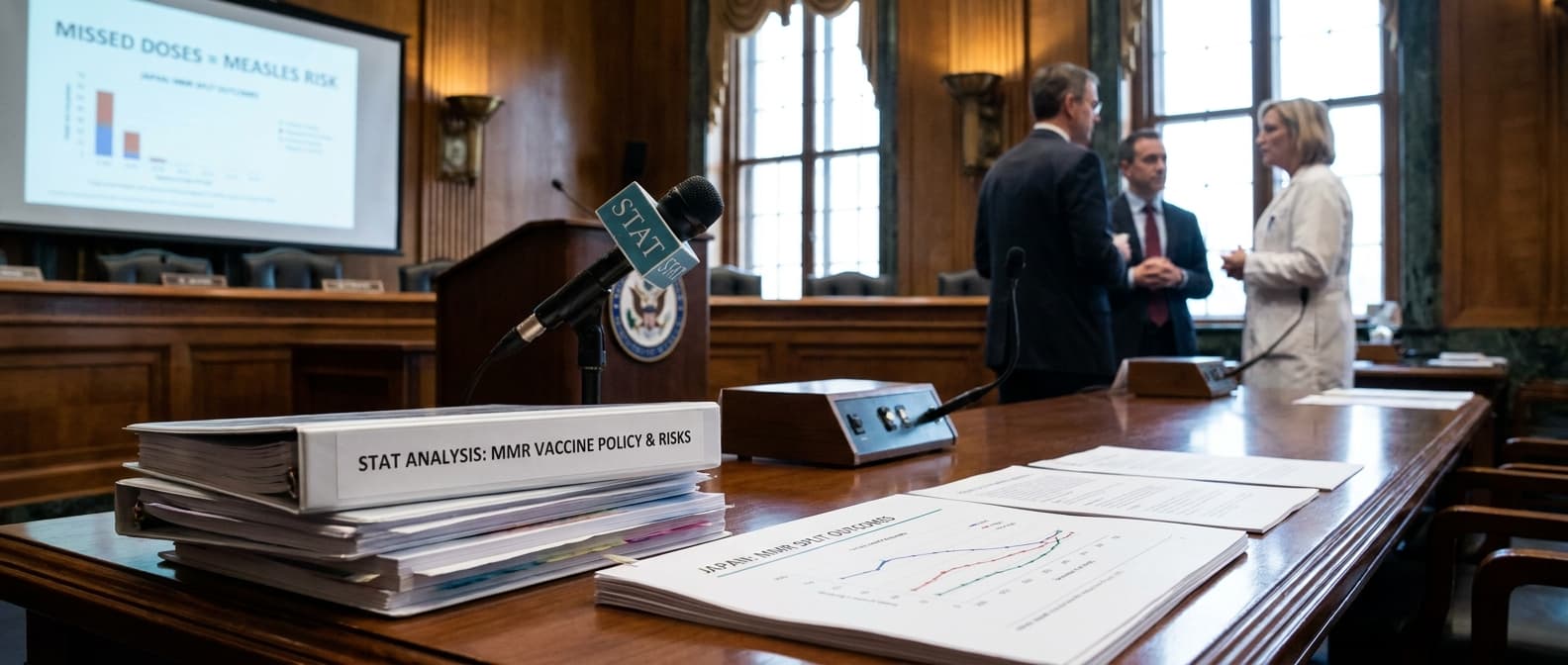
STAT Reports Splitting MMR Into Separate Shots Could Raise Missed Doses And Measles Risk

The current push to split MMR follows President Trump’s executive order calling for separate measles, mumps, and rubella shots. STAT’s review says more than 60 years of vaccine use and international experience suggest the practical effect would be more missed doses and more preventable illness, not a safety gain.
History offers a clear warning about efforts to split the measles, mumps, and rubella vaccine into separate shots. In STAT’s review, the likely result is not safer immunization, but more missed doses and more children left exposed to preventable infections.
That argument comes as President Trump’s executive order calls for the MMR vaccine to be broken up. STAT says the evidence base cuts the other way: the combined shot has a long safety record, while fragmenting vaccination schedules creates more opportunities for children not to complete them.
The Record Behind MMR
The modern MMR vaccine is rooted in work by Maurice Hilleman at Merck. After his daughter Jeryl Lynn developed mumps in March 1963, Hilleman used a throat swab from her infection to begin work that led to the mumps vaccine licensed in 1967. He later combined mumps with measles and rubella vaccines to create MMR, which was licensed in 1971 and remains in use in the U.S.
STAT’s account emphasizes the disease burden those vaccines were built to prevent. Before the measles vaccine was in wide use, measles caused 48,000 hospitalizations annually in the U.S., 1,000 cases of encephalitis, and about 500 deaths. Rubella was usually less severe in the infected person, but during the 1964 and 1965 epidemic it led to 20,000 infants being born with congenital rubella syndrome, including some 11,000 born deaf, 3,500 blind, and 1,800 with intellectual disabilities. Before vaccination, mumps was the leading cause of deafness in children.
The article also notes evidence that measles infection can increase the risk that children later die from other infectious diseases because of effects on the immune system.
Safety Claims And The Policy Dispute
On safety, STAT says more than 60 years of use show the MMR vaccine’s benefits are large. It also states that numerous studies have found the shot does not increase the risk of autism spectrum disorder. The same article says there is no evidence that combining many vaccines increases autism risk, and that thimerosal, which was never in MMR and is no longer used in routine childhood vaccines in the U.S., has not been shown to cause harm despite long-running allegations.
That matters because a policy to separate MMR would require a new product path without an evidence-backed safety rationale. STAT says there are no single-dose measles, mumps, or rubella vaccines marketed in the U.S., and exactly how or if they would become available remains an open question.
Japan’s Cautionary Example
STAT points to Japan as the most concrete warning about what can follow the loss of a combination vaccine. In 1989, Japan introduced an MMR vaccine using a different strain of the mumps virus. That vaccine was suspended in 1993 after it appeared to increase cases of meningitis that was not caused by bacteria, leaving only individual measles, mumps, and rubella vaccines available.
The article says mumps remains endemic in Japan, with more than 300 cases of mumps-induced hearing loss in 2015 and 2016 according to one survey. Measles vaccination rates fell to 83% in 2001, and an outbreak that year affected an estimated 265,000 children. Japan also had a rubella epidemic in 2012.
STAT is careful not to claim a direct causal link between the MMR withdrawal and every later outbreak, noting that other factors were involved over many years. But the practical lesson is the key policy signal: lower or spotty vaccination rates create risk, while removing the combination shot did not change autism rates. Japan later introduced a measles-rubella combination vaccine in 2006, was verified as having eliminated measles in 2015 and rubella in 2025, and this year an expert panel cleared an MMR shot that is not yet available.
A Stanford modeling study cited by STAT estimated that measles could become endemic, making any policy that increases friction in childhood vaccination a public-health and implementation risk, not just a messaging change.
Join the BioIntel newsletter
Get curated biotech intelligence across AI, industry, innovation, investment, medtech, and policy delivered to your inbox.