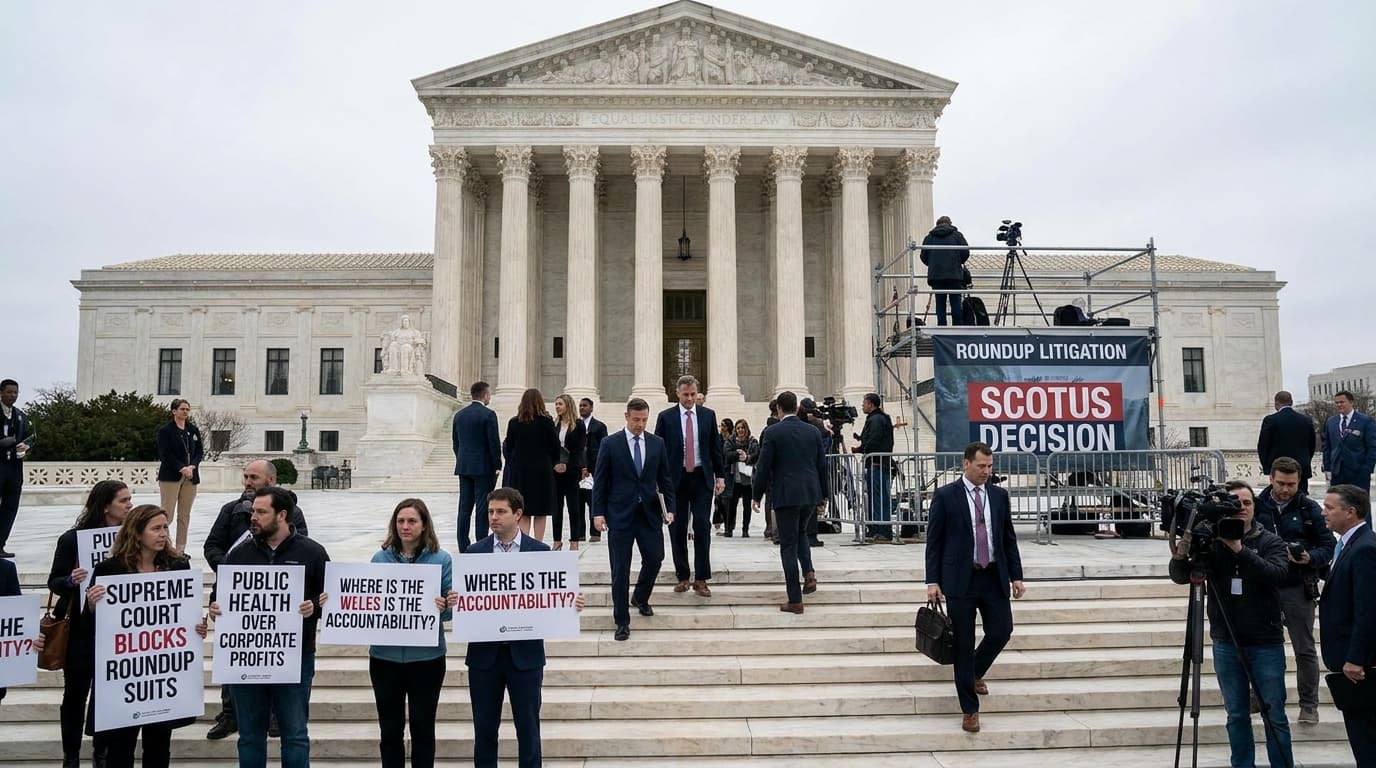
Supreme Court Shields Roundup Maker from Thousands of Lawsuits: Implications for Public Health, Regulation, and Legal Precedents

The Supreme Court's latest decision on Roundup litigation represents a pivotal legal event with broad implications for both product liability law and public health governance in the United States. This in-depth analysis explores the legal, scientific, and regulatory factors underpinning the Court’s opinion, assessing what it means for consumers, companies, and the courts going forward.
Introduction
In recent developments that have reverberated throughout the biotechnology, agricultural, and public health sectors, the United States Supreme Court has handed down a ruling that sides with the maker of the widely used weedkiller Roundup. By blocking thousands of lawsuits alleging that the product failed to warn people about its potential carcinogenicity, the Court has changed the legal landscape for both manufacturers and those seeking redress. This analysis explores the background, the contours of the ruling, the scientific debate over glyphosate (the active ingredient in Roundup), and what this means for future litigation and regulatory frameworks.
Background on the Litigation
Roundup has been at the center of controversy for years. As one of the world’s most utilized herbicides, concerns about its safety—primarily whether its active ingredient, glyphosate, could cause cancer—have led to a cascade of lawsuits. Plaintiffs have argued that the manufacturer failed to sufficiently warn consumers about the alleged risks, with lawsuits numbering in the thousands across the United States. Many of these cases had made significant progress in state and federal courts, and considerable settlements had been reached in previous years.
Legal Context
Product liability law in the United States allows consumers to sue manufacturers for failing to warn about known or reasonably foreseeable risks associated with their products. In the case of Roundup, plaintiffs argued that the company neglected to adequately warn them that the product might be carcinogenic, pointing to certain scientific studies and international classifications. On the other hand, the manufacturer has consistently maintained that Roundup’s safety is supported by regulatory bodies such as the Environmental Protection Agency (EPA).
With thousands of actions consolidated in multidistrict litigation, the Supreme Court’s intervention was highly anticipated. The decision to block these lawsuits is significant not only for Roundup but also for the principle of federal preemption, which holds that federal approval or regulation of a product can shield manufacturers from some state-level liability claims.
The Supreme Court’s Reasoning
According to the ruling, the key issue is whether federal regulation of pesticide labeling by the EPA preempts state-law claims that the company should have included warnings about cancer risk. The Supreme Court ruled in favor of the manufacturer, stating that EPA's explicit approval of Roundup's label, which does not require a cancer warning, means that state-law claims are preempted.
Legal Precedent and Preemption
Preemption is a legal doctrine that limits the ability of states to impose their own requirements when a federal agency has set explicit standards. The ruling interpreted the Federal Insecticide, Fungicide, and Rodenticide Act (FIFRA) as giving EPA central authority over label content. Because the EPA has found insufficient evidence to require a cancer warning for glyphosate, the Court found that allowing state courts to enforce additional labeling requirements would conflict with federal authority. This interpretation, while long debated, solidifies the protective effect of federal regulatory clearance for companies in highly regulated sectors.
The Scientific Debate: Is Glyphosate Carcinogenic?
At the core of the litigation and regulatory debate lies the question: does glyphosate cause cancer? The answer, according to available evidence, is contested and highly nuanced.
Regulatory Agency Stance
- EPA: The U.S. Environmental Protection Agency maintains that glyphosate is "not likely to be carcinogenic to humans" when used as directed. This conclusion has been reaffirmed in multiple regulatory reviews as recently as the mid-2020s.
- International Agency for Research on Cancer (IARC): In contrast, IARC, an arm of the World Health Organization, classified glyphosate as "probably carcinogenic to humans" in a landmark 2015 monograph. This assessment has been highly cited by plaintiffs.
- Other Jurisdictions: Regulatory agencies in Europe, Canada, Japan, and Australia have generally echoed the EPA's conclusions, though some European countries have moved to restrict or phase out glyphosate as a preventive measure.
Ongoing Research
Research into glyphosate’s health effects continues, with meta-analyses and long-term cohort studies providing data points on both sides. Overall, while there is evidence suggestive of some risk, especially with occupational exposures at high levels, regulatory reviews have broadly determined the risk for average consumers to be minimal under standard usage conditions.
Impact on Future Litigation
The Supreme Court ruling establishes a powerful precedent that will likely shield manufacturers of EPA-approved herbicides from most state-level failure-to-warn claims, at least where EPA has concluded warnings are not necessary. Plaintiffs' avenues may be narrowed primarily to claims outside the scope of label warnings (e.g., design defect, negligence, or fraud), though each of these faces steep hurdles under prevailing federal statutes and precedents established by this case.
Changes in Legal Strategy
Litigants, plaintiffs’ attorneys, and public health advocates may need to reconsider their strategies. The ruling does not entirely foreclose challenges to Roundup and similar products, but signals that the path forward will be much more difficult, especially regarding warnings or label content. The focus may shift to pursuing actions based on purported misrepresentation, misconduct in regulatory processes, or injuries seemingly outside the scope of EPA labeling.
Regulatory and Industry Perspectives
The ruling enables greater certainty for companies whose products are extensively regulated by federal agencies. Some in industry and policy advocacy argue that clear, predictable legal frameworks are critical for innovation and market stability. Opponents, however, warn that deference to federal agencies could undermine state-level consumer protection and leave gaps in long-term public health safeguards, especially in the face of evolving evidence or perceived regulatory capture.
The Role of Agencies
EPA and other federal agencies now bear considerable responsibility for both the scientific and legal oversight of products like Roundup. Calls for enhanced transparency, public engagement, and independent review in regulatory science are growing, especially as regulatory decisions increasingly determine not just label language but also liability exposure.
Implications for Other Industries
Federal preemption effects are not limited to agricultural chemicals. The ruling is being closely watched by stakeholders in pharmaceuticals, medical devices, and other consumer products subject to robust federal oversight. The decision may influence how courts handle failure-to-warn and other liability claims involving pharmaceuticals and medical devices approved by the FDA, potentially extending regulatory shield doctrines even further and leading to more centralized control over risk communication.
Broader Public Health Considerations
For the public, the decision may raise concerns about whether regulatory reviews are sufficiently robust and responsive to new science. Skeptics point to the potential for gaps or delays in regulatory action, the incentive for companies to prioritize federal over state liability, and the challenges for individuals seeking recompense for injuries they believe are linked to complex scientific matters.
Still, the ruling reflects the current state of science and regulation—a landscape where certainty is rare, evidence is complex, and the intersection of law, science, and policy remains contentious. The Court’s opinion, while addressing the intricacies of EPA oversight and state tort law, leaves open questions about how to balance innovation, risk, consumer rights, and scientific uncertainty.
Conclusion
The Supreme Court’s decision to block thousands of lawsuits against the maker of Roundup weedkiller solidifies a key legal principle in favor of federal preemption, while simultaneously igniting debate over regulatory science, consumer protection, and access to legal remedy. As plaintiffs regroup, regulators reassess, and industry recalibrates, the ultimate consequences of this ruling will unfold in both courtrooms and fields across the country.
For all stakeholders—patients, consumers, companies, and policymakers—the ruling underscores the vital role of science-based regulation and the enduring challenge of balancing legal consistency with robust health protections.
For further details, visit the original article at STAT News.
Join the BioIntel newsletter
Get curated biotech intelligence across AI, industry, innovation, investment, medtech, and policy delivered to your inbox.