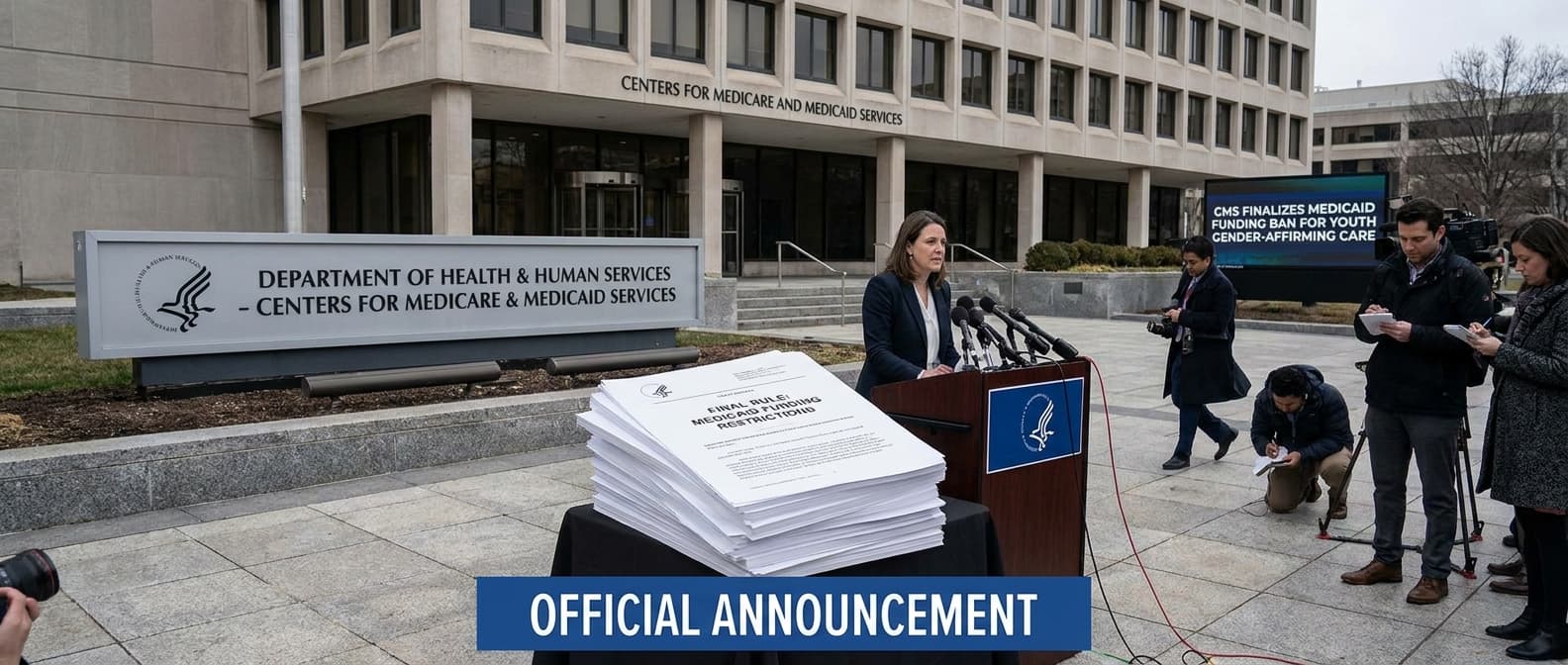
Trump Administration Finalizes Medicaid Funding Ban For Youth Gender-Affirming Care, Raising A Harder Court Test

The rule takes effect on Oct. 13 and applies to federal Medicaid funding for anyone under 18 and CHIP funding for anyone under 19, while leaving states free to use their own Medicaid dollars and allowing federally funded mental health care to continue. Its immediate significance is not only coverage loss but a more legally insulated attempt to reshape care through payment policy after several court setbacks.
The Trump administration has moved its campaign against youth gender-affirming care onto firmer procedural ground by finalizing a payment rule rather than relying only on executive actions and public declarations. The Centers for Medicare and Medicaid Services announced Tuesday that federal Medicaid and CHIP dollars can no longer be used to pay for pediatric gender-affirming medications and surgery, and the rule is set to take effect on Oct. 13.
That shift matters because earlier efforts have repeatedly run into legal trouble. STAT reported that judges have ruled against Justice Department subpoenas, a declaration from the health secretary, and parts of the president’s executive order halting all federal support for this care. Lawyers interviewed by STAT said the final CMS rule may be more difficult to challenge in the short term because the agency took it through the usual rulemaking process, including review of nearly 35,000 public comments and responses in the final document.
Why this rule may be harder to block
Legal experts quoted by STAT described the rule as more defensible than some of the administration’s previous steps. Travis Jackson, a partner in health care law at McDermott Will & Schulte, said the agency is “trying to position this rule to withstand the inevitable legal challenges,” adding that it appears to have learned from vulnerabilities that undermined earlier efforts. Carmel Shachar, director of the Health Law and Policy Clinic at Harvard Law School, said, “This rule feels less out there than some of the other proposals.”
The restrictions are specific. For Medicaid, the federal funding ban applies to gender-affirming medication and surgery for anyone under 18. For the Children’s Health Insurance Program, the ban extends to anyone under 19. Federal funds can still be used for mental health care, and states are not barred from using their own Medicaid dollars to pay for gender-affirming care.
The administration paired the rule with a broader enforcement signal. STAT reported that on Thursday, the Department of Health and Human Services released a report on diagnostic coding practices among gender-affirming care clinicians and referred hundreds of health care groups to the Justice Department for investigation into those practices. Even where courts have checked parts of the policy agenda, the administration has still pressured at least dozens of hospitals into closing or pausing gender-affirming care programs.
The legal weak points
Durable does not mean untouchable. STAT reported that lawsuits are expected, and a press officer from Andrea Campbell’s office confirmed that the Massachusetts attorney general plans to challenge the rule in court.
One major issue is authority. CMS says in the final rule that it has “independent legal authority” to determine which kinds of health care the federal government funds. But lawyers told STAT that a unilateral decision to revoke federal coverage without a directive from Congress may be unusual or even unprecedented. Katie Keith, director of Georgetown University’s Center for Health Policy and the Law, said that if the agency had many supporting examples, “they would cite them.” The most relevant example in the rule is the abortion funding restriction under the Hyde Amendment, which came from Congress, not agency initiative.
Another vulnerability is whether the rule is really about federal funding or whether it strays into regulation of medical care, which is generally a state matter. Keith pointed to a new “tapering period” in the final rule that allows federal funds to continue covering hormones for six months after the rule takes effect, until April 2027. Clinicians providing gender-affirming care have emphasized that there is no safe way to wean transgender people off their medications. That creates a tension inside the rule: if the policy is only about payment, the inclusion of a tapering period may invite arguments that the government is trying to direct treatment itself.
The evidentiary basis may also be contested. STAT said the final rule repeatedly cites the gender dysphoria report released by HHS last year, criticizes the methodology of a Utah State Legislature-commissioned report that reached different conclusions, and omits a recent report out of the Netherlands that also contradicted the HHS review. Keith said there are “legitimate questions” about whether the record before HHS truly supports the action taken.
The near-term signal is that payment policy has become the administration’s more effective lever. Even if the rule is eventually narrowed or struck down, it is structured to hold longer than the administration’s earlier moves and to reshape provider behavior well before the courts reach a final answer.
Join the BioIntel newsletter
Get curated biotech intelligence across AI, industry, innovation, investment, medtech, and policy delivered to your inbox.