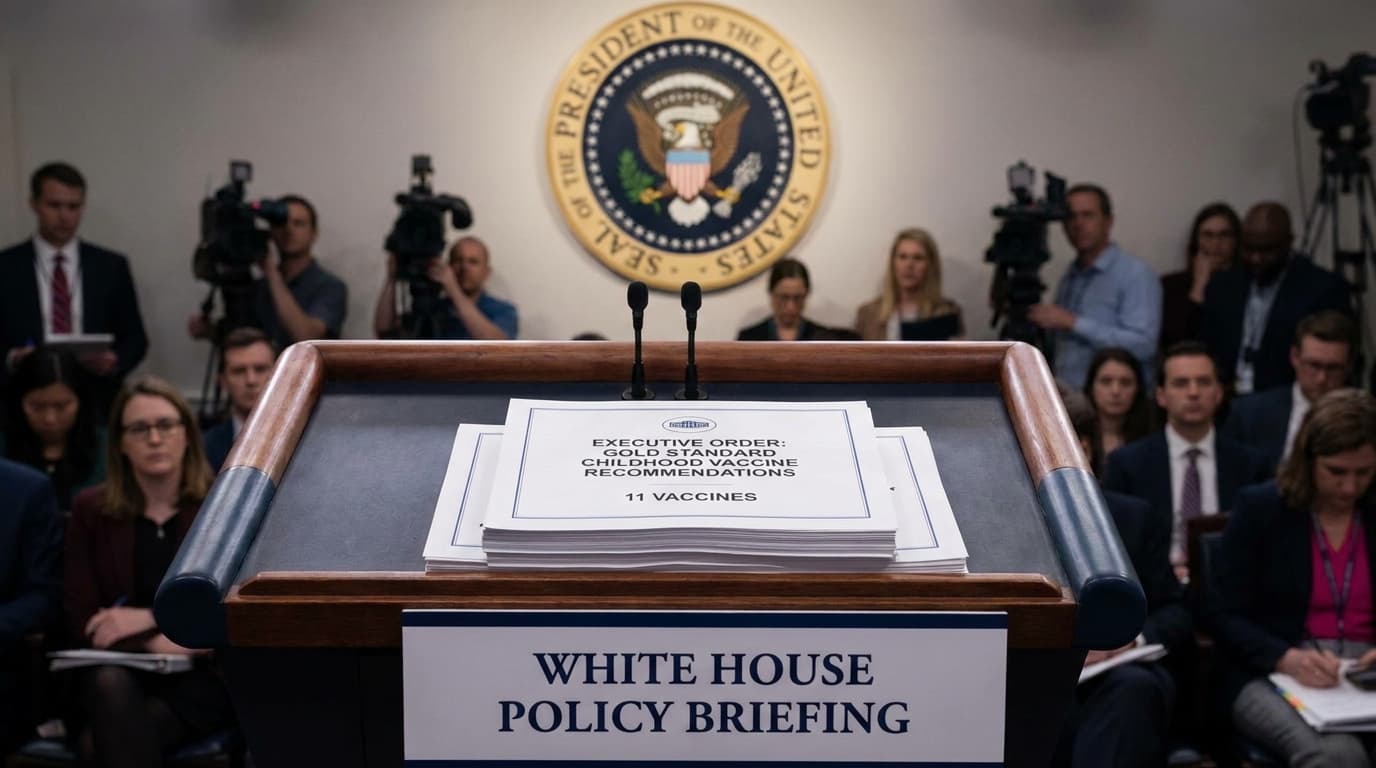
Trump Administration Issues Childhood Vaccine Order Cutting Routine Recommendations To 11, After Court Setback

The Trump administration on Monday publicly re-entered vaccine policy after months of avoiding the topic for political reasons, according to STAT. The order presents a new "Gold Standard Childhood Vaccine Recommendations" schedule, ties the change to earlier court intervention, and directs further review of some of the president’s assertions even as experts and at least one Republican lawmaker criticized the lack of evidence behind them.
President Trump on Monday signed an executive order that replaces the federal government’s previous childhood vaccine recommendations with a new schedule endorsed through the White House rather than the usual public, scientist-led process described by STAT. The order recommends that all children receive 11 vaccines instead of the 18 previously recommended by the federal government, and Trump said the doses would be spread out over a longer period.
The administration did not provide immunological evidence for the revised schedule. According to Heidi Overton, a health policy adviser at the White House, the order was issued in response to a court stalling previous changes to vaccine policy. After the signing, a White House official told reporters that the administration believes the new policy complies with earlier court orders and would survive future challenges because the president can make recommendations based on what he understands to be the best view of the science and the gold standard for vaccination.
What changed
The order creates what the administration calls "Gold Standard Childhood Vaccine Recommendations" and sorts vaccines into categories for all children, children at high risk of infection, or children whose vaccination should be discussed with a clinician. STAT reported that the recommendations were made in consultation with the president’s advisers and relied on comparisons between the U.S. system and those in other countries. The White House did not answer questions about why that approach was used or who advised the president on the order.
One of the most contentious elements is the order’s call for the MMR vaccine to be broken up into three separate vaccines for measles, mumps, and rubella. Experts told STAT that such a change would not be possible without years of work and investment, and that it is not supported by evidence. Trump initially said, without evidence, that the combined shot could be "quite lethal," then later said there is not evidence that it is lethal while adding that he had heard the claim from others. Overton later clarified that the administration still recommends the MMR shot for all children.
A White House official, when asked why Trump endorsed splitting up MMR, pointed to a review from two Kennedy-chosen advisers. STAT reported that the review recommends the shot and does not discuss separating it into individual vaccines.
The policy and legal signal
The immediate significance is not only the revised schedule but the mechanism used to produce it. The federal government’s vaccine approach has typically been set through a scientific process that is public and evidence-based. This order substitutes a presidential directive for that structure, which is a meaningful policy shift even if hospitals and physicians do not adopt the recommendations.
That implementation caveat matters. STAT noted that hospitals and doctors have ignored previous vaccine recommendations from the Trump administration, arguing that federal officials were not offering evidence to support policy overhauls. That means the order’s practical effect may be uneven at the national level, even though it raises the stakes for state programs, insurers, providers, and public messaging around childhood immunization.
The administration is also framing the order as a way around prior legal resistance. If that position is tested again, the central dispute may be less about whether the White House can issue recommendations and more about how much weight those recommendations carry when they depart from established medical guidance without presenting supporting evidence.
What to watch
Trump said parents could still vaccinate their children if they wish and that insurance would continue covering the shots. He also connected the order to the administration’s broader effort to understand and stop rising autism rates, while saying he does not know the cause of those increases.
The president directed the federal health department’s Task Force on Safer Childhood Vaccines to issue a report on the evidence behind assertions made in the order, including the idea of splitting up the MMR vaccine, and on how to implement the White House directive. Health secretary Robert F. Kennedy Jr. said the agency had already launched "unprecedented" research efforts in vaccines.
Criticism came quickly. A host of health experts objected to the order, and Sen. Bill Cassidy of Louisiana, who leads the Senate’s health panel, wrote on social media that the executive order is wrong and that the president does not have the expertise to make these changes. That response points to the next phase of the fight: whether the administration can turn a politically driven recommendation into a durable national standard when the medical and institutional infrastructure has already shown a willingness to resist unsupported vaccine policy changes.
Join the BioIntel newsletter
Get curated biotech intelligence across AI, industry, innovation, investment, medtech, and policy delivered to your inbox.