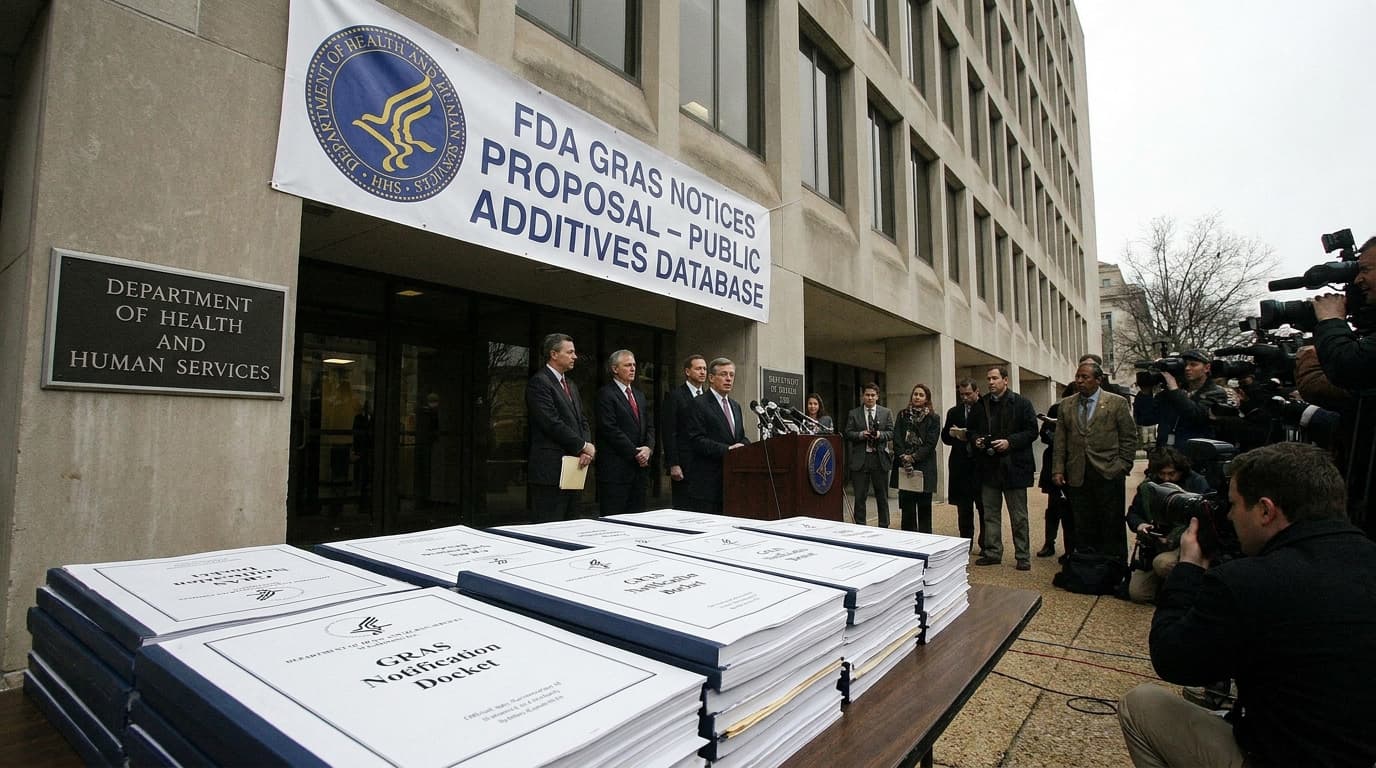
The Trump Administration Proposes FDA GRAS Notices, Opening A Public Additives Database

The Department of Health and Human Services on Monday outlined a proposed shift in the treatment of substances deemed “generally recognized as safe,” or GRAS. The change stops short of pre-market approval, but it would force notice to the Food and Drug Administration for new ingredients and create a public database of existing GRAS uses, narrowing what agency officials described as a decades-old information gap.
The Department of Health and Human Services on Monday announced a proposal that would, for the first time, require companies to notify the Food and Drug Administration when they want to add a new substance to human or animal foods under the “generally recognized as safe,” or GRAS, framework. Under the plan, manufacturers would also have to provide details on how they determined that an additive met GRAS criteria.
The proposal would also reach substances already on the market. Manufacturers with existing GRAS ingredients would need to tell the FDA how those additives are used, and HHS officials said that information would be made public in a database. That would not require companies to prove current additives are safe, but it would give the agency and outside researchers a clearer inventory of chemicals in the food supply.
What The Proposal Would Change
HHS Secretary Robert F. Kennedy Jr. has criticized what he calls the opaque GRAS loophole for years, arguing that the current system has allowed thousands of chemical additives into the food supply without meaningful vetting of their health effects. Monday’s proposal does not eliminate that structure, but it would require disclosure where self-determined GRAS decisions have often remained invisible to regulators.
FDA acting commissioner Kyle Diamantas said on a call with reporters that the plan would not establish “pre-market approval” of chemicals. He said Congress would need to amend the Food, Drug, and Cosmetic Act of 1938 to give FDA that authority. His argument for the rule is narrower: mandatory notice would “close a decades-old information gap” while staying within the agency’s existing limits.
Once a notice for a new ingredient reaches the FDA, the agency would review it within 45 days to confirm that it meets legal requirements, according to the proposal. Within 180 days, the FDA would complete a more substantive review and could ask manufacturers for more information or determine that an application has not met GRAS criteria, Diamantas said.
Where Supporters And Critics Diverge
Supporters of stronger food-additive oversight described the proposal as meaningful even though it falls short of forcing companies to obtain affirmative approval before marketing ingredients. Vani Hari, known as the FoodBabe and an adviser and ally in the administration’s food policy efforts, called it “a major step forward” and said the main benefit would be transparency about what consumers are eating.
Jennifer Pomeranz, an associate professor of public health policy and management at NYU School of Global Public Health who has studied the GRAS system, said the change would protect consumers because FDA currently has no reliable way to identify self-GRAS substances that companies do not disclose on food labels or otherwise.
Critics from another direction said the proposal does not address the part of the food supply they see as most closely tied to chronic disease. Former FDA Commissioner David Kessler told STAT that the action would not tackle refined carbohydrates and sweeteners common in ultra-processed foods. He filed a citizen petition a year ago asking the FDA to classify refined starches as unsafe and outside GRAS, which would shift the burden to food makers to prove substances such as high-fructose corn syrup are acceptable for human consumption. Kennedy said in February that he would act on Kessler’s petition and sent its position to the White House, but STAT reported that nothing has come of that yet.
Nutritionist and food-industry watchdog Marion Nestle was also unimpressed by the scope of the move, saying the company would still be responsible for the science and would still be hiring its own experts to say an additive is safe.
The Strategic Constraint
The policy signal is that the Trump administration is trying to turn a long-running political critique of GRAS into an operational disclosure regime, even without new statutory authority. That matters because a public database of additive use could change the market indirectly: not by banning substances up front, but by making them easier for agency staff, researchers and advocates to track and challenge.
The limitation is capacity. Nestle questioned whether the FDA has enough staff to review notifications, and the agency’s ranks were thinned out last year, including in food-related divisions. Previous administrations that wanted tighter GRAS oversight also worried that a more active review system could be labor-intensive and expensive. If the rule is finalized, its practical force may depend less on the text than on whether the FDA can process the notices it compels.
Join the BioIntel newsletter
Get curated biotech intelligence across AI, industry, innovation, investment, medtech, and policy delivered to your inbox.