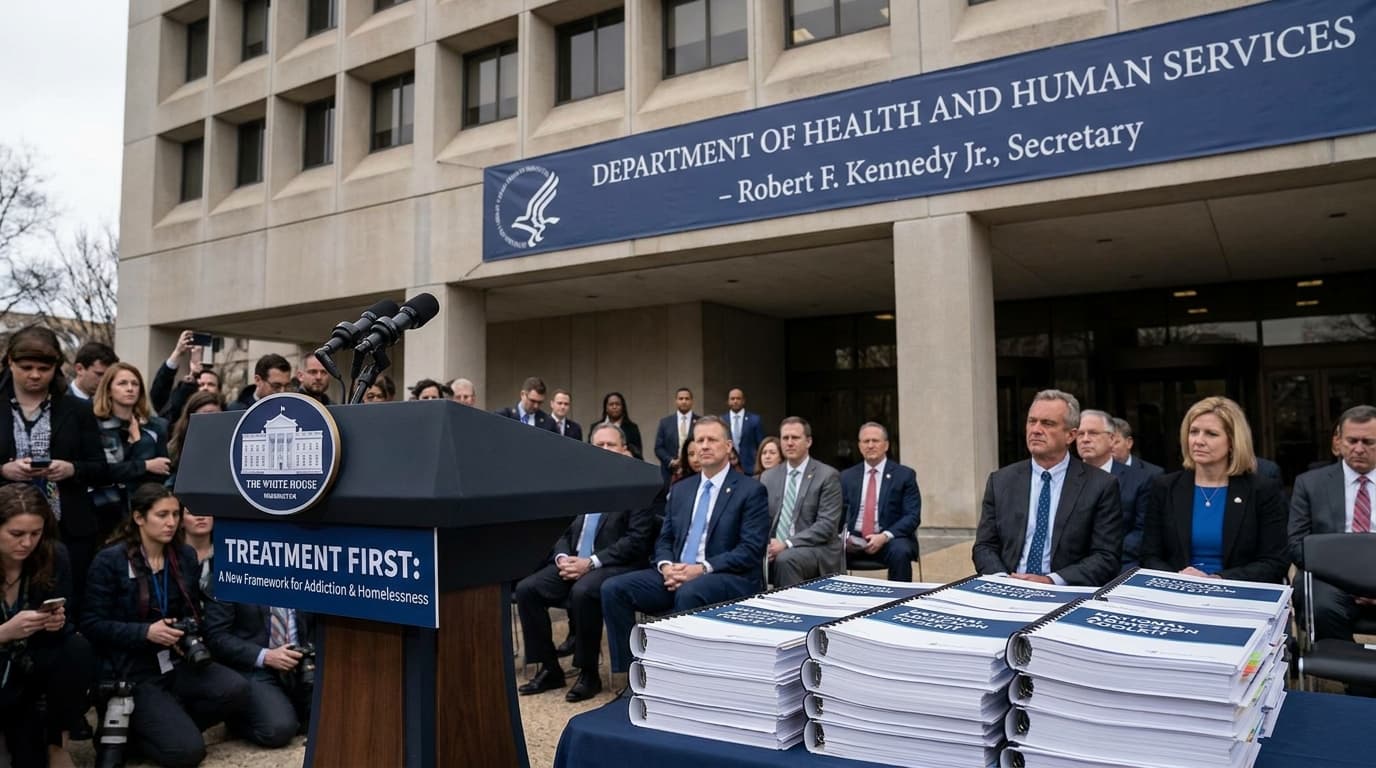
Trump Administration Unveils ‘Treatment First’ Addiction Toolkit, Rejecting ‘Housing First’ And Harm Reduction

The White House’s new toolkit marks a clear policy break from the Biden administration’s “housing first” and harm reduction approach. For providers and local governments, the practical signal is that federal support is being steered toward recovery models built around treatment, structure, and abstinence rather than unconditional housing access.
The Trump administration on Wednesday released a new framework for addressing addiction and homelessness that puts “treatment first,” boosts faith-based interventions, and rejects both harm reduction principles and the “housing first” model associated with the Biden administration.
The toolkit keeps medical treatment in the picture but frames abstinence as the end goal, rather than treating reduced drug use or reduced harms as sufficient outcomes on their own. Health secretary Robert F. Kennedy Jr. said in a statement that “recovery begins when we connect people with effective care, not leave them trapped in addiction and homelessness,” while Scott Turner, the secretary of the Department of Housing and Urban Development, said “housing is essential, but housing alone is not enough.”
What the framework changes
The document lays out a holistic recovery model that includes regular sleep cycles, daily schedules organized around treatment-related activity, and employment as a central part of the overall strategy. It also says relapse should be treated as a setback rather than necessarily a failure, while still making clear that abstinence is a primary goal.
A central policy break is the administration’s opposition to unconditional housing access. The toolkit cites one study showing that veterans in a supportive housing group were more likely to die of a drug overdose, using that finding to argue against providing housing without treatment requirements.
The strategy also favors elevating people with lived experience of addiction, homelessness, and recovery into influential outreach and recovery roles. That is a program design choice as much as a messaging one: it suggests the administration wants service delivery shaped by recovery narratives, not only by clinical or housing policy frameworks.
Where the friction points are
The toolkit makes only passing mention of methadone and buprenorphine, two medications known to greatly reduce the odds of dying from opioid overdose. That limited emphasis matters because, in recent months, a number of federal government actions have raised doubts about the administration’s support for medication-assisted treatment, also known as medications for opioid use disorder.
At the same time, the document endorses contingency management for meth addiction, the practice of offering financial incentives to people who reduce drug use or stop altogether. That approach aligns with current evidence and stands out because many contingency management providers had worried it would be ideologically incompatible with the administration’s broader posture.
The result is a framework that is not uniformly anti-medical, but selective in how it defines acceptable evidence-based care. It is more supportive of treatment models tied to recovery structure and abstinence than of approaches centered on overdose risk reduction or low-barrier support.
The policy signal
Despite the administration’s rejection of “housing first,” that model has shown some success in recent years. The source points in particular to Houston, where the city moved 25,000 people from the streets into homes over a decade. Local officials have described the effort as both a local success and a national model, even though it has more recently faced funding strain while homelessness rates have held steady.
That contrast is the main strategic signal in the new toolkit. The administration is not simply adjusting addiction policy around the edges; it is redefining what kinds of outcomes and interventions it wants communities to prioritize. For organizations that depend on federal alignment, the shift could favor programs built around abstinence, work, routine, and faith-linked recovery supports, while making harm reduction and unconditional housing models a less natural fit for future federal backing.
Join the BioIntel newsletter
Get curated biotech intelligence across AI, industry, innovation, investment, medtech, and policy delivered to your inbox.