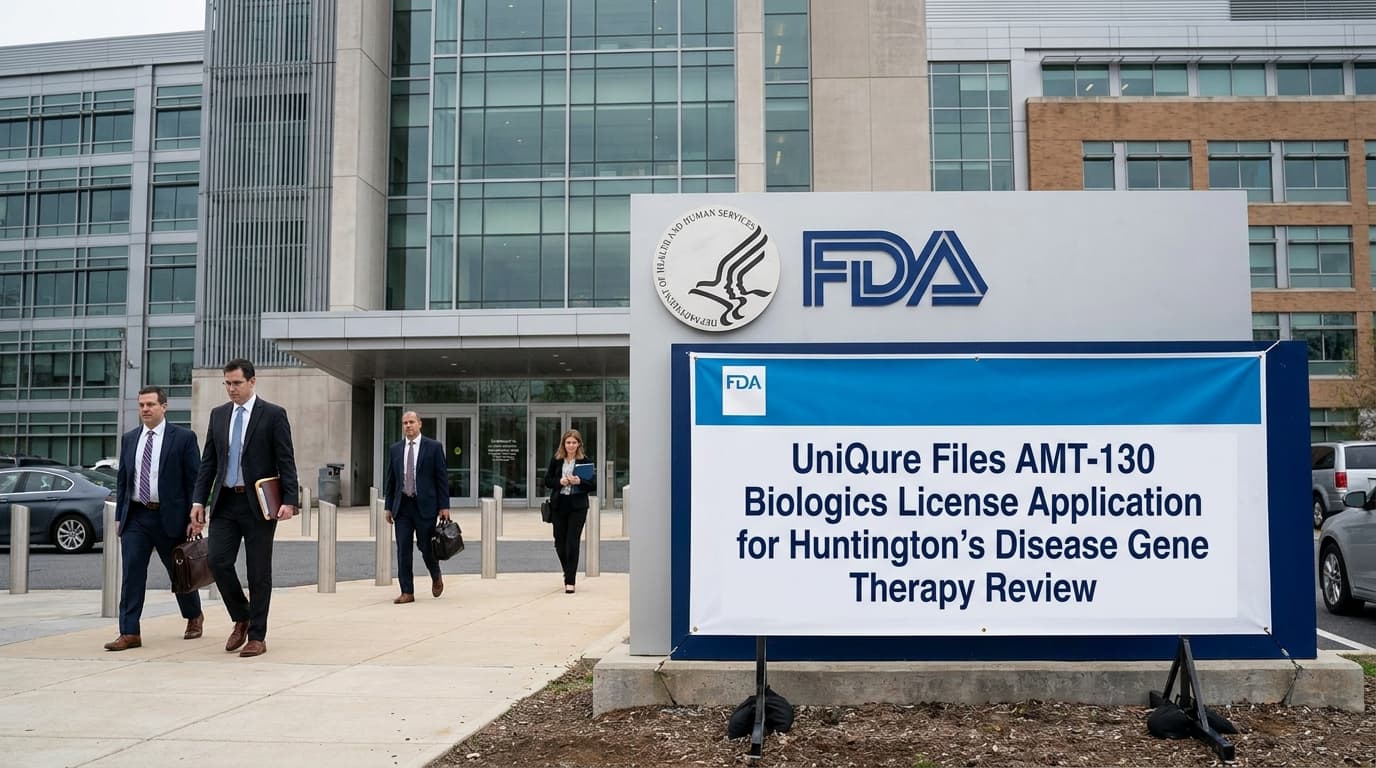
UniQure Files AMT-130 For FDA And U.K. Review, Reopening A Huntington’s Gene Therapy Path After FDA Reversal

The applications put AMT-130 on track to become the first genetic treatment for Huntington’s disease if regulators agree that three-year Phase 1/2 data can support accelerated approval. The bigger signal is regulatory: the case tests how far the FDA will go in accepting external controls and small-population gene therapy data after a public dispute inside the agency earlier this year.
uniQure has submitted a biologics license application to the FDA for its Huntington’s disease gene therapy AMT-130 and has also applied for approval in the United Kingdom. The company said it requested FDA priority review, which, if granted, would mean a six-month review cycle after a 60-day BLA review period.
If the FDA accepts the filing for priority review, uniQure said an action date for a potential accelerated approval could fall in late April or early May 2027, depending on the exact submission date. If approved, AMT-130 would be the first-ever genetic treatment for Huntington’s disease.
The regulatory path
The submission follows months of visible disagreement with the FDA over whether uniQure’s evidence package was sufficient. In November 2025, the FDA told the company it “no longer agrees” that data from uniQure’s Phase 1/2 trial were “adequate to provide the primary evidence in support of a BLA submission,” according to a company update cited by BioSpace.
That position reversed four months after former FDA Commissioner Marty Makary and former Center for Biologics Evaluation and Research director Vinay Prasad left the agency. The FDA then again agreed that the therapy’s three-year data were sufficient to support an application for accelerated approval.
The dispute mattered beyond AMT-130 itself because the application relies on a small study paired with an external control rather than a conventional late-stage randomized package. William Blair said the Phase 1/2 design aligns with the FDA’s plausible mechanism pathway publication and draft guidance on gene therapies for small populations, which specifically states that external controls may be appropriate in certain contexts. For developers in rare diseases, that makes this filing a test of how durable that flexibility is amid leadership turnover.
The data and next steps
uniQure is supporting the filing with three-year data from a Phase 1/2 trial that compared AMT-130 with a propensity score-matched external control derived from the Enroll-HD natural history database. The company announced in September 2025 that those data showed a 75% slowing of the disease.
Even with the application now filed, investors are not treating the path as fully de-risked. William Blair wrote that some regulatory risk remains because of continued leadership changes at the FDA.
A confirmatory study is already part of the picture. In a follow-up note, William Blair said management indicated that the company had reached alignment with the FDA on key elements of that trial, and Stifel called that alignment another positive sign. The company is “confident” the study will be well underway before the FDA makes its accelerated approval decision, according to Stifel’s summary of management’s position.
The planned confirmatory trial would include around 200 patients with 2:1 randomization between AMT-130 and standard of care. That setup suggests the filing is not only about whether the FDA accepts the existing package, but whether uniQure can keep a post-filing development program moving fast enough to support an accelerated path in a technically demanding indication.
Commercial implications
William Blair predicted a “measured” launch for AMT-130 given the requirement for surgically guided administration and estimated peak global sales of $3.2 billion in 2035. That qualifier is important: even if approved first, uptake may be constrained by procedure complexity, center readiness and the realities of delivering gene therapy into the brain.
Still, the filing moves Huntington’s disease into a different competitive and regulatory category. For uniQure, success would turn a long-running scientific program into a commercial one. For the sector, the more immediate signal is whether the FDA will translate stated openness to small-population gene therapy flexibility into an actual approval decision.
Join the BioIntel newsletter
Get curated biotech intelligence across AI, industry, innovation, investment, medtech, and policy delivered to your inbox.