Vaping And Cannabis Reach Record Or Near-Record Use Among Young Adults, As Survey Shows 19% Nicotine Vaping

The University of Michigan’s Monitoring the Future survey found young adults’ nicotine vaping reached its highest level since the question was added in 2017, and cannabis use stayed near prior peaks. The report pairs those trends with continued declines in alcohol use and historically low cigarette smoking, creating a more mixed public-health picture than a single headline suggests.
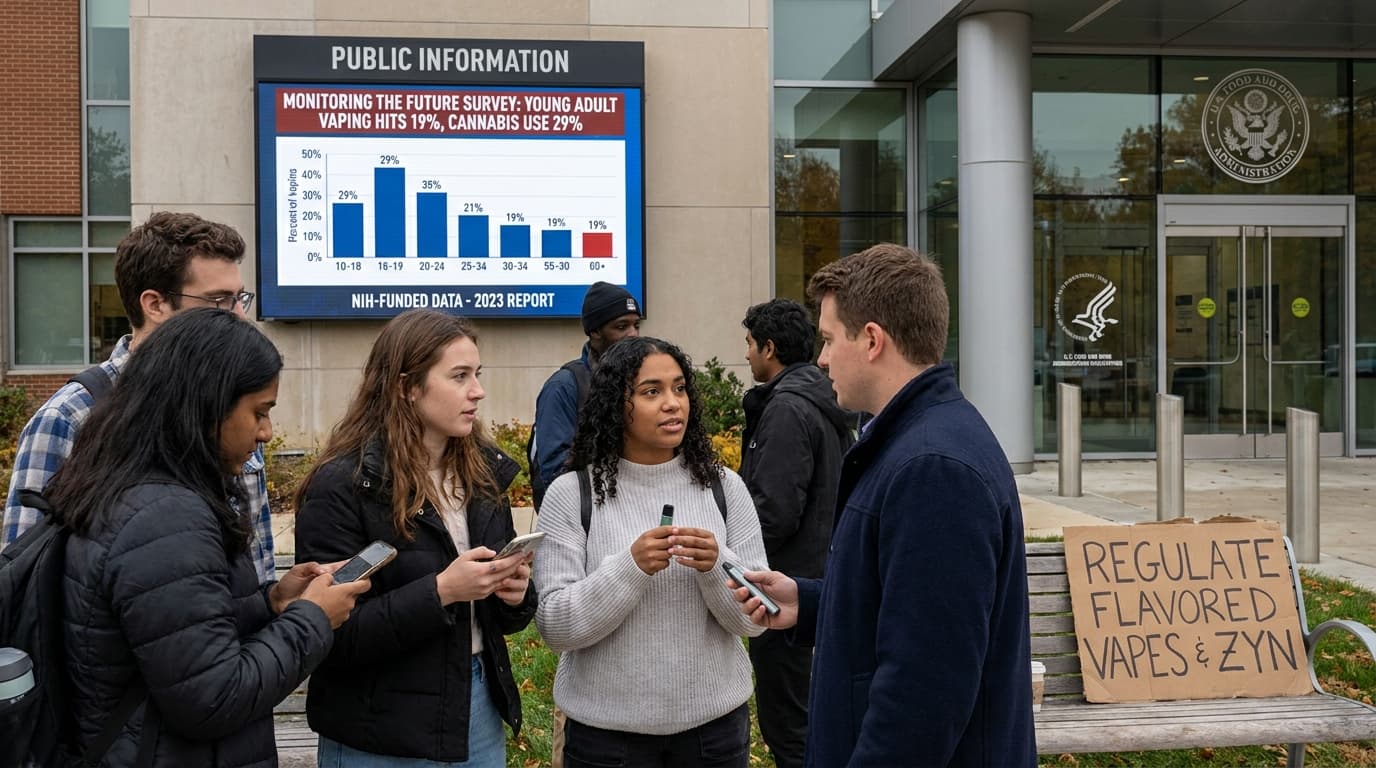
Young adults’ use of nicotine vapes and cannabis remained at historically elevated levels last year, according to new results from the Monitoring the Future survey conducted at the University of Michigan. Among adults ages 19 to 30, 19% said they had used nicotine vapes in the past 30 days, the highest level since that question was first added in 2017, while 29% said they had used cannabis in the past 30 days, just below the all-time high of 30% the previous year.
The survey also found a record high of 12% of young adults reported daily cannabis use. At the same time, alcohol use continued to decline and cigarette smoking stayed relatively low, suggesting a shift in substance use patterns rather than a simple broad-based increase across all categories.
The data
The annual survey, supported by the National Institutes of Health, gathers data from about 20,000 Americans ages 19 to 65. For young adults, the nicotine vaping figure has more than tripled since 2017, according to the report. Cannabis use in the same age group remained elevated even though it was slightly below the prior year’s peak.
Other findings were more mixed. About 60% of young adults and adults between 35 and 50 reported drinking alcohol in the last 30 days, but overall alcohol use continued to decline. Cigarette smoking among young adults was 8% in the past 30 days. The survey’s authors wrote that smoking in this group has been declining steadily since 2004, though the rate of decline may be plateauing.
The survey also tracked newer nicotine products. It first began asking about nicotine pouches such as Zyn in 2023, and since then, past-12-month use among young adults has risen from 5% to 13%. The survey did not ask about pouch use in the past 30 days.
Among other findings, heroin use among young adults rose from 0.2% in 2024 to 0.6% in 2025, while psychedelics use fell from 9% to 7%.
Nora Volkow, director of the National Institute on Drug Abuse, described the results as mixed in a press release. She said it was reassuring to see relatively low smoking rates and a continuing decline in alcohol use among adults, but said rising rates of cannabis, nicotine, and certain other drug use warrant attention.
The policy picture
The vaping data arrive alongside recent policy moves that critics say could expand access to flavored products that appeal to younger users. This spring, the FDA authorized fruit-flavored vapes for the first time, though the products contain age-gated technology intended to stop people under 21 from using them. Shortly after, the agency said that under certain conditions it would not prioritize enforcement against unauthorized fruit-flavored vapes already on the market.
Stefanie Gratale, an assistant professor at Rutgers School of Public Health focused on tobacco control, said it is difficult to pinpoint one cause for the survey’s trends. But she said access to unauthorized flavored e-cigarette products, difficulty enforcing regulations, and competing priorities in siloed regulatory approaches at the state and federal levels can all play a role. Her broader point is a policy one: public messaging and product regulation are now interacting in a market where the risk profile of nicotine products is increasingly fragmented and harder to communicate clearly.
Nicotine pouches raise a related issue. Tim McAfee, a former head of the Office of Smoking and Health at the Centers for Disease Control and Prevention, said the increase in pouch use is especially concerning after the FDA’s recent authorization of new nicotine pouch flavors and its June decision to allow Zyn pouches to be marketed as lower-risk than cigarettes. McAfee said tobacco companies use FDA harm-reduction claims not only to target current cigarette smokers, but also to open new markets among people not currently smoking.
That commercial implication matters because the survey suggests lower-risk claims do not necessarily stay confined to switching campaigns. Cigarette use remains historically low, but rising uptake in vapes and pouches among young adults points to category expansion rather than simple substitution.
What the signal is
The most important signal in the new survey is not that one substance is replacing another cleanly. Instead, the data show a consumer market where combustible cigarettes continue to lose ground, alcohol is easing lower, and nicotine and cannabis products with different regulatory frameworks are gaining traction among young adults.
For regulators, that means product-by-product decisions can reshape behavior faster than broad public-health messaging can catch up. For companies, it means growth is increasingly concentrated in formats that sit at the center of marketing, flavor, and risk-communication disputes. The survey does not settle which policy decisions drove the change, but it does show where use is accumulating.
Join the BioIntel newsletter
Get curated biotech intelligence across AI, industry, innovation, investment, medtech, and policy delivered to your inbox.