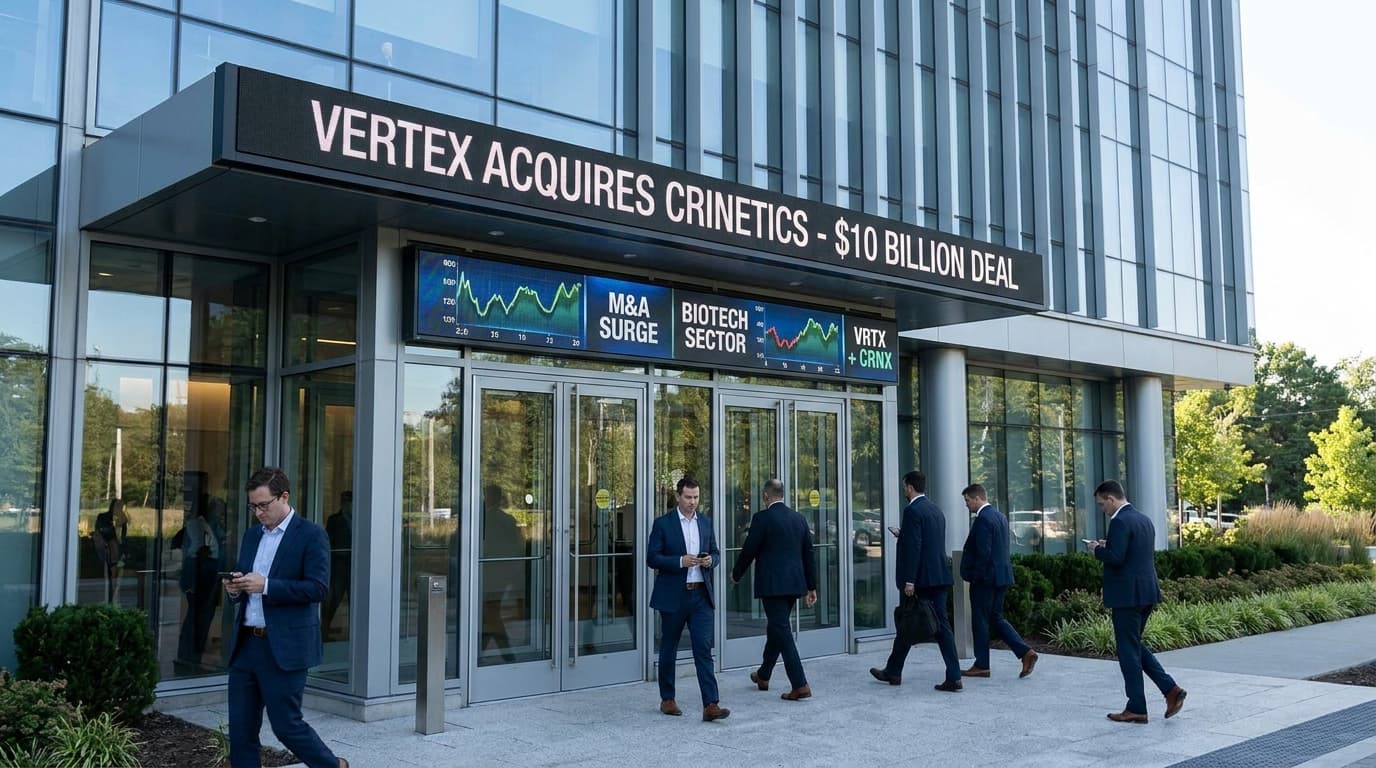
Vertex’s $10 Billion Bet: Acquiring Crinetics Pharmaceuticals in a Surging Biotech M&A Landscape

Vertex Pharmaceuticals has announced its $10 billion acquisition of Crinetics Pharmaceuticals, a significant deal in a year shaped by a surge in biotech mergers and acquisitions. This transaction centers around Crinetics’ rare endocrine disorder assets and underscores the industry’s appetite for innovation through strategic consolidation.
Vertex Pharmaceuticals' $10 Billion Acquisition of Crinetics: What It Means Amid a Biotech M&A Surge
Introduction
On July 6, 2026, Vertex Pharmaceuticals announced the acquisition of Crinetics Pharmaceuticals for a staggering $10 billion. This colossal deal spotlights both Vertex’s ambitions and the broader momentum seen in the biotech industry’s mergers and acquisitions (M&A) space. Crinetics, a biopharma company specializing in treatments for rare endocrine disorders, brings to Vertex a portfolio that fits seamlessly with the acquirer's strategy of targeting significant unmet medical needs. But this $10 billion transaction is about more than corporate realignment — it reflects profound shifts in drug development, pipeline diversity, and how companies position themselves for future breakthroughs. In this in-depth analysis, BioIntel unpacks the implications of this deal for the companies, their investors, patients in the rare disease community, and the industry at large.
The Vertex–Crinetics Deal: Details and Immediate Impact
Transaction Overview
Vertex Pharmaceuticals’ move to acquire Crinetics Pharmaceuticals will see the former spending $10 billion to add Crinetics and its drug pipeline, notably including a promising treatment for a rare endocrine disorder. The agreement, made public in July 2026, comes at a time when competition for innovative assets in biotech is ferocious, and large pharmaceutical companies are turning to M&A to replenish pipelines and anticipate future growth amid looming patent expirations elsewhere.
Strategic Motivations
From Vertex’s perspective, the acquisition fulfills several strategic objectives:
- Access to Novel Therapies: Crinetics brings with it a leading drug for a rare endocrine condition, signaling a push into markets with high barriers to entry and limited competition.
- Pipeline Expansion: Beyond its leading asset, Crinetics has a suite of early- and mid-stage programs that could complement Vertex’s focus, diversify its assets, and provide new growth avenues.
- Sector Leadership: The acquisition elevates Vertex’s standing in the rare disease space, building on its track record, including advances in cystic fibrosis and other specialty areas.
Market Reaction
While full stock market details are not divulged at announcement, typical initial reactions to such deals involve a boost in the target company’s valuation and scrutiny on the acquirer’s strategic vision and balance sheet capacity. M&A deals at this scale often redefine a company’s growth narrative and may also draw the attention of competitors and investment analysts searching for the next likely target in the red-hot biotech M&A environment.
Rare Endocrine Disorders: Why Are They a Strategic Prize?
The Unmet Need
Rare endocrine disorders represent clinically challenging, often underserved, patient populations. Therapy development is complicated by:
- Small patient populations
- Limited natural history data
- Complicated regulatory pathways Despite that, therapies in this space often receive regulatory incentives — such as orphan drug status, priority review, or market exclusivity — making them attractive targets for pharmaceutical innovators.
Crinetics’ Drug Portfolio
Crinetics’ foremost asset, highlighted in the acquisition, targets a specific rare endocrine condition. While the precise disease and drug name are not disclosed in early headlines, the sector’s attention typically focuses on treatments for acromegaly, Cushing’s disease, or related metabolic disorders. Such drugs often command premium pricing, fill a void in therapeutic options, and can be fast-tracked through regulatory processes owing to their novel mechanisms and high medical need.
Vertex’s Broader Strategy: The M&A Approach
Rising Competition and Patent Expiration Pressures
The pharmaceutical sector is known for innovation cycles, but also for waves of patent expirations (the so-called "patent cliff"). This threat compels companies like Vertex to:
- Seek high-value, late-stage assets via acquisition
- Bolster R&D productivity through pipeline expansion
- Enter disease areas adjacent to or synergistic with existing expertise
Vertex’s Track Record
Known chiefly for its dominance in cystic fibrosis therapies, Vertex has more recently moved into gene editing for sickle cell disease and other innovative modalities. This Crinetics acquisition signals intent to further diversify, possibly insulating the company from volatility in any single therapeutic franchise.
Biotech M&A: A Broader Trend
Vertex’s bold move mirrors a wider phenomenon: Biotech M&A is at record levels, as larger firms use acquisitions to:
- Offset R&D risk
- Acquire advanced science quickly (vs. building in-house)
- Tap into highly specialized teams and intellectual property
Implications for the Biotech Sector
Investor Perspective
Investors typically reward clear acquisition rationales, especially when acquirers like Vertex can point to synergies, a strong balance sheet, and a history of integrating such deals successfully. Risk is higher in R&D-driven acquisitions, but so is the reward if flagship drugs meet or exceed expectations.
Competitive Dynamics
This deal places extra pressure on other mid-cap biotechs in the rare disease field. As one major acquirer moves, others may seek to snap up valuable targets or alternatively shift to partnering/licensing routes. The sector’s competitive tempo could heat up substantially as a result.
Impact on Patients
For patients with rare endocrine disorders, this acquisition could accelerate access to new treatments — should Vertex leverage its development, regulatory and commercialization prowess. Questions also arise around pricing, access, and post-market support, all perennial issues in rare disease therapeutics.
Regulatory Scrutiny and Policy Context
Large M&A deals invariably come with regulatory scrutiny. Authorities may assess:
- Market concentration risks
- Impact on drug pricing and access
- Competitive effects in niche therapeutic areas Given the still-limited overlap between Vertex and Crinetics, antitrust hurdles may be minimal, but regulatory emphasis on healthcare M&A is intensifying across the U.S. and Europe.
The Road Ahead: Integration and Innovation Challenges
Integration Complexities
Acquisitions in biotech require more than financial transaction management — they demand careful cultural, operational, and scientific integration. For Vertex, ensuring that Crinetics’ talent, R&D productivity, and core innovations are preserved (or even enhanced) post-acquisition is fundamental to maximizing deal value.
The Innovation Mandate
The broader lesson from deals like this is clear: In a time of scientific revolution and capital competition, large companies must look outside their own walls. Whether it be through in-licensing, partnerships, or pure M&A, acquiring late-stage assets with strong proof of concept can shape the industry’s trajectory for years to come.
Conclusion
Vertex’s $10 billion acquisition of Crinetics is both a headline-grabbing event and a bellwether for biotech in 2026. It underscores how companies with strong balance sheets are willing to pay premiums for differentiated science addressing significant unmet needs. As the landscape of drug development grows even more competitive and capital-intensive, such deals will likely become more common, with ripple effects across innovation cycles, patient access, and industry strategy. Stakeholders — from patients and investors to regulators and competitors — will be watching closely to see if Vertex can deliver on the promise of its largest acquisition to date.
Source: STAT+: Vertex acquires Crinetics Pharmaceuticals for $10 billion as biotech M&A booms
Join the BioIntel newsletter
Get curated biotech intelligence across AI, industry, innovation, investment, medtech, and policy delivered to your inbox.