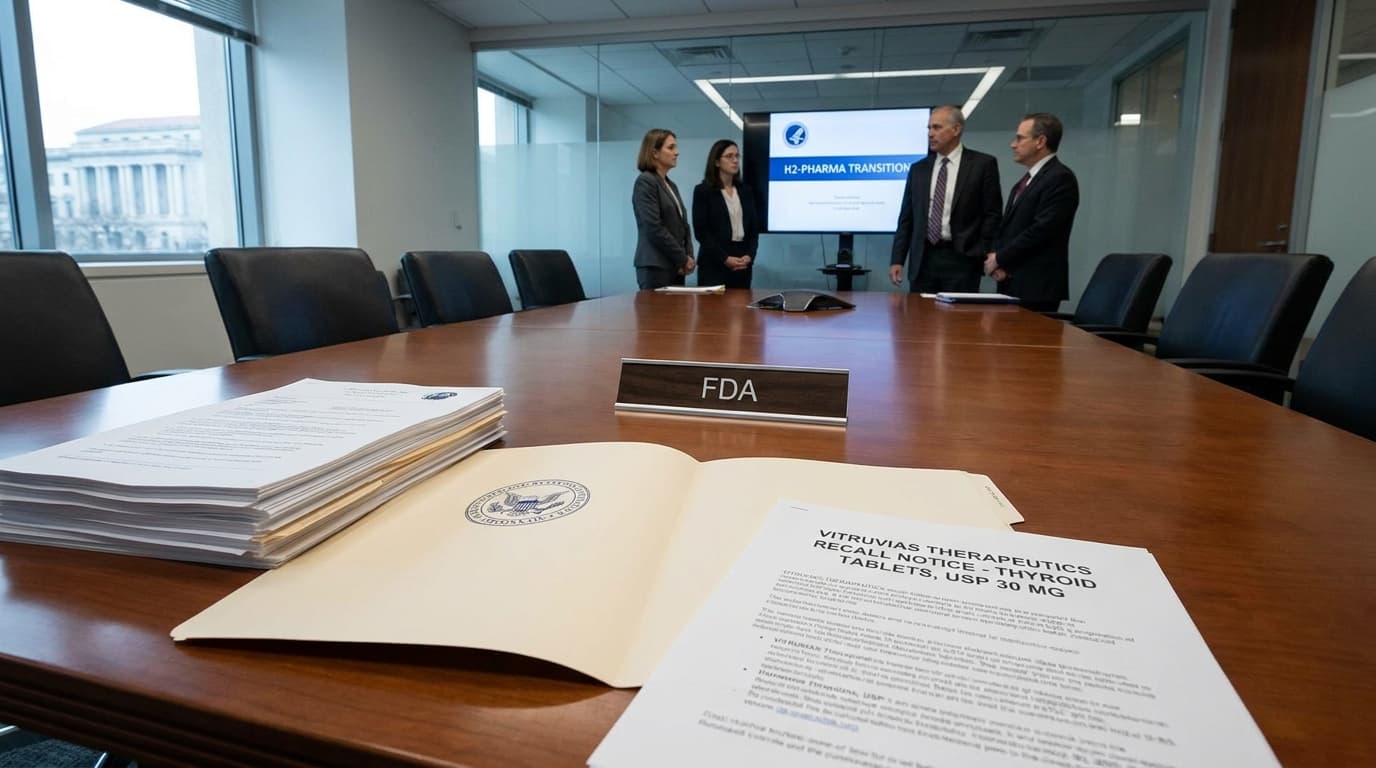
Vitruvias Recalls 3,655 Thyroid Tablet Units And Ceases Operations, Handing Products To H2-Pharma

The recall affects tablets distributed across the U.S. last year and was made with the FDA’s knowledge. The event combines a product quality problem with the disappearance of the company behind it, creating immediate continuity questions for a niche generic medicine.
Vitruvias Therapeutics is voluntarily recalling 3,655 units from a single lot of generic Thyroid Tablets, USP 30 mg, after testing confirmed the potential for the tablets to be superpotent. Separately, the company says on its website that it has ceased operations and transferred all of its products to H2-Pharma.
The recalled lot was distributed across the U.S. last year. Vitruvias said the tablets could cause overactive thyroid and lead to adverse events including weight loss, muscle weakness and rapid heart rate.
The recall
Vitruvias’ thyroid tablets are produced from pig thyroid glands. They are indicated for replacement or supplemental therapy in patients with hypothyroidism and for the treatment or prevention of euthyroid goiters.
According to the company, consuming a superpotent product could cause overactive thyroid, with adverse events ranging from heat intolerance to heart rhythm disturbances. Vitruvias said the risks could be particularly harmful to seniors, pregnant women and infants, especially if exposure persists over an extended period of time. The company noted that seniors with high thyroid hormone levels can suffer cardiac health problems, while overtreatment of hypothyroidism is linked to premature delivery and low birth weight in pregnant women and negative effects on infant development.
As of the Aug. 23 recall, Vitruvias said it had not received reports of adverse events related to the superpotent tablets. It warned patients not to stop treatment without contacting their healthcare provider for guidance or for a replacement prescription.
The regulatory and supply signal
Vitruvias said it is conducting the recall with the FDA’s knowledge, and the FDA posted the notice on its website without adding information beyond the company’s statement. The immediate issue is product quality, but the broader signal is continuity risk: the company behind the recall is no longer operating, while patients taking a replacement therapy may need an alternative prescription during the transition to H2-Pharma.
For a technically difficult generic product, that combination matters. A recall can usually be handled as a contained manufacturing event, but when it coincides with a company shutdown, it also becomes a market access issue for prescribers, pharmacists and patients relying on continued supply.
The company behind the product
Vitruvias was founded in 2013 and focused on technically difficult generic products, particularly sterile injectables. In 2018, the company raised $11.5 million in a series A round led by JW Asset Management and Perceptive Advisors. At the time, it had recently received approval for its first drug through the abbreviated new drug application pathway and was preparing to launch the product.
The company was founded by Carl Whatley, who spent 21 years at Wyeth before launching and selling a series of businesses. After selling ProEthic Pharmaceuticals to Kowa Company in 2008, Whatley led Midlothian Laboratories to a takeover by Hi-Tech Pharmacal and then founded Vitruvias.
Join the BioIntel newsletter
Get curated biotech intelligence across AI, industry, innovation, investment, medtech, and policy delivered to your inbox.