WHO Advances Phase 3 Ebola Vaccine Trial In DRC, As Bundibugyo Outbreak Tops 4,500 Cases

WHO officials said the outbreak centered in Ituri province has already become the second-biggest Ebola epidemic on record and is moving faster than any previous Ebola outbreak. The proposed study would randomize known contacts of cases to receive Ervebo or placebo, with additional Bundibugyo-specific vaccines potentially added if early safety and dosing data support their use.
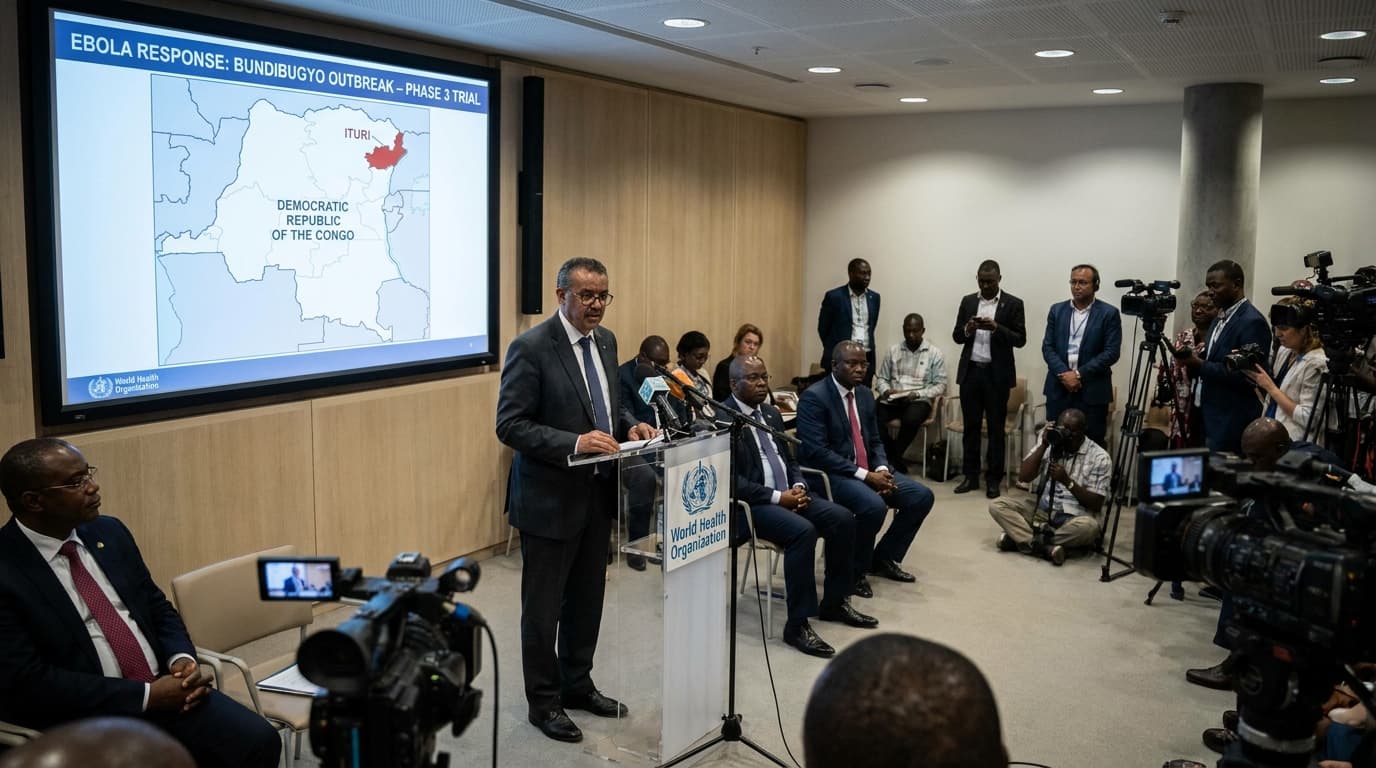
The World Health Organization said discussions with authorities in the Democratic Republic of the Congo are moving forward to expedite a multi-armed Phase 3 clinical trial of Ebola vaccines aimed at containing the spread of Bundibugyo virus in the country’s northeast. The urgency is rising with the scale of the outbreak: WHO Director-General Tedros Adhanom Ghebreyesus said Wednesday that it is already the second-biggest Ebola epidemic on record and is moving faster than any previous Ebola outbreak.
As of Monday, more than 4,500 cases had been confirmed in the outbreak, centered in Ituri province near the borders of Uganda and South Sudan, and more than 2,060 of those cases had died. Tedros said that at its current pace the epidemic is on track to eclipse the West African Ebola outbreak of 2014-2016, which turns the vaccine strategy from a research question into an outbreak-control decision with unusually high stakes.
The trial design
The first product slated for field study is Merck’s Ervebo, a one-dose vaccine that targets Ebola Zaire rather than Bundibugyo. WHO officials said an expert panel that advises the agency was initially reluctant to recommend Ervebo for this outbreak, but growing evidence from animal and human studies suggested the shot could offer some cross-protection against Bundibugyo and should be tested.
Tedros said WHO has recommended including Ervebo in a Phase 3 trial because it is not yet known whether the vaccine is efficacious against Bundibugyo disease in humans. Vasee Moorthy, who heads the WHO’s R&D blueprint program, said the agency is close to submitting a protocol to regulatory and ethics committee officials in the DRC for approval.
If authorized, the trial would randomize known contacts of cases individually to receive Ervebo or a placebo. That differs from the ring vaccination model used in the Ebola Ça Suffit trial in Guinea during the West African outbreak, where rings of contacts and contacts of contacts were randomized to immediate or delayed vaccination. Moorthy said subsequent Ebola trial experience led officials to conclude that individual randomization would be a more efficient approach in this setting.
Why Ervebo is being used first
Ervebo’s use reflects the practical reality that the outbreak is advancing faster than Bundibugyo-specific vaccines are ready. Field studies after the Guinea work estimated Ervebo’s effectiveness against Ebola Zaire at about 84%, but WHO officials were explicit that this does not establish efficacy against Bundibugyo in humans.
That distinction matters commercially and operationally. In most outbreak settings, a proven product would be the obvious first choice. Here, the leading available vaccine is being deployed because it exists, can be studied now, and may provide cross-protection, while better-matched candidates are still generating early clinical data. The trial therefore doubles as an emergency response tool and a mechanism to determine whether the currently accessible vaccine is actually useful for this species.
What could enter the study next
Several Bundibugyo-specific candidates could join the trial in the early autumn if their Phase 1 readouts support that step. The Oxford Vaccine Group at the University of Oxford is running a Phase 1 trial of its experimental vaccine, while production partner the Serum Institute of India is trying to produce large quantities of doses. Moderna has also begun a Phase 1 trial of a messenger RNA vaccine in Canada.
Moorthy said both groups expect results in September that could provide the initial safety and dosing data needed for possible inclusion in the Phase 3 study. Both programs are hoping their vaccines can be used as single-dose regimens, though Moorthy said it remains to be seen whether they can be effective without a booster. A third Bundibugyo-specific vaccine from IAVI, built on the same platform as Ervebo, is further back; WHO said it will be several months before enough doses are available for use in a Phase 3 trial.
The policy tension around access
WHO officials did not address during the press conference a separate report that DRC authorities want to roll out Ervebo for general use outside a clinical trial, an approach that has support from the Africa Centres for Disease Control and Prevention. STAT reported that it is unclear whether the DRC could obtain enough doses to execute that plan.
There is a roughly 500,000-dose stockpile of Ervebo, but it is controlled by the International Coordinating Group on Vaccine Provision, which is run by the International Federation of Red Cross and Red Crescent Societies, Doctors Without Borders, the United Nations Children’s Fund, and the WHO. That governance structure means the next phase of the response is not only about science; it is also about who decides when scarce doses move from controlled trial settings into broader field use.
Join the BioIntel newsletter
Get curated biotech intelligence across AI, industry, innovation, investment, medtech, and policy delivered to your inbox.