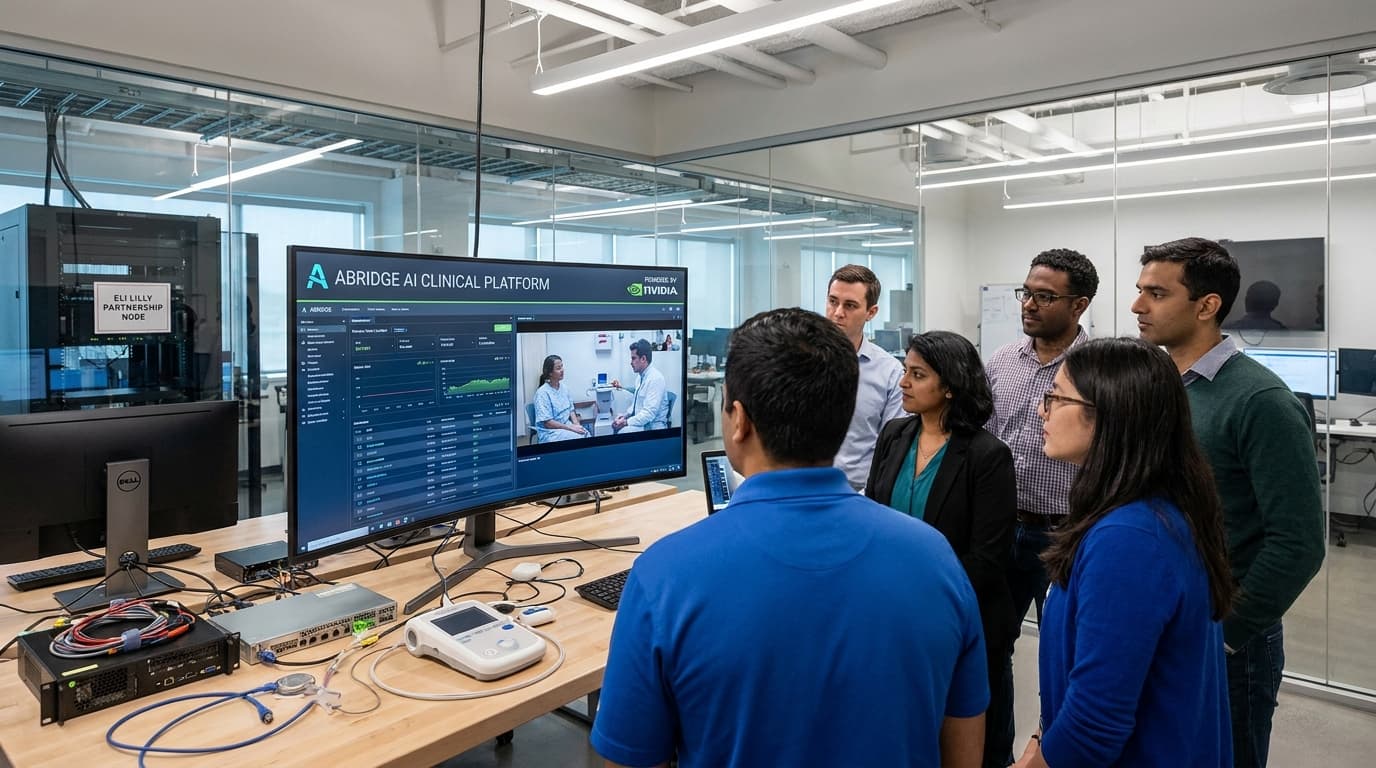
Abridge’s Strategic Evolution: Clinical AI Platform Expansion, New Pharma Alliances, and Fundraising Milestones

Clinical AI company Abridge has gone public with four major developments indicating a pronounced shift from its origins as an AI-based documentation tool. The new trajectory is defined by alliances with Nvidia and Eli Lilly, additional platform capabilities, and a more visible ambition to shape healthcare information flow among key stakeholders.
Introduction
In June 2026, Abridge, previously known primarily as an AI-powered scribe automating clinical documentation, announced a suite of updates that signal a substantial repositioning in the healthcare technology marketplace. Historically, Abridge has been one of several digital health startups enabling providers to streamline paper trails and compliance tasks through artificial intelligence. Now, the company has deliberately staked its claim as something more—a comprehensive AI solution platform aiming to reshape interactions across payers, providers, and the pharmaceutical industry.
This detailed overview traces Abridge’s evolution, the strategic intent behind recent business moves, and what this might mean for the broader digital health sector.
The Four Pillars of Abridge’s Announcement
According to reporting by MedCity News, Abridge’s New York City event laid out four foundational updates:
-
Partnership with Nvidia Foundation Model:
- Signaling technical credibility and ambition, Abridge has partnered with Nvidia, one of the most influential players in AI hardware and enterprise AI development. The use of Nvidia’s foundation models for clinical language and context is anticipated to accelerate Abridge’s AI capabilities, spanning documentation, data structuring, and possibly decision support.
-
Eli Lilly Investment:
- The direct investment from Eli Lilly, one of the world’s largest pharmaceutical companies, both underscores pharma-sector confidence in Abridge’s platform and signals a crossover—AI documentation companies are increasingly attracting not only healthcare delivery partners but also the pharmaceutical research sector. Such partnerships can drive AI integration into clinical trials, real-world evidence generation, and post-market surveillance.
-
Expanded Platform Capabilities:
- While initially viewed as strictly a scribe tool, Abridge now intends to roll out advanced platform features. These new capabilities likely include real-time analytics, interoperability enhancements, workflow integration, and compliance optimization. This move responds to the growing demand for seamless integration with EHR systems, payer interfaces, and other health IT solutions.
-
Role as a Mediator Between Payers and Providers:
- In a healthcare landscape often characterized by data silos, administrative friction, and competing incentives, Abridge envisions its platform helping to facilitate communication and efficiency between insurers and healthcare providers. The company’s messaging suggests a commitment to not just automate documentation but to address broader bottlenecks impeding reimbursement, quality measurement, and value-based care contracts.
Context: Abridge in the Competitive AI Health Market
The clinical documentation AI market has rapidly expanded since the early 2020s, with multiple entrants—ranging from large EHR vendors incorporating native AI assistants to startups tailoring niche transcription solutions. Abridge’s recognition that scribing alone is a limiting market position comes at an opportune moment: consolidation and capability expansion are widely regarded as necessary for survival.
Market Positioning
Abridge’s rebranding coincides with several trends:
- Hospitals and health systems demanding interoperability and seamless integration across platforms.
- Payers investing in digital health to control costs and gain greater clarity in care documentation.
- Pharmaceutical companies seeking real-world data pipelines that can support research, marketing, and regulatory reporting.
While competitors such as Nuance (acquired by Microsoft) and Suki have staked claims in AI-powered documentation, Abridge’s simultaneous outreach to payers and pharmaceutical companies marks a nuanced approach, potentially unlocking differentiated avenues for growth.
Strategic Implications of Partnerships and Investments
The Nvidia Foundation Model Partnership
Nvidia’s solutions extend beyond data centers and chips; its foundation models increasingly serve as the backbone of large-scale, industry-specific AI applications. By integrating Nvidia’s language models, Abridge stands to accelerate:
- Data processing with improved speed, context awareness, and multilingual capabilities.
- Compliance with evolving standards for patient information handling, including HIPAA and GDPR.
- Opportunities for future clinical decision support products, as richer structured data becomes available immediately at the point of care.
Eli Lilly’s Stake in AI-Driven Clinical Documentation
As an investor, Eli Lilly’s participation indicates a two-pronged confidence: in Abridge’s team and technology, but also in the market’s appetite for AI tools uniquely positioned on the edge between provider and pharma data needs. This may also foreshadow attempts by traditional pharmaceutical players to hedge against the mounting pressures of R&D costs, regulatory compliance, and post-market surveillance requirements.
Platform Expansion: Beyond the Notes
Electronic documentation is an entry point; the path to stickier, higher-value contracts lies in providing actionable insights and helping customers (hospitals, payers, pharma, life sciences) optimize:
- Coding and billing accuracy.
- Risk adjustment under value-based contracts.
- Real-world data gathering for clinical investigation or regulatory reports.
- Workflow automation and quality measurement.
These functions, once segmented, now appear poised for integration as interoperability and analytics mature.
Mediation Across Healthcare Stakeholders
Healthcare is notorious for misaligned incentives and communication breakdowns. The practical upshot of Abridge’s declared intent to “mediate” payer-provider relations could take multiple forms:
- Real-time adjudication support to minimize denied claims or automate resubmissions.
- Automated explanations of benefits and clarification of clinical intent for reviewers.
- Embedding AI models that evolve from mere transcription to advocacy for optimal documentation in line with payer requirements.
What Does This Mean for the Digital Health Ecosystem?
Abridge’s repositioning does not occur in a vacuum. Rather, it reflects several converging forces across the U.S. and global healthcare landscape:
- Maturation of AI in healthcare: Early enthusiasm has given way to expectations for demonstrable ROI, interoperability, and measurable improvements in patient and clinician experience.
- Regulatory and policy evolution: As value-based care models proliferate, both providers and payers face steeper penalties for incomplete or inaccurate documentation, further driving demand for AI-centered solutions that do more than automate basic administrative tasks.
- Pharma’s increasing reliance on real-world data: The blurring of boundaries between provider, payer, and pharmaceutical workflows requires comprehensive platforms that can simultaneously support billing, quality, compliance, and research data streams.
Competitive Landscape and Future Challenges
Abridge’s pursuit of platform status offers promise but also comes with risks. Health IT history is replete with companies overextending themselves, aiming for broad feature sets but failing to achieve robust adoption. Execution will be key, particularly as clinical teams resist workflow changes and health systems remain cautious about data security and vendor lock-in.
The partnership with Nvidia provides a technical edge, but sustaining performance across complex hospital environments will require ongoing engineering investment, cross-platform integration expertise, and responsive customer support. Similarly, close alignment with Eli Lilly must be balanced against potential conflicts of interest, data governance questions, and the need to assure provider customers of independence.
Conclusion: Inflection Point for Abridge and the Sector
Abridge’s June 2026 updates reflect a decisive pivot—one that positions the company not as a utility provider for clinical documentation, but as a mediator and innovator in the broader data, payer, and pharma ecosystems of healthcare. Its actions will be watched closely, as success could inspire a new generation of AI startups to seek bolder, cross-industry partnerships. Conversely, the challenges of scale, adoption, and integration remain daunting, suggesting that the next phase for clinical AI will reward those who balance vision with operational discipline.
For now, the signals are clear: The age of the AI scribe as a standalone product is ending, and the era of integrated, multipurpose AI platforms is underway.
This article is based on original reporting by MedCity News. For full details, visit the source below.
Join the BioIntel newsletter
Get curated biotech intelligence across AI, industry, innovation, investment, medtech, and policy delivered to your inbox.