AI Can Accelerate Discovery — Development Still Decides What Advances

While AI’s role in speeding up the initial discovery phase is undeniable, the journey from promising in silico leads to approved drugs remains challenging. This article explores how AI, development processes, and regulatory standards interconnect in modern drug R&D.
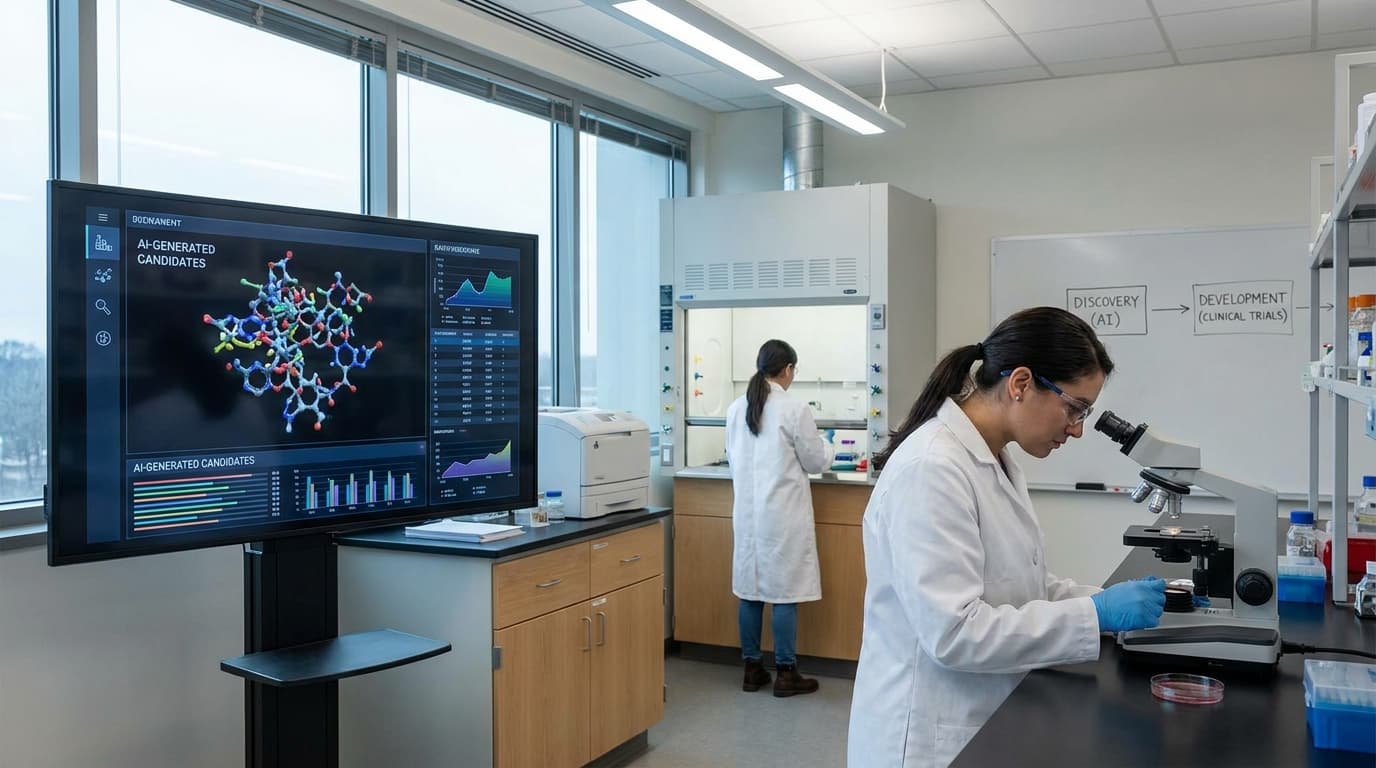
The integration of artificial intelligence (AI) into drug discovery is often touted as one of the most transformative trends within the broader life sciences and pharmaceutical industries. Over the past decade, a growing number of startups and established companies have employed various AI and machine learning (ML) models to sift through vast chemical libraries, predict molecular interactions, and generate hypotheses rapidly for novel therapeutics. But even as the pipeline of AI-generated candidates grows, a familiar reality persists: the leap from lab to clinic is dictated by the difficult, often unpredictable, confines of traditional drug development.
A New Era for Drug Discovery: The Promise of AI
To understand the present landscape, we first need to define what AI is bringing to the table in the context of drug research. Historically, identifying a new drug candidate could take years of painstaking bench work, as scientists synthesized and tested compounds manually or via high-throughput screening approaches of limited scale. With the advent of powerful neural networks, deep learning models, and next-generation computational chemistry, thousands (even millions) of potential therapeutics can now be triaged and selected in silico.
The advantages are clear:
- Speed: AI can predict biological activity, toxicity, and pharmacokinetics at unprecedented scale and velocity.
- Breadth: Machine learning tools help scientists explore chemical spaces that are too vast for human intuition or brute-force experimental methods.
- Novelty: New molecular structures—sometimes never before seen—emerge from generative models based on predefined target profiles or desired attributes.
A surge of partnerships between pharma giants and technology companies, alongside a proliferation of venture-backed biotech startups focused on AI-driven platforms, underscores the perceived value. Today, dozens of AI-enabled candidates are progressing through early- and mid-stage clinical trials. The industry speaks excitedly about “accelerating” drug discovery, and at times, about fundamentally “changing” the paradigm.
Where the Accelerator Ends: The Bottleneck of Development
Yet, as highlighted in MedCity News, the story does not end with the prediction of interesting molecules. While AI “will continue changing how small molecules are discovered, the candidates that generate the most interest in silico still have to succeed under real development conditions."
The Realities of Clinical Development
Transitioning from promising early data to a viable therapeutic product involves:
- Preclinical Testing: Safety, toxicity, and efficacy studies in cell lines and animal models remain essential regulatory prerequisites.
- Manufacturing: The synthesis and scalable production of complex new molecules can present unforeseen difficulties, especially for entirely novel chemical matter.
- Pharmacodynamics & Pharmacokinetics: Accurate predictions for how a compound acts in the body, and how the body acts on it, are still dependent on real-world biological complexity, which models may not capture fully.
- Clinical Trials: Human biology is messy; effects observed in silico or in animal models may not translate predictably to people. Statistical power, patient heterogeneity, and trial design are all crucial.
Many AI-derived candidates face the same attrition rates as traditionally discovered molecules once they enter these development pathways.
Beyond the Algorithm: The Human and Regulatory Factor
Moreover, the development gauntlet is shaped by larger realities:
- Regulatory Demands: Agencies such as the FDA or EMA require thorough, reproducible data at every stage, from Investigational New Drug (IND) filings to Biologics License Applications (BLAs).
- Investment and Commercialization Pressures: Investors and boards look for clear routes to market, sufficient intellectual property protection, and a favorable risk/benefit profile amid competitive landscapes.
- Patient and Physician Acceptance: Uptake often depends on robust safety profiles, compelling efficacy results, and acceptance from the end-user community—none of which can be assured by computational predictions alone.
AI’s Rising Role and the Persistent Value of Traditional Expertise
Does this mean AI’s role is overhyped? Not necessarily. Observers note that while AI is supercharging the research side, accelerating hypothesis generation, and unearthing hidden molecular gems, drug development remains “development” for a reason. Each successful new therapy owes its existence not just to machine learning, but to a comprehensive development engine—one that marshals preclinical and clinical expertise, regulatory navigation, manufacturing acumen, and often, good fortune.
For example, innovative AI platforms can suggest modifications to reduce toxicity or improve drug-like properties very early, potentially saving millions of dollars and years of work downstream. But clinicians, chemists, and regulatory professionals must still vet, refine, and shepherd these concepts through every subsequent hurdle.
Case Studies: From Hypothesis to Healthcare Intervention
Several recent examples illustrate how AI is making a real-world impact—albeit with caveats:
- Protein Folding & Structure Prediction: Tools like AlphaFold have dramatically improved scientists’ ability to anticipate the shapes of proteins critical for disease processes. Still, leveraging these insights to design and validate actual therapies is a journey.
- High-Throughput Virtual Screening: Biotechs specializing in AI-driven virtual screening have enabled pharma partners to select clinical candidates from vast compound libraries. But many are still awaiting their first approved therapies.
- De Novo Drug Design: Generative AI models can recommend wholly novel molecular scaffolds. However, these often pose chemical synthesis challenges, and unknown toxicity or immunogenicity risks require extensive bench and animal work before entering the clinic.
Despite these technological leaps, the human-led processes of stepwise validation, ethical oversight, robust statistical design, and regulatory compliance remain bedrocks of modern drug development.
The Future: How Will AI and Human Ingenuity Co-Evolve?
The future will likely see even closer integration between algorithmic prediction and real-world laboratory and clinical workflows. Hybrid teams—drawing on data science, chemistry, biology, and medicine—are becoming the norm at forward-thinking companies and academic centers.
- Iterative Looping: AI models will become more useful as they continually ingest and learn from both preclinical and clinical outcome data, creating a virtuous cycle.
- Personalized Drug Development: As more patient-level data flows through these systems, tailored therapies for specific populations may become more feasible—and trial designs more adaptive.
- Regulatory Engagement: Regulatory agencies are actively exploring how to integrate machine-learning driven approaches into adaptive and pragmatic trial frameworks, though standards and validation pathways are still evolving.
Yet, none of this lessens the crucial role regulatory affairs, translational scientists, manufacturing engineers, clinicians, and payers play in bringing a new medicine from discovery to patients.
Conclusion: The Path Forward
In summary, AI has turbocharged the creativity and throughput of the early stages of drug discovery, opening the door to more, and more diverse, potential treatments. It is, without doubt, a vital tool in the innovation arsenal. But the cold, hard reality is that development—not just discovery—still ultimately determines what gets to patients. Every AI-generated lead must navigate a labyrinth of biological, regulatory, and human obstacles before reaching the market.
The companies and teams best positioned for future success are those that acknowledge both sides of this equation—embracing the power and promise of AI without overlooking the irreplaceable value of engineering, clinical, regulatory, and commercial expertise. As such, the R&D lifecycle may evolve, but its endgame—safe, effective, accessible medicines—remains unchanged.
For an in-depth analysis on this evolution, see the original MedCity News reporting.
Join the BioIntel newsletter
Get curated biotech intelligence across AI, industry, innovation, investment, medtech, and policy delivered to your inbox.