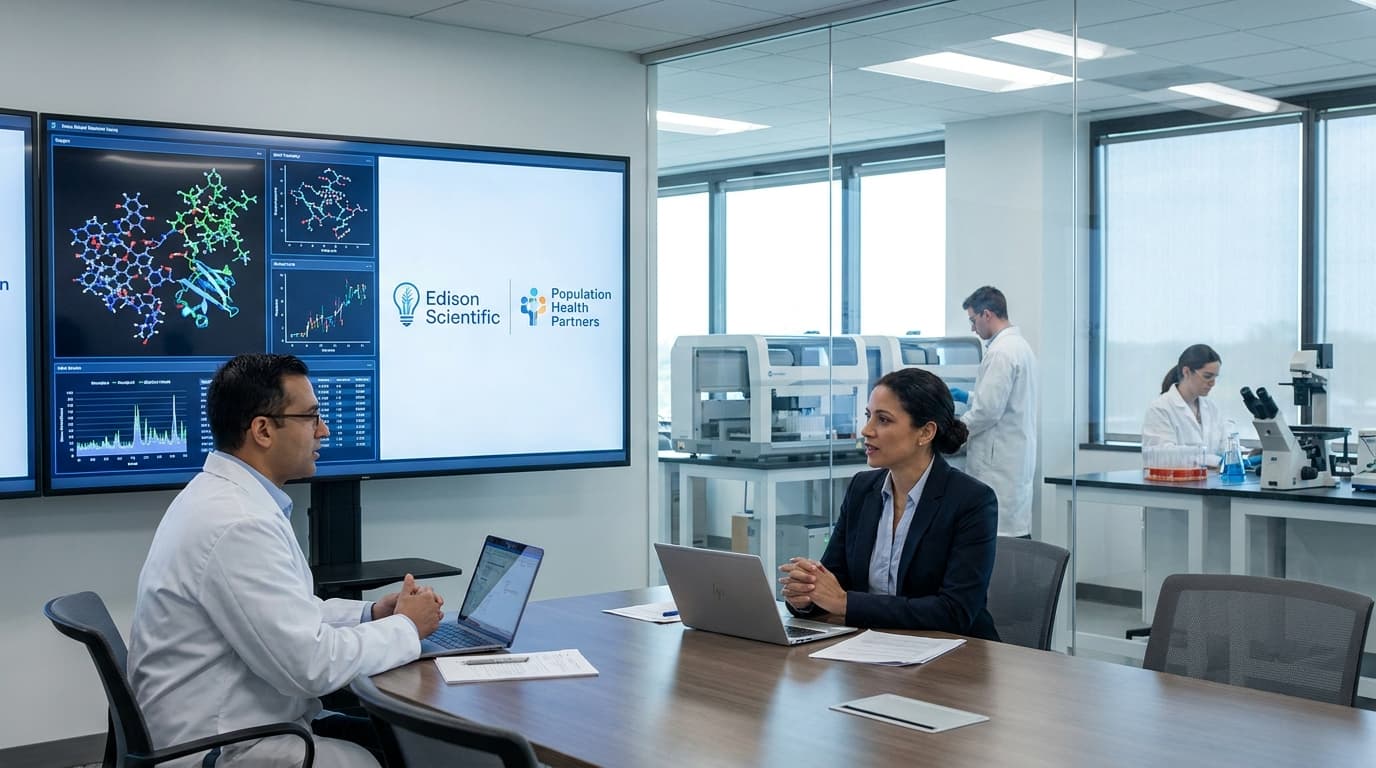
AI Pioneer Edison Scientific Teams Up with Population Health Partners to Launch New Biotechs

Edison Scientific, a leader in AI-driven science, and investment firm Population Health Partners are joining forces to develop new biotechs empowered by artificial intelligence. The partnership will harness the potential of AI agents for drug discovery and development, promising to reinvent how biotech startups are founded and scaled in a rapidly evolving scientific landscape.
Overview: A Defining Partnership in AI-Driven Biotech Innovation
The intersection of artificial intelligence and biotechnology is rapidly redrawing the boundaries of drug discovery and development. In a noteworthy move that is likely to reshape the industry, Edison Scientific—a company recognized for its pioneering work in scientific AI—and Population Health Partners, a global investment firm with deep experience in building successful biotechs, have announced a strategic partnership to create new biotech ventures. The joint effort aims to deeply embed AI agents from the earliest stages of drug conceptualization all the way through clinical development—marking a bold step into the future of life sciences entrepreneurship.
The Strategic Alliance: More Than Capital and Code
The collaboration between Edison Scientific and Population Health Partners is a clear signal: traditional silos separating computational science, biology, and finance are giving way to integrated innovation ecosystems. By bringing together the sophisticated AI capabilities of Edison Scientific and the industry know-how and resources of Population Health Partners—the same investment team previously involved with the formation of Metsera—the alliance is positioned to launch startups where AI is not merely an auxiliary tool, but a central architect of both research strategy and business decisions.
Why This Partnership Matters
This development comes at a time when AI agents are moving from proofs of concept in computational labs to real-world impact within the pipeline of new therapeutics. While the promise of artificial intelligence in life sciences has often been weighed down by skepticism, recent advances in large-scale machine learning, molecular modeling, and automated experiment design are shifting the balance. As investment capital pours into biotech, demand grows for venture creation platforms that move ideas to proof-of-concept—and ultimately, to the clinic—both more efficiently and with a higher hit rate.
Edison Scientific’s Next Chapter: From Algorithms to Application
Edison Scientific stands out in the increasingly crowded AI-for-biotech space due to its focus on developing autonomous AI agents capable of proposing, testing, and refining hypotheses at a speed and scale unmatched by traditional R&D paradigms. Their algorithms are tailored not just for brute-force data mining, but for reasoned inference and iterative learning—a crucial distinction as the complexity of biological systems outpaces what even the largest research teams can manually comprehend. Coupled with Population Health Partners’ track record in translating scientific breakthroughs into scalable companies, the partnership is positioned to create a pipeline of new ventures that can leverage these advanced capabilities from the outset.
Drug Discovery: A Process Ripe for AI Acceleration
The traditional drug discovery process, from hit identification to clinical development, is notoriously slow, costly, and prone to failure. With each phase requiring years of iterative experimentation, screening, and testing, investment timelines stretch and attrition rates climb. This inefficient dance is where AI agents can make the most profound impact.
Examples of AI-Powered Transformation:
- Target Identification: Instead of laboriously sifting through mountains of literature or inconclusive experimental data, AI agents can rapidly integrate multi-omics datasets to predict novel druggable targets with greater accuracy.
- Lead Optimization: AI models simulate molecular interactions and forecast off-target effects, minimizing the risk of late-stage setbacks.
- Clinical Design: Automated systems can propose optimal clinical trial parameters—including dosage, patient selection, and endpoints—by analyzing historical data at scale, potentially improving both speed and success rates.
From Research Bench to Business Model: The Formation of New Biotechs
Partnering with Population Health Partners gives Edison Scientific the ability to not just develop new technology but to catalyze the foundation of new ventures around it. Unlike traditional startup incubators or accelerators, this approach is more akin to a ‘company creation platform’ where teams, capital, and scalable infrastructure are built in from day one. The backing from a firm with roots in successes like Metsera means that both strategic direction and operational execution are deeply informed by industry experience.
Industry Reaction and Potential Implications
This collaboration between Edison Scientific and Population Health Partners is notable for its ambition and its attempt to operationalize a vision that has, until now, mostly lived in whitepapers and investor presentations. Industry observers suggest that this could trigger a new wave of venture creation within biotech, where AI-driven R&D becomes foundational, not just supplementary.
The early-stage biotech environment has been marked by a burst of AI-oriented activity since 2023, with everything from protein-folding models to virtual screening platforms seeing substantial venture influx. However, most efforts have struggled to scale beyond enabling technologies for pharma partners. By building completely new biotechs from the ground up—where AI is embedded in every decision—this partnership could change the calculus for many early-stage investors deciding between platform bets and asset-centric strategies.
AI Agents: Beyond the Buzzwords
What distinguishes the approach from the broader market is the application of true ‘autonomous agents’—systems that can independently generate scientific questions, design experiments, interpret outcomes, and loop those insights back into their strategy. This ‘closed-loop’ model of discovery, if realized at scale, could reduce the cycle time for early-stage drug programs, lower costs, and enable the pursuit of targets previously shelved as too complex or too risky for conventional programs.
Looking Forward: Critical Questions and Next Steps
While the ambition is clear, significant questions remain:
- Integration: How seamlessly will AI-agent-driven startups be able to integrate with existing regulatory, clinical, and commercial frameworks?
- Human Oversight: What guardrails will be put in place to mitigate risks of AI-driven bias or erroneous outputs leading to failed programs?
- Return on Investment: Can this model produce clinical-stage assets, and ultimately, approved therapies, more reliably than traditional structures?
Industry insiders will be closely watching both the process and outputs of this new partnership. Success could prompt rapid “copycat” efforts by other AI and biotech venture groups, amplifying the influx of both capital and talent into the domain.
Conclusion: The Promise and Peril of AI-First Biotech Venture Creation
The collaboration between Edison Scientific and Population Health Partners stands as a harbinger for the kind of AI-integrated, cross-disciplinary biotech organizations that may soon become industry standard. As more capital, talent, and technology converge on the challenges of drug discovery, the lines between biological insight and computational intelligence continue to blur. The partnership’s ultimate success will depend on bridging those worlds—not just in software code or investment dollars, but in tangible medicines that meet real-world patient needs.
As AI agents move from theoretical promise to practical deployment, the biotech sector faces both an unprecedented opportunity and a host of fresh risks. Edison Scientific and Population Health Partners are betting that their approach will be the blueprint for the next generation of biotech startups. The scientific community, investors, and—most importantly—patients will be watching.
Source: STAT News
Join the BioIntel newsletter
Get curated biotech intelligence across AI, industry, innovation, investment, medtech, and policy delivered to your inbox.