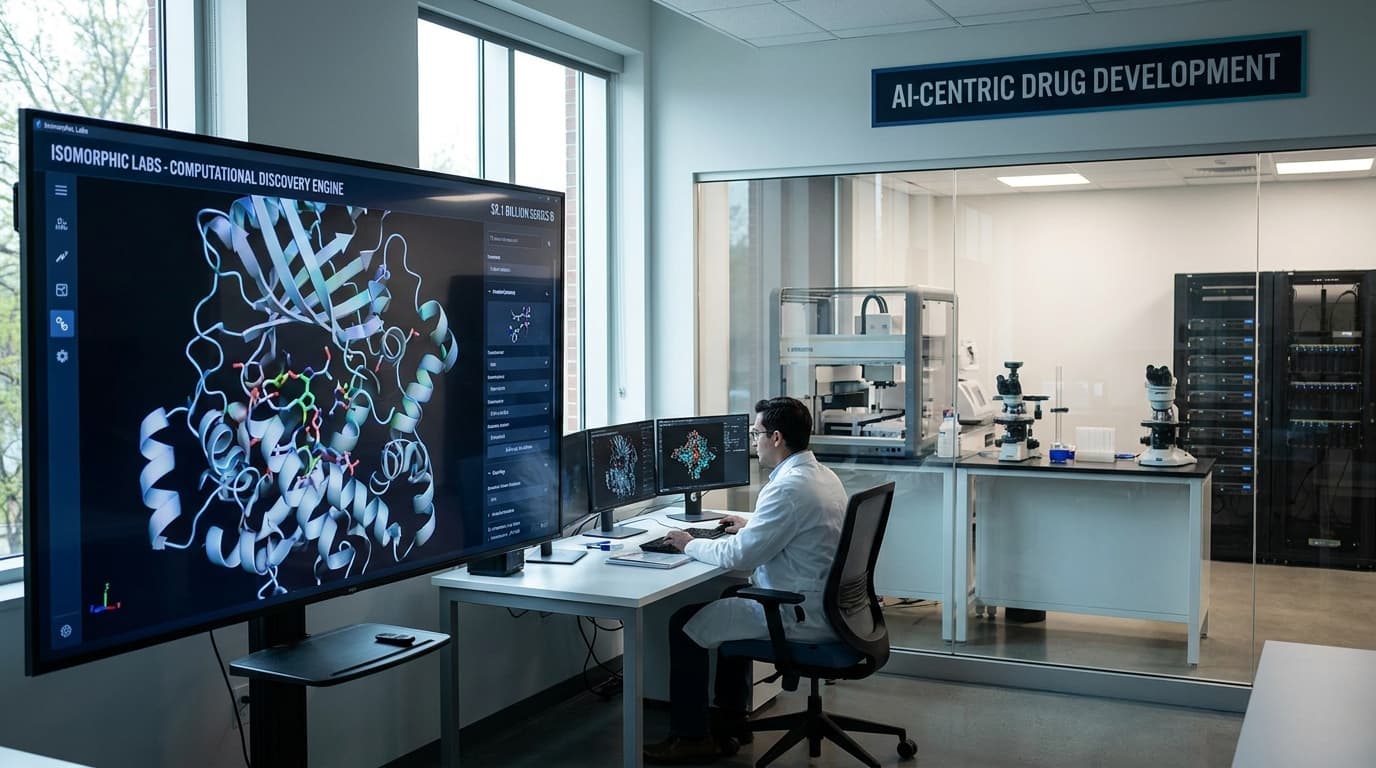
AI-Centric Biotechs Draw Billion-Dollar Backing, Pressuring Biopharma To Move Risk Checks Upstream

Investor enthusiasm for companies such as Isomorphic Labs, Generate:Biomedicines and NewLimit is pushing biopharma to take machine learning more seriously across discovery and development. The clearest industry implication in the reporting is a shift from treating AI as a productivity tool to treating it as a way to identify failure earlier and allocate capital more selectively.
An emerging group of AI-centric biotechs is attracting major capital and, in the process, increasing pressure on biopharma leadership to improve drug development failure rates. In BioSpace’s reporting, executives argue that the core change is not simply discovering more molecules faster, but moving risk management much earlier in the development cycle.
That distinction matters because the current wave of financing is rewarding companies built with computation at the core. The article points to May’s $2.1 billion series B for Isomorphic Labs, described as the second-largest round in biotech history, even though the company has no disclosed candidate. It also notes a $425 million initial public offering for Generate:Biomedicines in March and a $435 million series C for NewLimit in June, each presented as evidence that investors are assigning substantial value to AI-first platforms.
The strategic shift
Tyrone Lam, chief business officer at GATC Health, told BioSpace that tech capital is putting pressure on biopharma leadership to fix failure rates because these investors understand the value of a fail-fast process. In his framing, the mandate for AI should not stop at speeding discovery. He argues that the larger opportunity is to use AI and predictive accuracy tools to de-risk the full drug development value chain, especially the initial investment.
In practice, the article says that could mean more thorough and streamlined preclinical work as well as better trial design through more appropriate endpoint and patient selection. The signal for industry strategy is that AI is being judged not only on output volume, but on whether it can improve development decisions before expensive clinical and regulatory setbacks occur.
Orr Inbar, CEO of QuantHealth, gives a narrower but related view in the same report. He says AI-driven companies have shown that AI can design proteins and molecules far faster than a chemist working by hand, which has changed part of the pipeline. That supports the productivity case for AI, but the article makes clear that investors and operators are now testing whether those gains can translate into a lower-risk path through development.
Where capital is flowing
The financing examples in the report show investors concentrating around companies with differentiated computational platforms rather than around late-stage clinical assets alone. Isomorphic Labs is highlighted as the strongest signal of AI’s central role in biopharma, with investor excitement tied to both its Alphabet ownership and its AI-centric development engine.
BioSpace describes Isomorphic’s platform as drawing on the AlphaFold family of models, which can predict protein, DNA and RNA structures and their interactions with other molecules. The company combines that with a curated “dataverse” that it says enables massive volumes of in-silico experiments in parallel across disease areas and modalities, from cancer to immunology and from small molecules to biologics.
Generate:Biomedicines is presented as another AI-first example, using generative AI to “deliberately generate medicines” for difficult-to-treat diseases. NewLimit, meanwhile, is using a proprietary model called Ambrosia to design payloads intended to reprogram the epigenome for aging-related applications; its lead asset, NLMT1001, is an mRNA-based program targeting liver cells and is set to enter human trials next year.
The article also notes that AI has become a priority for established pharmaceutical companies, citing investments by Merck, Eli Lilly and Bristol Myers Squibb to build internal capacity. Outreach is also going the other direction: Anthropic named Novartis CEO Vas Narasimhan to its board in April, and late last month launched Claude Science, an AI workbench for life sciences.
The constraint on the thesis
The same source also stresses the limits of a tech-investor lens. Lam warns that tech money may overhype discovery velocity while discounting development and regulatory constraints. Inbar puts it more directly, saying these investors often bring expectations that do not fit a process that is inherently slow and unpredictable.
That tension is the real commercial readout from the story. Capital is increasingly rewarding AI-native biotech models, but the durable advantage will depend on whether those platforms improve the probability of success beyond discovery. Faster design has already won attention; earlier identification of bad bets is the harder claim, and the one that could matter most for returns.
Join the BioIntel newsletter
Get curated biotech intelligence across AI, industry, innovation, investment, medtech, and policy delivered to your inbox.