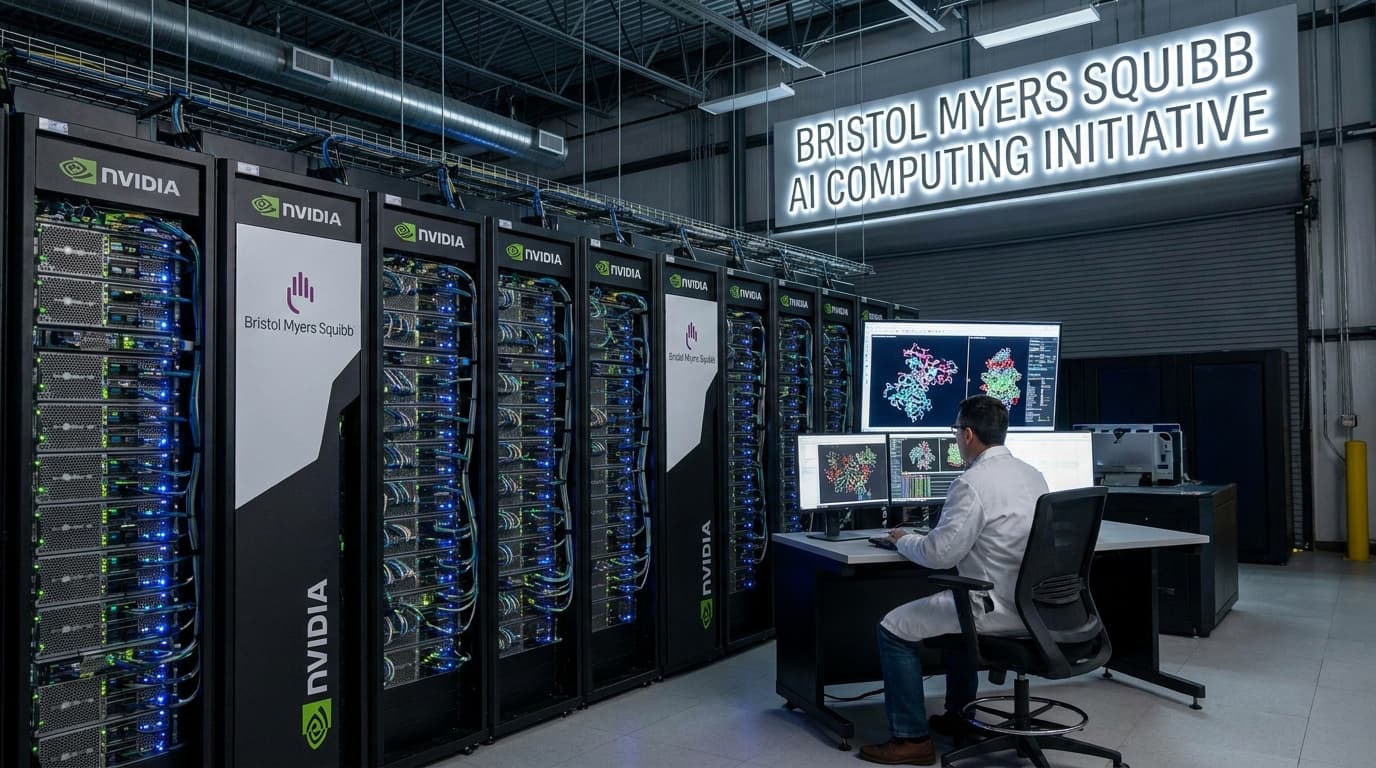
Bristol Myers Squibb Claims Pharma's Largest NVIDIA AI Supercomputer Initiative

BMS becomes the third major drugmaker in less than a year to announce the construction of the 'largest' NVIDIA AI supercomputer in pharma, reflecting escalating competition and unprecedented digital infrastructure investment across the industry.
Bristol Myers Squibb Becomes Latest Company to Claim It’s Building Pharma’s Largest NVIDIA AI Supercomputer
Introduction
In a noteworthy and highly visible move, Bristol Myers Squibb (BMS) has announced plans to construct what it touts as the largest NVIDIA AI supercomputer in the life sciences sector. This news marks a significant chapter in the story of pharmaceutical companies scaling up their use of high-performance computing and artificial intelligence (AI) in drug discovery and development. BMS is not alone in this endeavor; it is reportedly the third major drugmaker in just nine months to make such a claim, underscoring a rapid intensification in the competition among pharmaceutical giants to dominate the AI infrastructure race.
The Race to Build Pharma’s Biggest AI Supercomputer
Background
The integration of AI technologies into the pharmaceutical industry has drastically accelerated in recent years. Companies aim to leverage AI-powered systems for a wide array of research and business applications—from molecular modeling and compound screening to optimizing clinical trial design and accelerating regulatory submissions. Supercomputers, powered by advanced GPUs such as those developed by NVIDIA, have emerged as the backbone of these ambitious projects.
BMS’s Announcement and Market Context
With Bristol Myers Squibb entering the fray, the pharmaceutical sector finds itself amidst a technological arms race. The very notion of building “the largest NVIDIA AI supercomputer in the life sciences industry” signals that the scale and scope of compute power being assembled for drug research are now of paramount strategic importance.
BMS joins two other large pharma peers that have made similar announcements within the past nine months—a clear indication that competitive parity is increasingly tied to digital infrastructure. For BMS, the initiative can be expected to reshape many facets of its research operations, while also challenging rivals to further enhance their own capabilities.
What Does a Pharma AI Supercomputer Do?
A pharma-focused AI supercomputer built on NVIDIA architectures is engineered for complex modeling, simulation, and machine learning at an unprecedented scale. The applications for such a facility include:
- Molecular Dynamics and Drug Design: Supercomputing allows researchers to simulate the interactions between molecules on a timescale and spatial scale previously unimaginable, identifying drug candidates far faster and with greater accuracy.
- Biological Data Integration: These systems can handle vast, multi-modal biological data, including genomic, clinical, real-world evidence, and imaging data—transforming this information into actionable insights for R&D teams.
- Clinical Trial Optimization: AI supercomputers can model patient populations, predict outcomes, simulate trial arms, and increase both the efficiency and success rate of clinical studies.
- Manufacturing and Supply Chain: Beyond discovery, advanced AI can optimize manufacturing yields and anticipate or mitigate disruptions in supply chains, crucial for global-scale product distribution.
The NVIDIA Factor
NVIDIA, known best for its graphics processing units (GPUs) that power both gaming and deep learning workloads, has become an essential provider to life sciences organizations seeking state-of-the-art computational power. NVIDIA’s CUDA platform, along with its growing ecosystem of AI software (including healthcare- and life-sciences-specific libraries), makes its hardware the gold standard for scientific computing. BMS’s supercomputer will likely leverage large clusters of NVIDIA’s latest GPUs, interconnected by high-speed networks and paired with petabyte- to exabyte-scale memory and storage architectures.
The Stakes: Competitive and Strategic Implications
Is the “Largest” Supercomputer a Moving Target?
With multiple companies seeking the crown for the largest NVIDIA-powered AI facility, a natural question arises: What metrics define “largest” in this context? Is it based on GPU counts, FLOPS (floating-point operations per second), storage capacity, or software optimization? As each company issues new press releases, the bar continues to move, making it likely that the industry will see a series of incremental upgrades and rebranding exercises as these investments scale.
Why Build at This Scale?
The motivation goes beyond PR. Drug makers increasingly recognize that many of the bottlenecks in R&D—from candidate discovery to regulatory submission—can be alleviated or even eliminated with massive computational resources. Companies that invest the most in scalable AI hope to:
- Shorten the time from target identification to IND and NDA filings
- Increase the probability of technical and regulatory success
- Unlock more insights from proprietary and public datasets
- Attract top AI and data science talent by offering best-in-class tools
Risks and Challenges
While the ambitions are clear, several major hurdles must be reckoned with:
- Cost and Complexity: Building and maintaining supercomputers requires sizable up-front and ongoing investments in hardware, facilities, and power.
- Talent and Skills Gap: Specialized expertise is required to set up, maintain, and fully exploit these systems, both from a hardware and software perspective.
- Data Security: As more proprietary and sensitive patient data is fed into these AI systems, the security risks rise accordingly.
- Measuring ROI: The translation of compute power into tangible R&D success is not always direct; companies must track both process improvement and scientific breakthroughs.
BMS’s Broader AI Initiative
Although specific details of BMS’s plans are currently limited, its move follows a strategic shift across the pharmaceutical industry toward digital transformation. Companies are no longer content to be passive consumers of off-the-shelf IT technologies—they are instead developing and operating some of the world’s most advanced computing ensembles.
BMS’s supercomputer is expected to drive partnerships with academic, tech, and industry collaborators, positioning the company as a potential leader not just in biopharmaceutical R&D, but also in AI methodologies tailored to life sciences needs.
Industry Reaction and Future Outlook
The competitive dynamic among big pharma to outdo one another in AI muscle invites several big questions for observers, investors, and regulators:
- Will these investments translate into higher R&D returns or simply higher fixed costs?
- How will this shape drug pricing, market competition, and ultimately, patient access to innovative treatments?
- Will smaller companies be left behind, or will cloud-based solutions and AI-as-a-service models keep the field more open?
- How will regulatory guidance for AI in clinical development keep pace with such rapid innovation?
Conclusion
Bristol Myers Squibb’s bold entry into the AI supercomputing race marks another milestone in the life sciences sector’s digital transformation. As drug discovery becomes ever more computationally intensive, and as data sets swell to sizes requiring unprecedented compute, the arms race for “largest” AI infrastructure shows no signs of abating. The outcome of these investments—measured not just by the size of the server rack, but by the speed and quality of medical breakthroughs—will determine who leads the next generation of pharmaceutical innovation.
Original story and full details can be found on STAT News.
Join the BioIntel newsletter
Get curated biotech intelligence across AI, industry, innovation, investment, medtech, and policy delivered to your inbox.