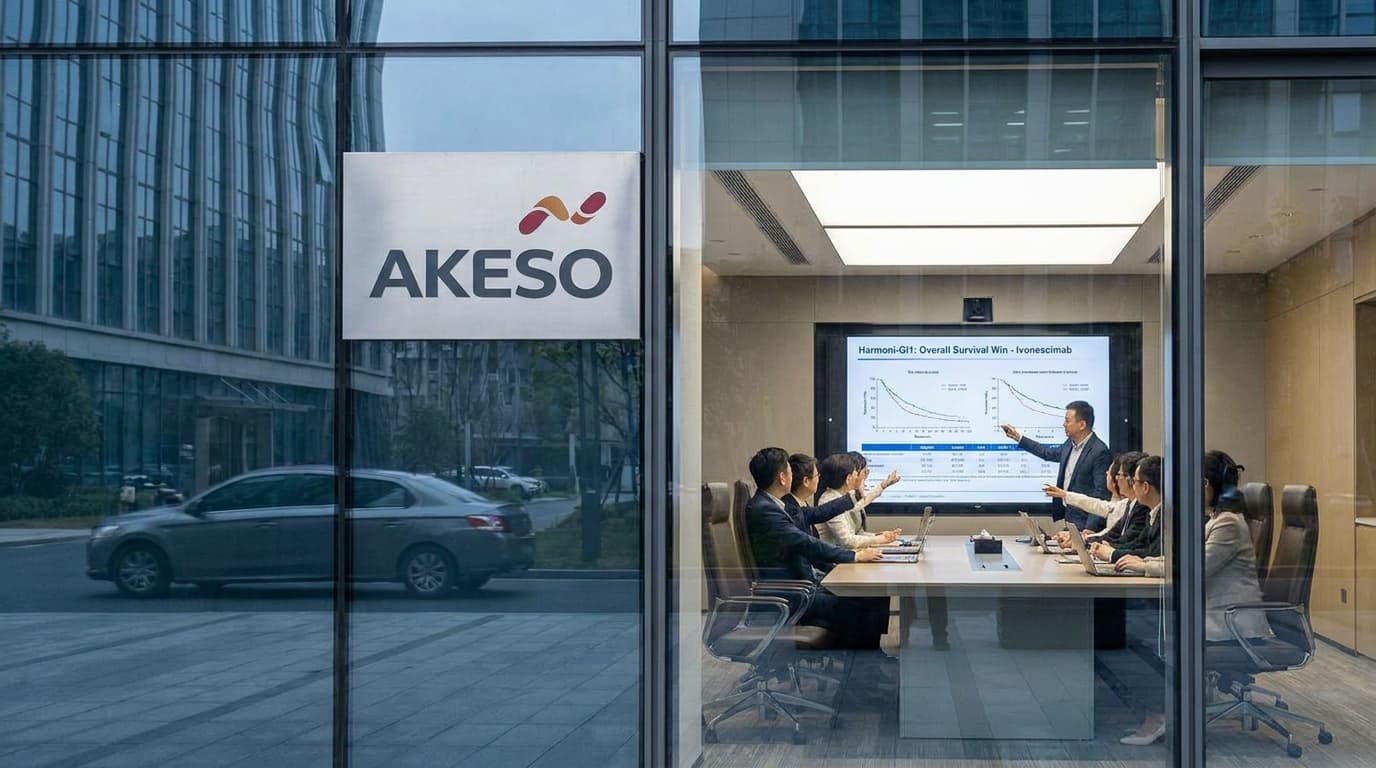
Akeso Reports Phase 3 Ivonescimab Survival Win In Biliary Tract Cancer, Extending Its Case Beyond Lung Cancer

Akeso described the Harmoni-GI1 result as clinically meaningful and statistically significant on overall survival, with progression-free survival and objective response rate also met. Strategically, the readout broadens the drug’s tumor-type story at a time when debate over changing progression-free survival magnitudes in lung cancer has sharpened attention on what kind of evidence regulators may ultimately value most.
Akeso said Tuesday that its PD-1xVEGF bispecific antibody ivonescimab, given with chemotherapy, prolonged survival versus AstraZeneca’s Imfinzi plus chemotherapy in a China phase 3 trial for first-line advanced biliary tract cancer. The company said the Harmoni-GI1 study met its primary endpoint of overall survival and also hit key secondary endpoints on progression-free survival and objective response rate.
For Akeso, the significance is broader than a single indication. The company has built ivonescimab’s profile largely in non-small cell lung cancer, but this is its first successful late-stage trial outside that setting. Michelle Xia, Ph.D., Akeso’s CEO, told Fierce that the outcome supports the bispecific design itself rather than a narrow tumor-specific effect, a claim that matters because investors have been debating whether the drug’s earlier lung cancer advantages can hold up across time and settings.
The Data
Akeso did not disclose detailed Harmoni-GI1 numbers and said the full results are being prepared for presentation at the European Society for Medical Oncology annual meeting this October. Even so, the company framed the outcome as a statistically significant and clinically meaningful overall survival benefit against an established immunotherapy-based regimen.
Xia said she had been confident heading into the readout because prior phase 2 data had been encouraging. In that earlier dataset, drawn from 22 patients, ivonescimab plus chemotherapy was associated with median overall survival of 16.8 months.
The control regimen in Harmoni-GI1 is meaningful because Imfinzi plus chemotherapy already has a place in biliary tract cancer. Back in 2022, the FDA approved Imfinzi-chemo as the first immunotherapy-based treatment for the disease after the phase 3 Topaz-1 trial showed median overall survival of 12.9 months versus 11.3 months for chemotherapy alone. Xia pointed to that history to argue that even modest survival gains can set treatment standards in this cancer type.
She also contrasted ivonescimab’s result with Roche’s prior attempt to intensify immunotherapy by adding the VEGF inhibitor bevacizumab to Tecentriq and chemotherapy, which did not produce an overall survival benefit. Her argument is that Harmoni-GI1 supports ivonescimab as more than a simple bundling of PD-1 and VEGF effects into one product.
The Commercial Picture
The biliary tract cancer result does not replace the investment case centered on lung cancer, but it does diversify it. Citi analysts wrote Tuesday that Harmoni-GI1 broadens the evidence base behind ivonescimab’s track record, while Jefferies analyst Faisal Khurshid called the win unexpected because biliary tract cancer is difficult to treat.
Xia argued that the indication itself is not trivial. Akeso enrolled nearly 700 participants in Harmoni-GI1 in 11 months, which she said reflects substantial disease burden, with 100,000 new incidents annually in China alone and growing. She also cited market research valuing the global biliary tract cancer market at between $1 billion to $4 billion.
That said, Jefferies wrote that the positive surprise in biliary tract cancer does not really alter the core Summit thesis. Public market attention remains concentrated on Summit Therapeutics, Akeso’s U.S. partner, and the upcoming Harmoni-3 readout in first-line NSCLC expected this year.
What To Watch
The immediate next step is the detailed Harmoni-GI1 presentation at ESMO in October, where investors and clinicians will be able to judge the magnitude of benefit rather than just the fact of success. Outside China, the ECOG-ACRIN Cancer Research Group has registered a new phase 2/3 trial slated to begin early next year testing ivonescimab plus chemotherapy in biliary tract cancer likely among a global population. Xia said Summit is not the sponsor, but the study is designed to be registrational.
The larger strategic question remains how much this win can offset anxiety around lung cancer data drift. Investors were rattled after an added interim analysis in Harmoni-3 missed statistical significance on progression-free survival for the squamous cohort. Separately, when Chinese authorities approved ivonescimab plus chemotherapy for first-line squamous NSCLC, the label showed an updated analysis from the China-only Harmoni-6 trial in which the progression-free survival advantage narrowed from 40% at a February 2025 cutoff to 28% at a September 2025 cutoff.
Leerink Partners analysts suggested in an Aug. 14 note that longer follow-up could also weaken the overall survival effect and that Harmoni-3’s overall survival improvement may fall below 20%. Xia countered that Harmoni-6 had already met both progression-free survival and overall survival at interim analysis, making later follow-up exploratory rather than determinative of statistical significance. She also argued that meeting overall survival, which she called the gold standard in oncology drug development, is sufficient to support a new standard of care even if progression-free survival effect sizes shift over time.
To support that point, Xia cited Merck’s phase 3 Keynote-407 study in first-line squamous NSCLC, where Keytruda plus chemotherapy’s progression-free survival benefit changed from 44% at an initial analysis to 43% at the protocol-specified final analysis, while its overall survival benefit declined from 36% to 29% with added follow-up. Her message is that some erosion in effect size is not unusual for immunotherapies. The signal from Harmoni-GI1 is that Akeso now has evidence investors can use to judge ivonescimab as a broader oncology platform, even though the drug’s valuation still hinges mainly on whether its lung cancer package satisfies regulators and the market.
Join the BioIntel newsletter
Get curated biotech intelligence across AI, industry, innovation, investment, medtech, and policy delivered to your inbox.