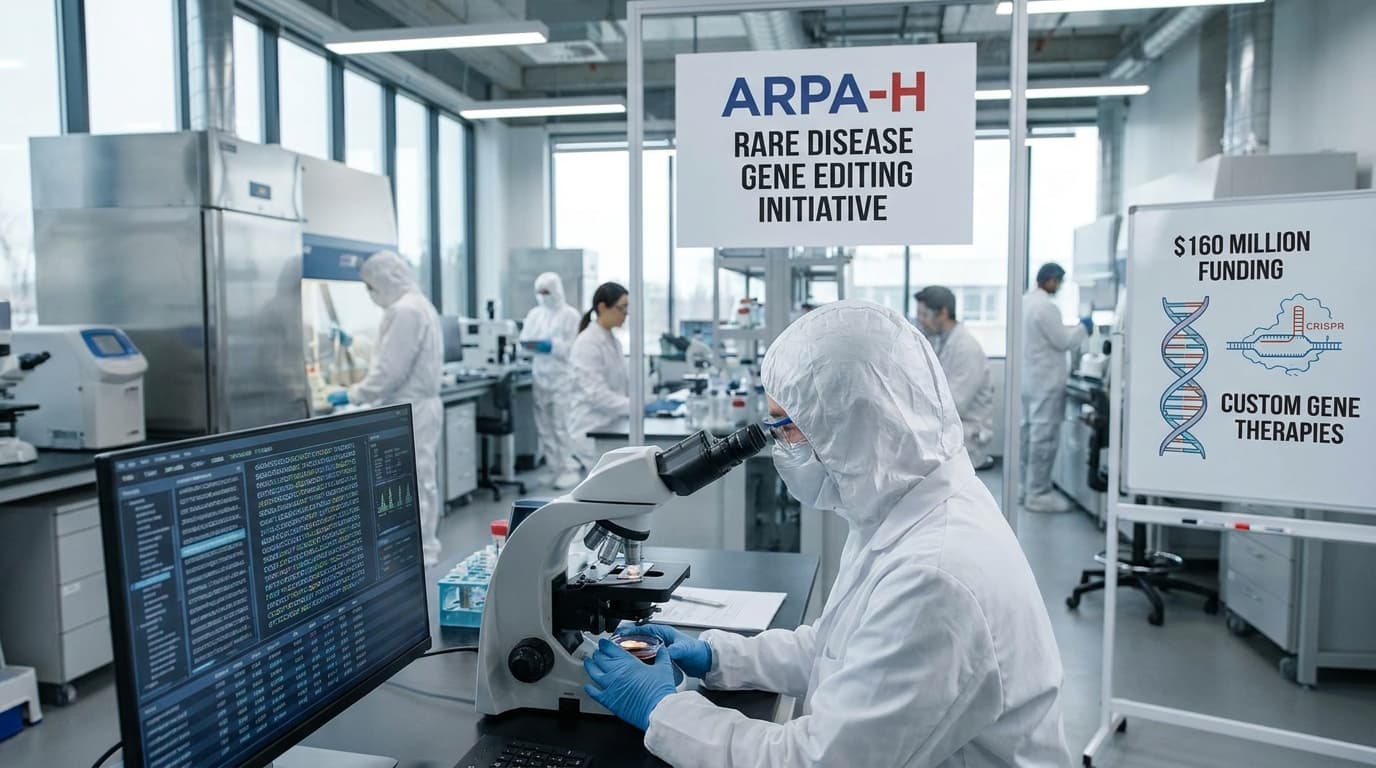
ARPA-H Launches $160 Million Initiative to Advance Custom Gene Editing for Rare Diseases

A new funding push by ARPA-H funnels $160 million toward custom gene editing for rare diseases, involving seven research labs and potentially catalyzing breakthroughs across the biotech sector. While the project faced delays due to administrative transitions, this large-scale investment signals robust government backing for next-generation therapeutic technologies and could reshape the landscape for treating ultra-rare conditions.
Introduction
In a significant move reflecting the White House’s growing attention to advanced biomedical technologies, the Advanced Research Projects Agency for Health (ARPA-H) has announced a $160 million program to propel the development of custom gene editing drugs—especially in the realm of rare diseases. This initiative, though delayed by changes in administration, aims to empower seven research laboratories with substantial grants and the resources required for ambitious translational projects at the frontier of genomic medicine.
This large-scale investment represents one of the most concentrated governmental funding efforts for bespoke gene editing to date and is poised to transform both scientific capabilities and regulatory thinking surrounding rare disease treatment. As genetic and genomic medicine continue to mature, programs like this not only facilitate breakthrough discoveries but also lay vital groundwork for commercial viability, clinical implementation, and broader systemic adoption of gene editing in healthcare.
Background: ARPA-H and the Trajectory of Gene Editing
ARPA-H was established as a high-impact, rapid-response agency styled after DARPA, the federal agency credited with spawning revolutionary innovations in information technology and defense. In healthcare, the mission of ARPA-H is similarly transformative—catalyzing projects which commercial markets or traditional NIH funding mechanisms may overlook due to risk or lack of immediate commercial potential.
Gene editing, particularly enabled by CRISPR and related technologies, has shown theoretical and laboratory promise for correcting mutations underlying thousands of rare and ultra-rare disorders. Despite several notable clinical trials, these advances have yet to realize their full therapeutic potential in individualized medicine, largely because of the enormous R&D investment required to develop treatments tailored to single patients or small patient populations. Regulatory complexity, manufacturing scalability, and reimbursement have also historically impeded rapid translation of gene editing for rare conditions.
The $160 Million Push: Program Structure and Vision
The $160 million program from ARPA-H is designed to clear some of these barriers by infusing a cohort of academic and nonprofit research labs with not only direct funding, but also expanded access to enabling technologies, regulatory consulting, and shared data platforms. The seven labs chosen to participate will focus on a diverse array of rare disease targets, ranging from hereditary metabolic disorders to neurogenetic syndromes where conventional therapies have failed or are nonexistent.
By cultivating both technical diversity and operational redundancy across the cohort, ARPA-H hopes to foster a pipeline of preclinical and early clinical programs that will validate, refine, and potentially accelerate the creation of ‘n-of-1’ or ultra-niche gene therapies. Importantly, this effort arrives at a moment when several successful cases of individualized gene editing—in the U.S. and globally—have highlighted the feasibility, but not the scalability, of bespoke treatments.
The Significance for Rare Disease Research
Rare diseases collectively affect millions worldwide, but each individual condition may impact as few as a handful of patients—rendering development and commercialization economically challenging. Nevertheless, the promise of gene editing technologies, which can theoretically correct genetic errors at their source, has galvanized patient advocacy groups and biotech startups alike, all of whom await solutions that traditional pharmaceutical models cannot deliver.
Government-driven investments like this serve to de-risk the early phase of discovery, nurture industry-academic collaborations, standardize regulatory engagement, and perhaps most crucially, set precedent for broader payor acceptance of high-cost, high-value therapies. As ARPA-H deploys its resources, the potential cascading impacts extend beyond initial research grants to the downstream sectors of biomanufacturing, diagnostics, bioinformatics, and patient access policy.
Delays and Administrative Hurdles
Though the ARPA-H program has been highly anticipated in rare disease and gene editing circles, a change in the federal administration reportedly delayed the program’s formal launch. This illustrates the broader reality that government-driven translational research is at times subject to political timelines and shifting agency priorities. Nonetheless, with seven labs now slated for sizeable support, the initiative is firmly underway and expected to generate early data in the next year.
What’s at Stake for the Biotech Sector
The presence of robust public funding is likely to accelerate scientific timelines and attract further private investment. Startups and established companies that succeed in leveraging ARPA-H-backed discoveries may be better positioned to move quickly into preclinical and early-stage clinical trials. Furthermore, the agency’s willingness to engage in regulatory consultation for cutting-edge, patient-specific gene therapies could lower the regulatory hurdles that have previously slowed, or sometimes halted, promising programs.
As the sector evolves, ARPA-H’s experiment with direct, large-scale investment offers a playbook for funding not just research, but also the ecosystem required to bring truly individualized therapies to patients at scale. The model will be closely watched by policymakers, patient advocates, investors, and competitors abroad.
Future Implications: Innovation, Access, and Ethical Frontiers
The success of this program could alter the calculus for rare disease research and treatment in three interrelated ways:
- Scientific Innovation: With ready access to funding, technology, and regulatory support, labs have an unprecedented opportunity to develop, test, and iterate gene editing strategies at a much faster pace than before.
- Patient Access: If regulatory and reimbursement models are developed in tandem with scientific breakthroughs, patients with rare diseases may see genuinely tailored treatments become available within their lifetimes.
- Ethical and Societal Considerations: As n-of-1 therapies grow more feasible, questions around consent, long-term monitoring, data sharing, and equitable access will move from theoretical debate to everyday practice. Public investment can help ensure these considerations are foregrounded, producing frameworks that maximize benefit while minimizing risk.
Conclusion
As ARPA-H injects $160 million into the push for custom gene editing in rare disease, the biotech sector enters a critical phase. This program signals strong government support for innovation beyond the boundaries of traditional commercial logic, prioritizing treatments that could transform or even cure conditions long neglected by mainstream pharmaceutical R&D. The next several years will reveal whether this unprecedented investment translates into sustainable clinical, financial, and social progress for patients and families long awaiting cures at the genetic level.
Source: STAT News – ARPA-H launches $160 million effort to develop custom gene editing drugs
Join the BioIntel newsletter
Get curated biotech intelligence across AI, industry, innovation, investment, medtech, and policy delivered to your inbox.