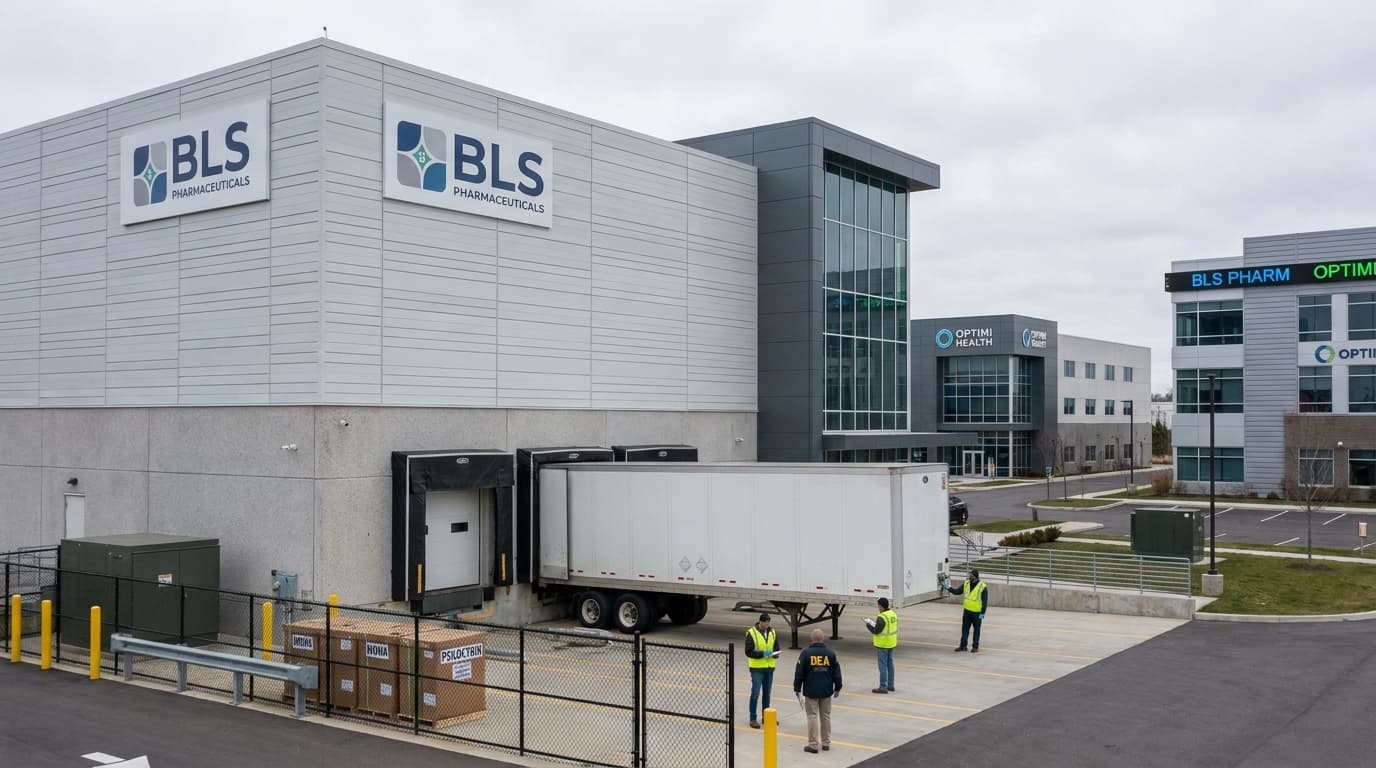
BLS Pharmaceuticals And Optimi Health Target U.S. Psychedelic Supply, As FDA And DEA Rules Shape Entry

BioSpace reports that manufacturers including Australia’s BLS Pharmaceuticals and Canada’s Optimi Health are preparing to supply MDMA and psilocybin products into the U.S. as policy support grows. Their opportunity depends not just on clinical progress, but on whether companies can satisfy FDA manufacturing standards and the Drug Enforcement Administration’s shipment-by-shipment controls for Schedule I substances.
Manufacturers outside the U.S. are trying to convert earlier regulatory openings in their home markets into a first-mover advantage in psychedelic medicines, even though the American market remains constrained by Schedule I controls and shipment-level federal oversight. The commercial opening described by BioSpace is not a broad launch market yet; it is an emerging supply opportunity for companies that can meet pharmaceutical manufacturing standards while navigating controlled-substance rules.
That makes manufacturing capability, not just clinical enthusiasm, a central differentiator. As U.S. policy support for psychedelics rises, companies with existing good manufacturing practices infrastructure for MDMA and psilocybin are positioning to supply trials now and potentially broader demand later.
The Regulatory Setup
BioSpace describes several developments pushing psychedelics closer to the U.S. mainstream this year. President Donald Trump ordered U.S. agencies to accelerate access to psychedelics, the FDA finalized guidance on clinical trials of the drugs, Eli Lilly acquired AtaiBeckley for $3.8 billion, and Resilient Pharmaceuticals, formerly known as Lykos Therapeutics, refiled for approval of its MDMA therapy without running the new trial requested by the FDA in a complete response letter.
Even with that policy support, MDMA and psilocybin remain Schedule I substances in the U.S., meaning there is no currently accepted medical use and a high potential for abuse under the classification cited in the source. For manufacturers, that creates a second regulatory track beyond standard drug production. Products must meet the FDA’s GMP standards, and importers need a Drug Enforcement Administration registration plus a permit from the federal agency for each shipment.
That combination is the article’s main strategic signal: U.S. demand may be building, but access to the market is gated by manufacturing compliance and controlled-substance logistics rather than by scientific interest alone.
Why Overseas Manufacturers See An Opening
Canada and Australia moved earlier on access frameworks. In 2022, Canada amended its regulations to allow healthcare practitioners to request access to restricted drugs including MDMA and psilocybin. In 2023, Australia rescheduled MDMA and psilocybin to permit prescribing for post-traumatic stress disorder and treatment-resistant depression, respectively.
Those shifts created demand for suppliers that could manufacture pharmaceutical-grade psychedelic products compliantly. BLS Pharmaceuticals is one of the companies that built around that need. CEO Sam Watson told BioSpace that BLS now has the infrastructure and supply chain to export GMP-released pharmaceutical medicine and wants to supply trials in the U.S., the U.K., Germany, and Switzerland.
Watson also said BLS sources APIs from U.S.-Canadian companies and performs the higher-value product manufacturing under its GMP license. In parallel, the company is building a facility in the U.K. that it plans to use for medicinal cannabis and, if licensed, for MDMA and psilocybin production.
Optimi Health is making a similar argument from Canada. The company recently used its IPO paperwork to describe what entering the U.S. would require and told investors the market will likely take 12 months to unlock. Optimi has two 10,000-square-foot pharmaceutical-grade mushroom cultivation and drug processing facilities in British Columbia and holds a Health Canada license for buying or making controlled materials used to synthesize MDMA.
The Commercial Constraint Beyond Approval
The article also points to a less discussed bottleneck: even if regulatory barriers ease, clinic capacity may limit uptake. The MDMA therapy the FDA rejected in 2024 involved three sessions lasting about eight hours each. That is a delivery model that can strain throughput.
AtaiBeckley, which Lilly is buying, tried to address that issue with a single-dose 5-MeO-DMT formulation designed for a two-hour session. Watson said he sees an opportunity in delivery mechanisms and compounds that improve administration, and argued that the manufacturing base being built now for MDMA and psilocybin should still matter as newer analogs or formats emerge.
That suggests the competitive race is not only about who can make current compounds. It is also about who can use today’s controlled-substance manufacturing capability as a bridge into future proprietary products and delivery systems.
Join the BioIntel newsletter
Get curated biotech intelligence across AI, industry, innovation, investment, medtech, and policy delivered to your inbox.